
Now Reading: NASA outlines nearly $1 billion investment into initial Moon Base missions
-
01
NASA outlines nearly $1 billion investment into initial Moon Base missions

NASA outlines nearly $1 billion investment into initial Moon Base missions

NASA’s vision for a future, long-term sustained presence on the Moon gained more clarity on Tuesday as the agency announced a series of contract awards for future robotic missions.
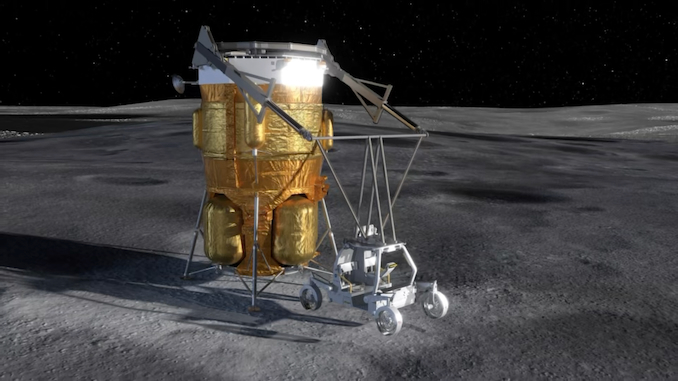
The agency announced that two companies developing lunar terrain vehicles (LTVs), Astrolab and Lunar Outpost, would each be receiving contracts valued at about $220 million each to finish their designs and get them to the Moon’s surface.
Astrolab’s Crewed Lunar Vehicle (CLV-1) takes after its original design, called FLEX, and Lunar Outpost’s Pegasus vehicle takes heritage from its earlier Eagle design. NASA previously put out a call for LTVs that would be capable of surviving on the Moon for up to 10 years, but revised its requirements to have more readily available options to augment earlier astronaut missions.
Connected to that, NASA also awarded the LTV delivery contract to Blue Origin, using it’s Blue Moon Mark 1 lander in a contract that’s worth $234 million for each LTV delivered.
“Since the beginning, Blue Origin has been committed to Lunar Permanence,” wrote Blue Origin CEO Dave Limp in a post on X. “Thank you, @NASAadmin, for sharing that vision. We’re ready to make it a reality.”
The announcement came during a news conference at NASA’s headquarters in Washington D.C.. NASA Administrator Jared Isaacman said these and other upcoming missions, scheduled to begin in the back half of 2026, that will lay the early ground work for an enduring presence on the Moon’s South Pole.
“As we announced during the Ignition event, we intend to take an iterative approach, sending a demand signal to industry for a lot of landers and rovers and tech demonstrations and all the scientific payloads these missions can accommodate,” Isaacman said.
“We are leveraging the NASA playbook from the 1960s, figuring out what works and what doesn’t in this epic science of survival because the Moon Base is as beautiful as it is hostile.”
In these early days of crewed landings during the Artemis era, LTVs will need be deployed at a safe distance from the Human Landing System (HLS) landers being provided by SpaceX and Blue Origin. They will kick up quite a bit of lunar regolith during their landing burns, which could damage an LTV if it’s too close.
“Protecting for [plume surface interaction], we plan to keep the LTVs approximately 2 km away when the landers land,” said Ryan Stephan, NASA’s acting director for cargo landers. He previously served as the Commercial Lunar Payload Services (CLPS) Technical Deputy based at Glenn Research Center.
“They’ll traverse in, be able to pick up the crew, and then do missions up to like 10 km during the crewed period and then uncrewed, like Carlos said, a total of like 400 km throughout the lifetime.”
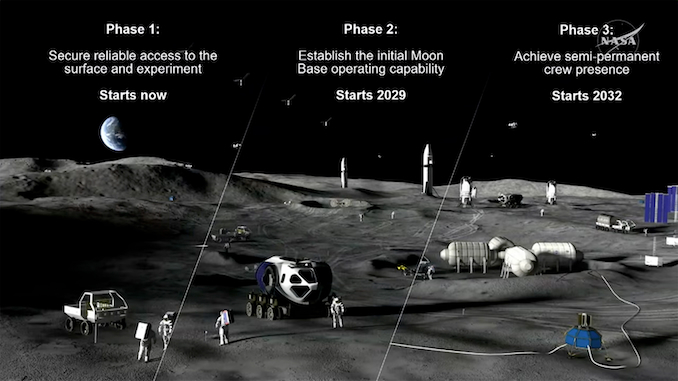
Moon Base Program Executive Carlos García-Galán said NASA envisioned footprint of the Moon Base to be “hundreds of square miles with different assets, all building up to the objective of permanent lunar presence on the Moon.”
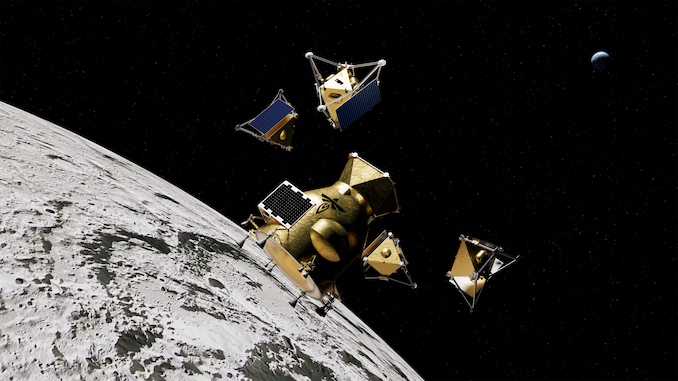
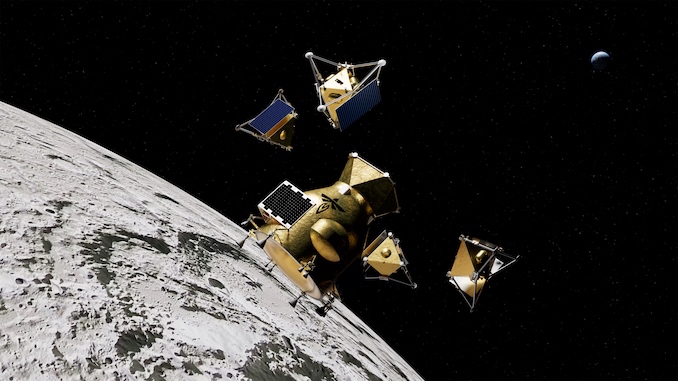
The first piece of the pie, dubbed Phase One, extends from now through 2029 and was the focus of Tuesday’s briefing. In addition to the lander and rover contracts announced, García-Galán also unveiled Firefly Aerospace as the recipient of a $75 million subcontract awarded by the Jet Propulsion Laboratory to deploy a series of lunar drones on the MoonFall mission.
During this technology demonstration, which will take place in 2028, one of Firefly’s Elytra Dark spacecraft will fly to the Moon over the course of 45 days before it enters lunar orbit. It will then de-orbit and deploy the drones about 50 km above the Moon’s South Pole.
These hopper drones are designed to last one lunar day (14 Earth days) and will test out the basic technology as well as performing imaging and scouting for future sites of interest.
“High-resolution imagery across all mission phases, including the deployment, the landing, and nominal operations of staying in-situ or hopping around,” García-Galán said. “It will continue image collect during an extended mission and it will analyze different sites for unprecedented detail and basically allowing us to build our understanding of soil mechanics, the terrain, the lighting conditions in-situ of wherever we want to go.”
The MoonFall drones can also have the capability of setting up what García-Galán called a “Moon Base perimeter” that would go on the corners of areas “where we think we have either key scientific objectives or we want to build up the Moon Base.”
Asked whether such a perimeter would act as a keep-out zone for nations not party to the Artemis Accords, an agreement for Deep Space best practices and understanding, Isaacman said it lent to the importance of reaching the Moon first before nations that the U.S. sees as adversaries, like China.
“I think the idea that there are areas of great interest on the lunar surface, we do want to get there and explore them and we also obviously want to be very mindful of the Outer Space Treaty, so that we are respectful of other nations that are putting assets on the lunar surface and we would expect that to be reciprocal,” Isaacman said.
Three missions that were formerly part of the original CLPS program were redesigned as Moon Base Missions 1-3:
- Blue Origin’s Blue Moon Mk.1 – Fall 2026
- Astrobotic’s Griffin-1 – late 2026
- Intuitive Machines’ IM-3 – late 2026










Related Posts
Stay Informed With the Latest & Most Important News
Previous Post
Next Post

Advertisement
-
 01Two Black Holes Observed Circling Each Other for the First Time
 -
 02From Polymerization-Enabled Folding and Assembly to Chemical Evolution: Key Processes for Emergence of Functional Polymers in the Origin of Life
 -
 03Astronomy 101: From the Sun and Moon to Wormholes and Warp Drive, Key Theories, Discoveries, and Facts about the Universe (The Adams 101 Series)
 -
 04True Anomaly hires former York Space executive as chief operating officer
 -
 05Φsat-2 begins science phase for AI Earth images
 -
 06Hurricane forecasters are losing 3 key satellites ahead of peak storm season − a meteorologist explains why it matters
 -
 07Binary star systems are complex astronomical objects − a new AI approach could pin down their properties quickly