
Now Reading: Mars to Titan: the next rallying call?
-
01
Mars to Titan: the next rallying call?


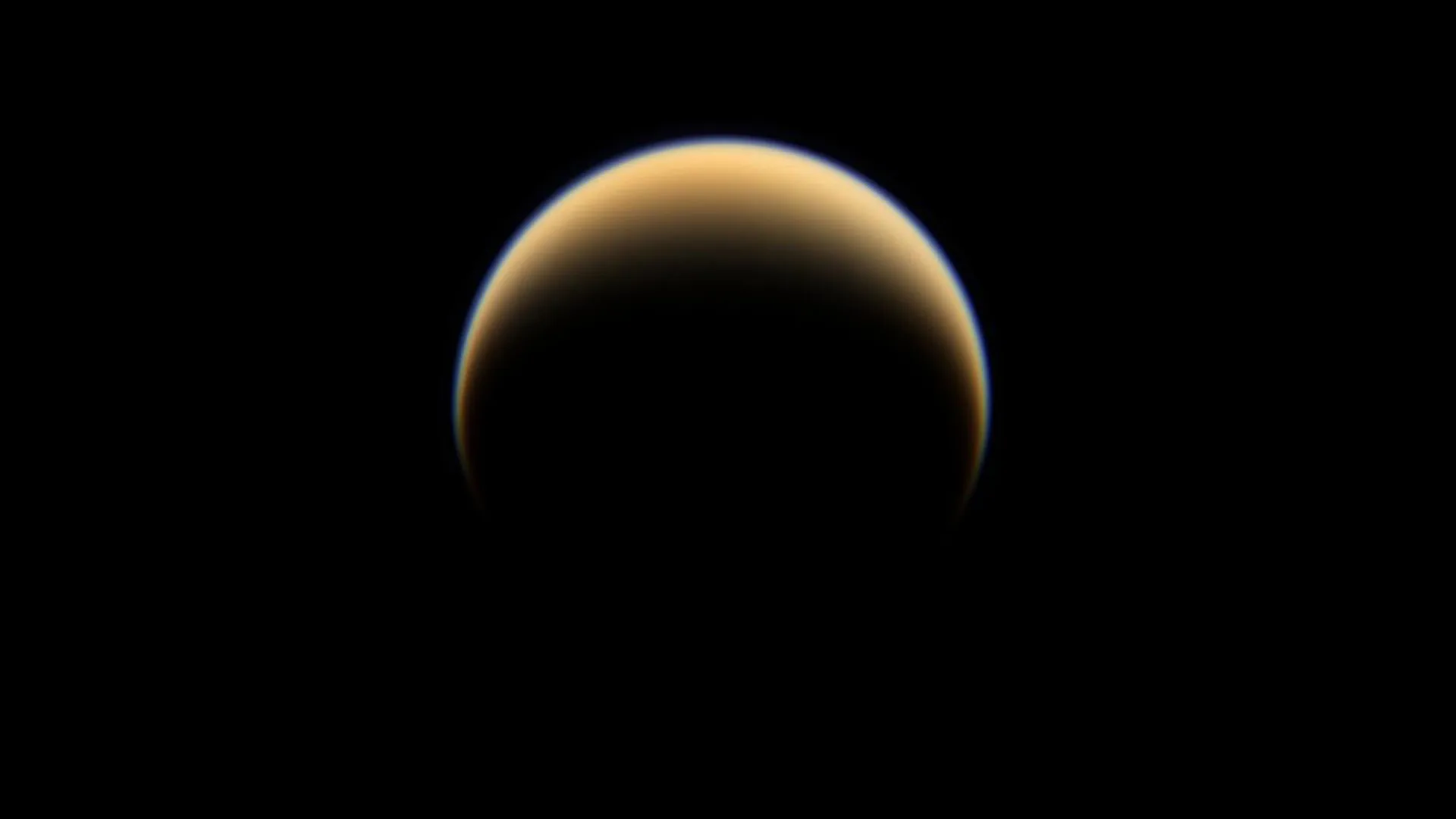

Where will humans go after Mars? Is Mars the end of the line or is it a steppingstone to somewhere else? If we “moon-to-Mars,” do we then “Mars-to-somewhere else?” These are curious questions that have received very little attention even though the answer has implications to current NASA lunar programs and planetary science mission planning. The next destination beyond Mars will require years of precursor science reconnaissance missions as well as use of the moon and Mars as analogs and proving grounds, echoing NASA’s blueprint for human exploration. There are knowledge and experience gaps that need to be filled, just as NASA is planning for going back to the moon and on to Mars. Formalizing the next destination will provide more incentives to ensure these missions are successful. So, it’s not too early to answer the question — where will we go next?
There are several options that can be considered, but only one bubbles to the top. The clouds of Venus would be a fascinating place to send humans. A buoyant airship could spend some time studying the planet’s atmosphere. While a worthwhile scientific mission for sure, its goals are limited to the high atmosphere with little study of the surface. It would not be a precursor to landing humans on Venus nor does it present a steppingstone. Jupiter’s Europa and Saturn’s Enceladus are other options. The potential extant life in these locations are tempting to chase. Unfortunately, the radiation level at the surface of these airless moons is far above acceptable limits for humans. Small asteroids are also problematic. Their gravity is so low that surface operations are barely possible. So that leaves us with one more option, Saturn’s largest moon, Titan.
Titan has a thick atmosphere that provides radiation protection and a surface pressure only 45% greater than Earth’s. Humans can adapt to this pressure. With an atmosphere of 95% nitrogen, compared to Earth’s 78%, the similarity is uncanny. Titan’s surface also provides water ice and hydrocarbons – ideal targets for in-situ resource utilization. From this standpoint Titan is more hospitable than Mars. The key challenge with Titan is likely going to be temperature and distance. It is much further away from Earth than Mars. The Cassini-Huygens mission needed about seven years to reach it and the planned Dragonfly mission is expected to take about six. It is so far away that sunlight reaching Titan is one percent of the light reaching Earth. Nuclear power systems developed for the moon and Mars will be required for Titan since solar arrays will not be practical for early missions.
The temperature at Titan’s surface is a nearly constant -179℃. These temperatures are seen in the permanently shadowed regions on our moon and have presented challenges to NASA’s extravehicular activity suit development program because of the deep cold. Fortunately, for Titan the suits can focus on more of the system on solving that program since decompression is not a driver there. Still, however, this cold temperature can present challenges to the design of habitat, spacecraft and mobility systems. The list of compatible materials grows short while the power demand for heaters increases. Time is on our side to solve this problem and missions to the moon will help.
Human missions to Titan would not happen any time soon. No one is proposing that we can skip the moon and Mars. Much to the contrary, these destinations are crucial steps. We first have to get our interplanetary “sea legs” under us and solidify our ability to travel great distances, land, live and then return from other planetary bodies. Going to Mars will be a giant leap in experience that will apply to Titan. We will learn ways to survive and reduce deep space travel time. It will teach us about performing descent and landing of large objects through an atmosphere other than Earth’s and how to equip crews to be self-reliant so far from Earth. The list goes on and on.
In addition to gaining the necessary experience from human missions to the moon and Mars before going to Titan, a concerted effort will need to be made to send a series of precursor robotic missions. Just as has been done for Mars, a series of reconnaissance missions will fill technology and knowledge gaps. Huygens was the pathfinder to the surface and Dragonfly will take the next major leap in testing air mobility on Titan. We will need to decide the nature of follow-on missions and the cadence we can send them. Orbital satellites will also be required to monitor Titan’s weather and surface properties and serve as communication relays. This campaign of deep space robotic missions will invigorate the planetary science community with new missions to the Saturnian system, tying them to new goals connected to NASA’s blueprint for human exploration. It all starts with declaring Titan as the next destination after Mars.
Human missions to Mars have been discussed for a long time. It has been 57 years since Werner von Braun’s The Mars Project vision. It takes humans, even inspired ones, a long time to formulate the missions, get the necessary answers and then create a program that will stand the test of time and politics. We are still waiting for human missions to Mars. So even if human missions to Titan are another 57 years after we land on Mars, it’s not too early to think about it now. More than that — we need to be talking about it now. The long travel time drives a much longer timeline for robotic missions than they have for Mars.
The recent Artemis II mission has shown us that watching humans go farther in space is inspiring and galvanizing for the space industry and the general public. Establishing Titan as the next destination for Mars will likewise inspire young minds to tackle the new challenges it presents. They’ll tackle them by taking humans back to the moon and on to Mars. Aiming for Titan will ensure we get to these places- because we must.
Titan is more than just a scientific point of interest, it could be the next human destination after Mars. Of all the candidate destinations, it is the most accommodating for humans. It also presents an entirely different kind of world to explore than ever before. But here are many questions to be asked and answered before we can take this giant leap forward. If NASA were to put it on the solar system roadmap, what would be the next steps? What would be the precursor science goals and the human spaceflight technology needs to make it happen? How could such a long-range goal be incorporated into current plans for the moon and Mars? A two-day conference called the Humans to Titan Summit in June will kick off this discussion among the planetary science and human spaceflight communities. Titan could be the next step in our journey to the stars!
William O’Hara is the founder and executive director of Explore Titan.
SpaceNews is committed to publishing our community’s diverse perspectives. Whether you’re an academic, executive, engineer or even just a concerned citizen of the cosmos, send your arguments and viewpoints to opinion (at) spacenews.com to be considered for publication online or in our next magazine. If you have something to submit, read some of our recent opinion articles and our submission guidelines to get a sense of what we’re looking for. The perspectives shared in these opinion articles are solely those of the authors and do not necessarily represent their employers or professional affiliations.










Related Posts
Stay Informed With the Latest & Most Important News
Previous Post
Next Post
Previous Post
Next Post


Advertisement
-
 01Two Black Holes Observed Circling Each Other for the First Time
 -
 02From Polymerization-Enabled Folding and Assembly to Chemical Evolution: Key Processes for Emergence of Functional Polymers in the Origin of Life
 -
 03Astronomy 101: From the Sun and Moon to Wormholes and Warp Drive, Key Theories, Discoveries, and Facts about the Universe (The Adams 101 Series)
 -
 04True Anomaly hires former York Space executive as chief operating officer
 -
 05Φsat-2 begins science phase for AI Earth images
 -
 06Hurricane forecasters are losing 3 key satellites ahead of peak storm season − a meteorologist explains why it matters
 -
 07Binary star systems are complex astronomical objects − a new AI approach could pin down their properties quickly