
Now Reading: Kongsberg NanoAvionics sets sights on building and supporting sovereign constellations
-
01
Kongsberg NanoAvionics sets sights on building and supporting sovereign constellations

Kongsberg NanoAvionics sets sights on building and supporting sovereign constellations

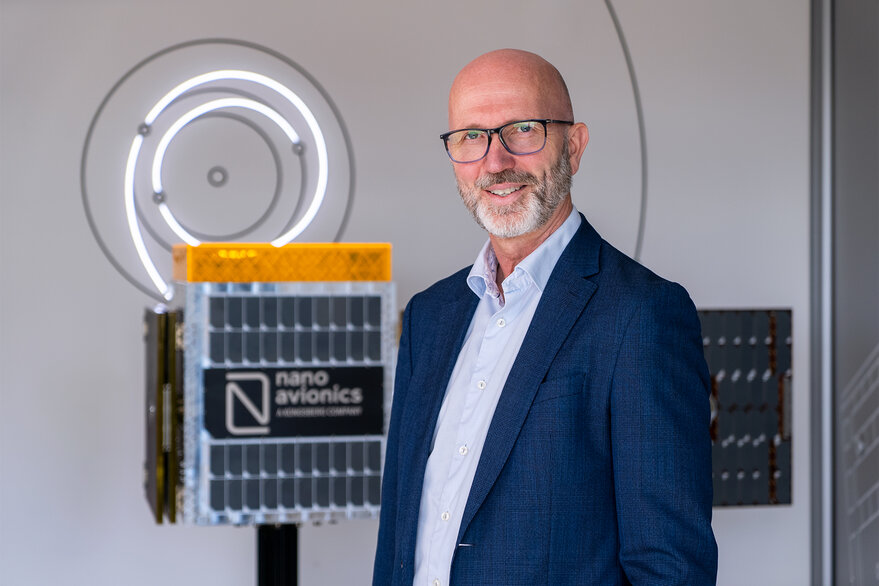

NanoAvionics, founded in 2014, was known for producing individual satellites and small constellations until April, when the company won a 122.5-million-euro contract ($142 million) to build the initial 280 satellites for SpinLaunch’s Meridian Space broadband constellation. How did the small satellite manufacturer and mission integrator based in Vilnius, Lithuania, position itself for large orders? Was Kongsberg’s 2022 decision to acquire NanoAvionics an important ingredient? A few days before SmallSat Europe, SpaceNews caught up with Atle Wøllo, Kongsberg NanoAvionics CEO and Kongsberg Space senior vice president, to find out.
SpaceNews: The SpinLaunch contract KSAT NanoAvionics announced in April seems like a departure for the company. Is it?
Atle Wøllo: Yes and no. Big constellations were always a goal. But to win the contract and to be able to execute it is very important to have the Kongsberg owner and have Kongsberg in the background. I have worked more than 30 years in Kongsberg in different roles. I’ve been CEO of other companies, and I’ve set up scaling of production from very small scale to big volume. We were selected because we had a good product, we had a good technical design and we had the Kongsberg background with the experience of scaling up.
What are your plans for scaling?
We have been planning for quite some time to build a new facility to go from small-scale to serial production. We’re already growing out our existing facilities and setting up clean rooms in neighboring buildings. The goal is for us to have a new facility in two years’ time.
Where will the new facilities be built?
Vilnius will be the center of excellence. We’re also looking at building in other countries where we see big potential.
Can you disclose what countries?
I would prefer not to because of the sensitivity. Particularly on the defense side, we have contracts we are not allowed to disclose.
NanoAvionics also announced a contract to supply solar arrays for Flexell Space. Is this another change in the business? Is NanoAvionics poised to become a major supplier of solar arrays or other constellation subsystems?
Subsystems have been sold from NanoAvionics before, but for a few years it hasn’t had any focus. Now, we have now strategically refocused on subsystems and made it a separate program area. We also will actively market it.
Recently, NanoAvionics and KSAT announced a strategic partnership to provide round-the-clock mission operations and “near real-time” data delivery. Why is that offering significant?
NanoAvionics has the capabilities to provide similar services. But KSAT has a much bigger organization and 24/7 operation. Being part of the Kongsberg family, it makes sense to operate together and to utilize this. We see this as a great opportunity for our customers because KSAT is very well known. We see it as a natural development and a strengthening of our capabilities. At the same time within the Kongsberg family, we are having more cooperation.
Space, in general, is a very important strategic direction for the Kongsberg Group. We see a lot of opportunities for instance for countries wanting sovereign solutions. This does not only apply to satellites, but the complete value-chain including services, ground stations, networks and appropriate payloads for these missions. We see opportunities in the market.
Does that mean a European nation, for example, could come to Kongsberg for a sovereign constellation operated and controlled locally?
Correct. And depending on the size of the constellation, you could also have satellites produced in your country.
NanoAvionics has completed the transition from a startup to a mature company that is profitable, has the right structure and has a lot of synergies with Kongsberg. At the same time, we are very aware of maintaining our advantages in cost and price structure. We think we are the best when it comes to reliability and quality, and we have a very competitive price. We are still investing quite a lot in research and development to improve reliability and quality and enhance the capabilities.
In short, we see a lot of opportunities and growth for Kongsberg NanoAvionics as well as for Kongsberg Space in general with the whole value chain. This includes also the launch portal in Aldaya in Norway, where Kongsberg also has ownership together with ISAR. We have a lot of demand for sovereign capabilities.










Related Posts



Stay Informed With the Latest & Most Important News
Previous Post
Next Post




Advertisement
-
 01Two Black Holes Observed Circling Each Other for the First Time
 -
 02From Polymerization-Enabled Folding and Assembly to Chemical Evolution: Key Processes for Emergence of Functional Polymers in the Origin of Life
 -
 03Astronomy 101: From the Sun and Moon to Wormholes and Warp Drive, Key Theories, Discoveries, and Facts about the Universe (The Adams 101 Series)
 -
 04True Anomaly hires former York Space executive as chief operating officer
 -
 05Φsat-2 begins science phase for AI Earth images
 -
 06Hurricane forecasters are losing 3 key satellites ahead of peak storm season − a meteorologist explains why it matters
 -
 07Binary star systems are complex astronomical objects − a new AI approach could pin down their properties quickly