
Now Reading: A Framework For Evaluating Biosignature Potential Against The Abiotic Baseline On Ocean Worlds
-
01
A Framework For Evaluating Biosignature Potential Against The Abiotic Baseline On Ocean Worlds

A Framework For Evaluating Biosignature Potential Against The Abiotic Baseline On Ocean Worlds

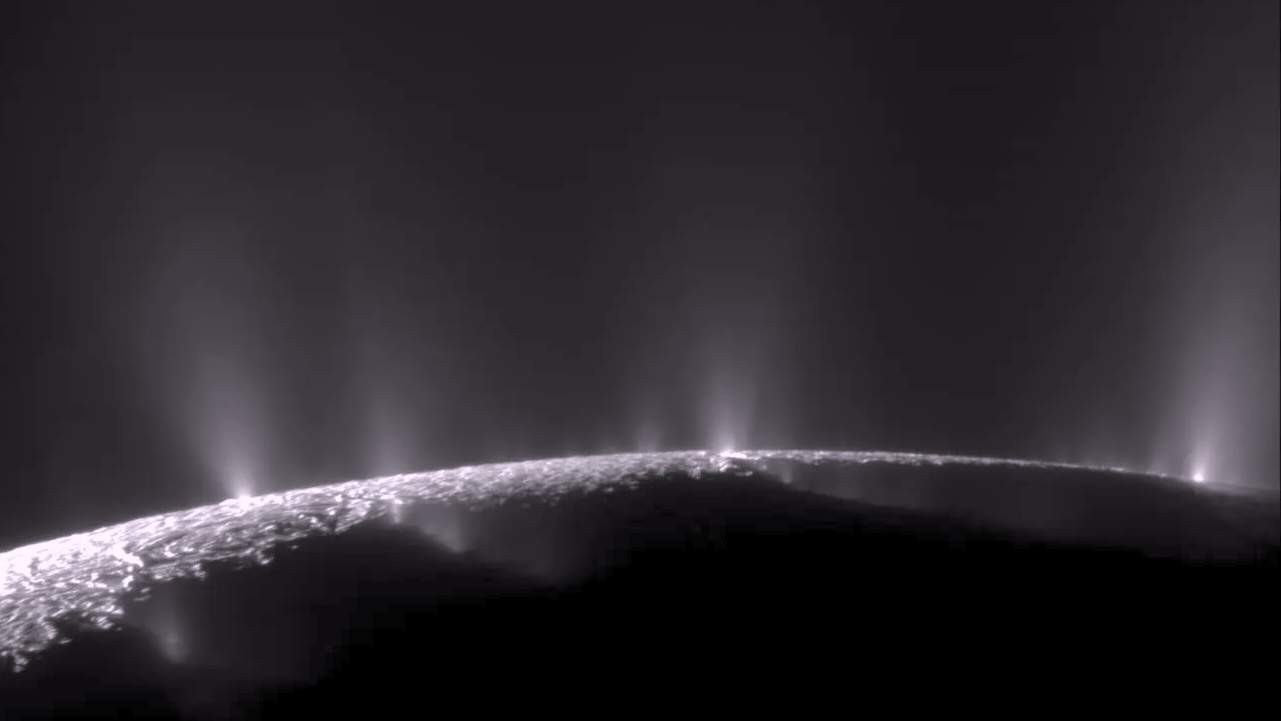
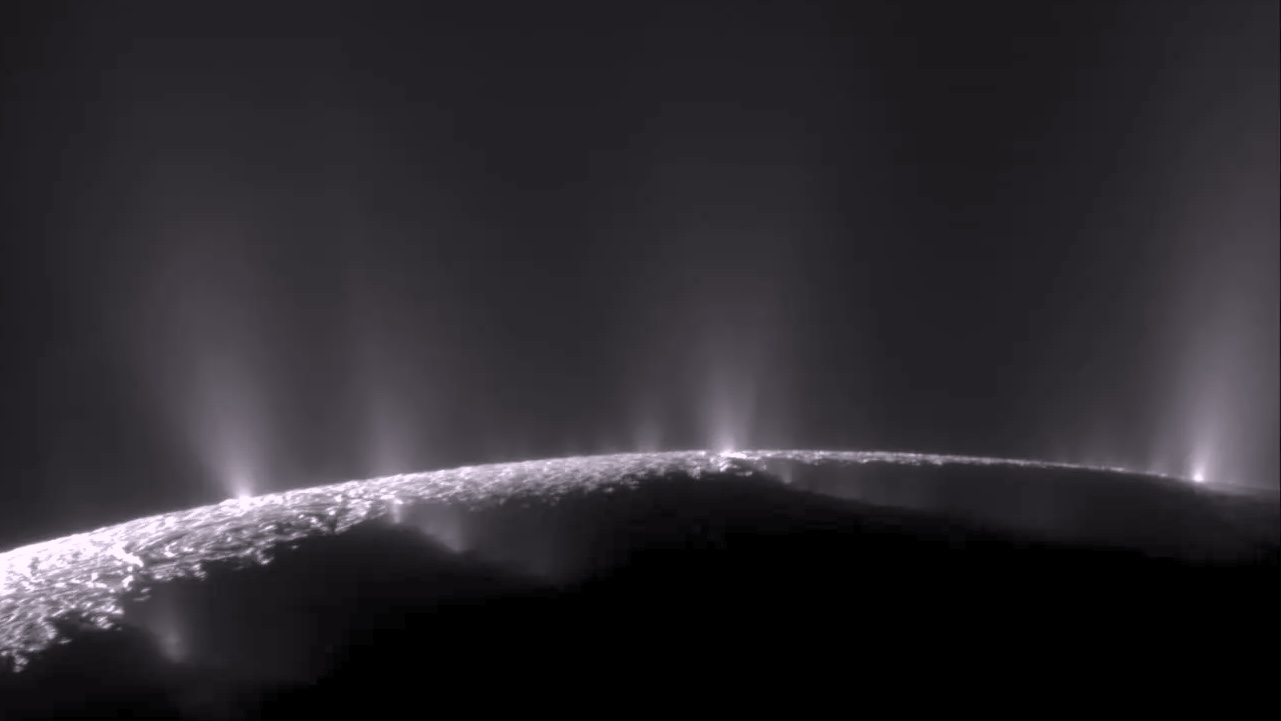
Ocean worlds are considered as targets for life detection missions because they meet several key requirements for habitability. However, identifying potential life on other worlds requires observing clear and unambiguous biosignature signals above the existing abiotic baseline.
Consequently, this necessitates evaluating uncertainty and variability in the abiotic baseline, including processes that can overlap, attenuate, or obfuscate biosignatures before they are observed. This article develops a quantitative framework for holistically evaluating abiotic baselines on ocean worlds to guide life detection strategies.
Using Enceladus as an example, we assess the potential of using: i) CH4 isotopes and their relationship with CO2, and ii) amino acid chirality as biosignatures, demonstrating that uncertainties in abiotic processes currently prevent hypothetical future δ13CCO2 and δ13CCH4 measurements from definitively inferring a biosphere on Enceladus.
Additionally, our results quantitatively show that neglecting the abiotic baseline risks false negative life detection claims for both isotopic and chiral biosignatures. Interpreting these and other alternative biosignatures on Enceladus, Europa, Titan, and similar planetary bodies therefore requires complimentary geophysical observations such as constraining internal temperatures to within ∼10-100∘C, and improving characterisation of the target’s rheology, lithology, initial abiotic organic inventory and ocean transport timescales.
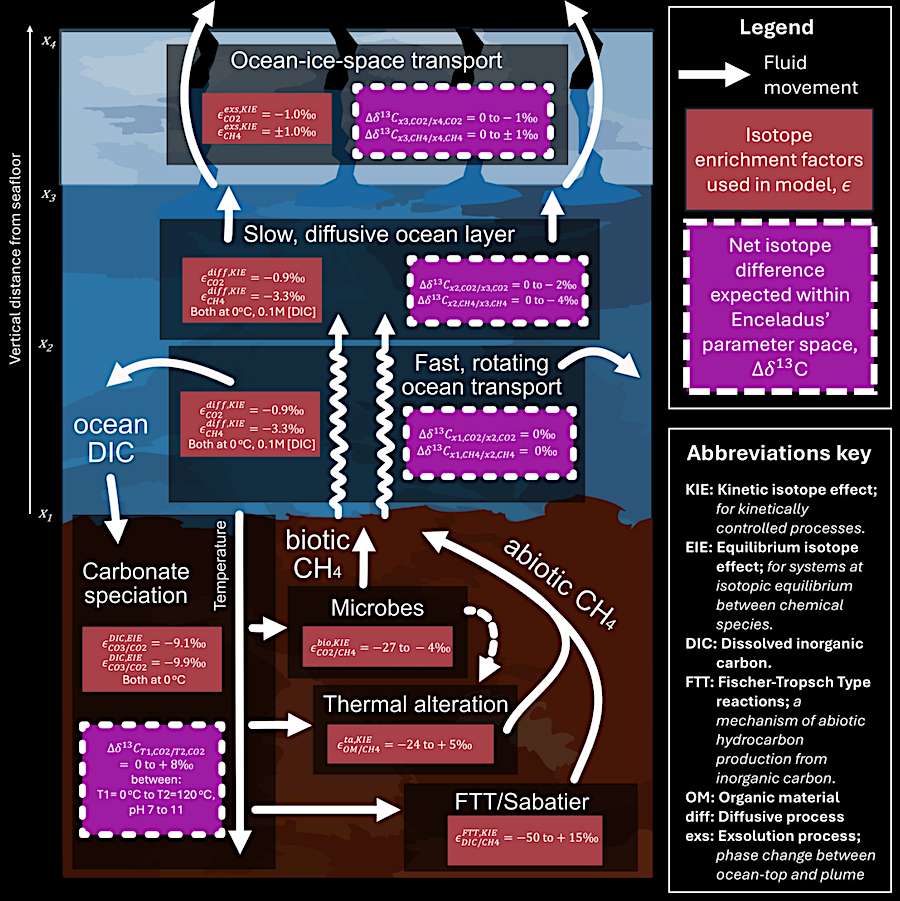
Schematic of carbon isotope cycling processes on Enceladus. Each black box represents a module that monitors key processes affecting influxes and outfluxes of chemical species, and their interactions therein (both bulk chemical and isotopic). For each module, the process-based isotope enrichment factor and/or the model predicted net isotope difference is noted. — astro-ph.EP
Peter M. Higgins, Weibin Chen, Oliver Warr, Lucas M. Fifer, Wanying Kang, Charles S. Cockell, Barbara Sherwood Lollar
Comments: Preprint. Journal reference and DOI will be added when available. 60 pages, 11 figures
Subjects: Earth and Planetary Astrophysics (astro-ph.EP)
Cite as: arXiv:2605.15337 [astro-ph.EP] (or arXiv:2605.15337v1 [astro-ph.EP] for this version)
https://doi.org/10.48550/arXiv.2605.15337
Focus to learn more
Submission history
From: Peter M. Higgins
[v1] Thu, 14 May 2026 19:00:57 UTC (4,034 KB)
https://arxiv.org/abs/2605.15337
Astrobiology,










Related Posts

Stay Informed With the Latest & Most Important News


Advertisement
-
 01Two Black Holes Observed Circling Each Other for the First Time
 -
 02From Polymerization-Enabled Folding and Assembly to Chemical Evolution: Key Processes for Emergence of Functional Polymers in the Origin of Life
 -
 03Astronomy 101: From the Sun and Moon to Wormholes and Warp Drive, Key Theories, Discoveries, and Facts about the Universe (The Adams 101 Series)
 -
 04True Anomaly hires former York Space executive as chief operating officer
 -
 05Φsat-2 begins science phase for AI Earth images
 -
 06Hurricane forecasters are losing 3 key satellites ahead of peak storm season − a meteorologist explains why it matters
 -
 07Binary star systems are complex astronomical objects − a new AI approach could pin down their properties quickly