
Now Reading: Asteroseismic Modelling Of Main-sequence Solar-like Stars And Kepler Exoplanet Host Stars With The FICO Procedure I. Catalogue Of Fundamental Stellar Properties
-
01
Asteroseismic Modelling Of Main-sequence Solar-like Stars And Kepler Exoplanet Host Stars With The FICO Procedure I. Catalogue Of Fundamental Stellar Properties

Asteroseismic Modelling Of Main-sequence Solar-like Stars And Kepler Exoplanet Host Stars With The FICO Procedure I. Catalogue Of Fundamental Stellar Properties

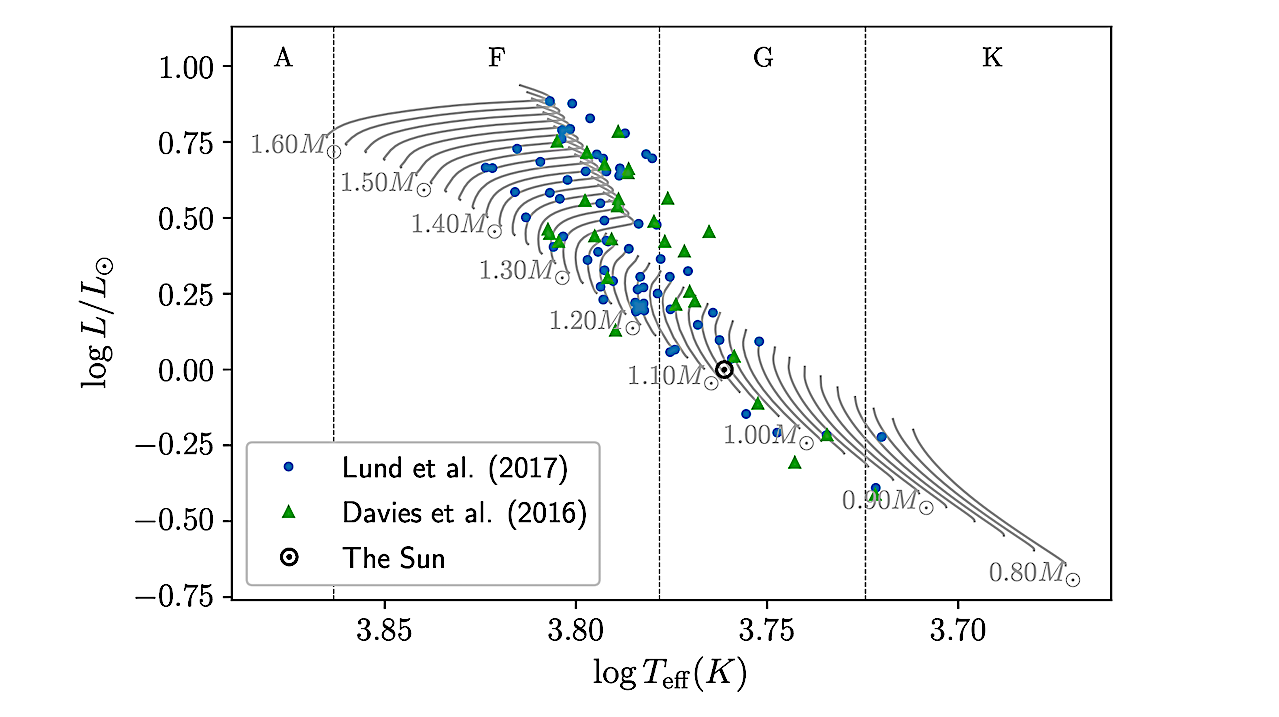
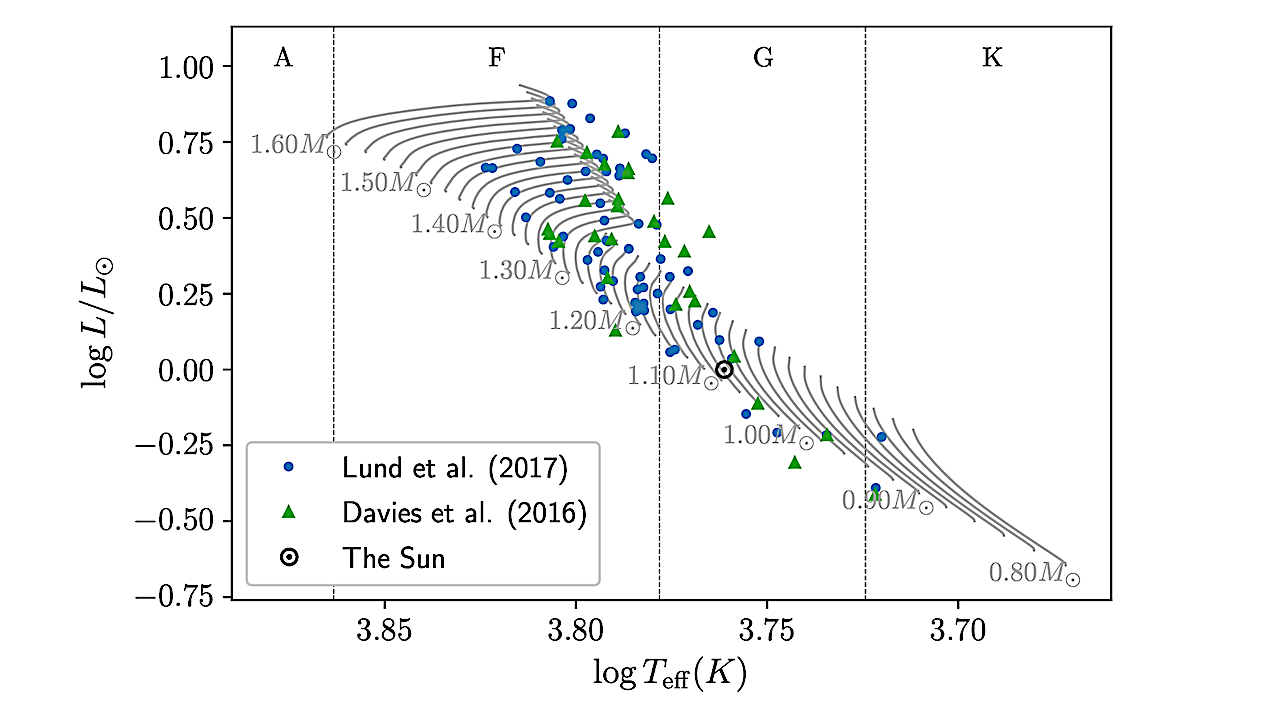
Hertzsprung-Russell diagram of the stellar catalogue. The Sun is shown as a reference and the letters stand for the spectral type. The grey lines represent evolutionary tracks of the Spelaion grid selected by fixing the initial chemical composition to X0 = 0.72 and Z0 = 0.018, and setting αov = 0. – astro-ph.SR
We present detailed asteroseismic modelling of 95 main-sequence solar-like stars and Kepler exoplanet host stars using the FICO procedure, a three-step method that combines forward and inverse techniques that enables precise inference of fundamental stellar parameters such as mass, radius, age, and mean density.
We applied the FICO procedure to a catalogue of stars with high-quality asteroseismic and classical observations, and compared its results against literature values. We also compared its performance with direct frequency fitting using semi-empirical surface corrections.
The FICO procedure achieved statistical precisions of 2.3%, 0.82%, 6.9%, and 0.49% in mass, radius, age, and mean density, respectively on average, well within PLATO quality requirements.
We reconfirmed that surface-independent methods more effectively mitigate biases inherent to semi-empirical surface corrections, particularly for stars more massive than 1.15 Msun or above 6050 K. Two regimes were identified: near-solar conditions, where both approaches perform similarly, and higher-mass stars, where surface-independent methods consistently outperform direct fitting methods.
While our results are consistent with literature values, we observed age biases (~11.5% on average for the Kepler LEGACY sample) that are comparable to the PLATO accuracy requirement of 10% for a Sun-like star, and therefore not negligible in that context. The FICO procedure provides a robust framework for high-precision stellar characterisation in the PLATO era.
Its hybrid architecture effectively addresses surface effects, making it a promising tool for the accurate determination of exoplanet host-star properties. Our findings also highlight the importance of carefully selecting and validating the physical assumptions embedded in stellar models, particularly in the context of next-generation space missions such as PLATO.
Jérôme Bétrisey, Daniel R. Reese, Camilla Pezzotti, Marie-Jo Goupil, Margarida S. Cunha
Comments: Accepted for publication in Astronomy and Astrophysics
Subjects: Solar and Stellar Astrophysics (astro-ph.SR); Earth and Planetary Astrophysics (astro-ph.EP)
Cite as: arXiv:2604.27842 [astro-ph.SR] (or arXiv:2604.27842v1 [astro-ph.SR] for this version)
https://doi.org/10.48550/arXiv.2604.27842
Focus to learn more
Submission history
From: Jérôme Bétrisey
[v1] Thu, 30 Apr 2026 13:28:30 UTC (1,939 KB)
https://arxiv.org/abs/2604.27842
Astrobiology, Stellar Cartography,










Related Posts

Stay Informed With the Latest & Most Important News





Advertisement
-
 01Two Black Holes Observed Circling Each Other for the First Time
 -
 02From Polymerization-Enabled Folding and Assembly to Chemical Evolution: Key Processes for Emergence of Functional Polymers in the Origin of Life
 -
 03Astronomy 101: From the Sun and Moon to Wormholes and Warp Drive, Key Theories, Discoveries, and Facts about the Universe (The Adams 101 Series)
 -
 04True Anomaly hires former York Space executive as chief operating officer
 -
 05Φsat-2 begins science phase for AI Earth images
 -
 06Hurricane forecasters are losing 3 key satellites ahead of peak storm season − a meteorologist explains why it matters
 -
 07Binary star systems are complex astronomical objects − a new AI approach could pin down their properties quickly