
Now Reading: Bacteria Reveal Hidden Powers Of Electricity Transfer
-
01
Bacteria Reveal Hidden Powers Of Electricity Transfer


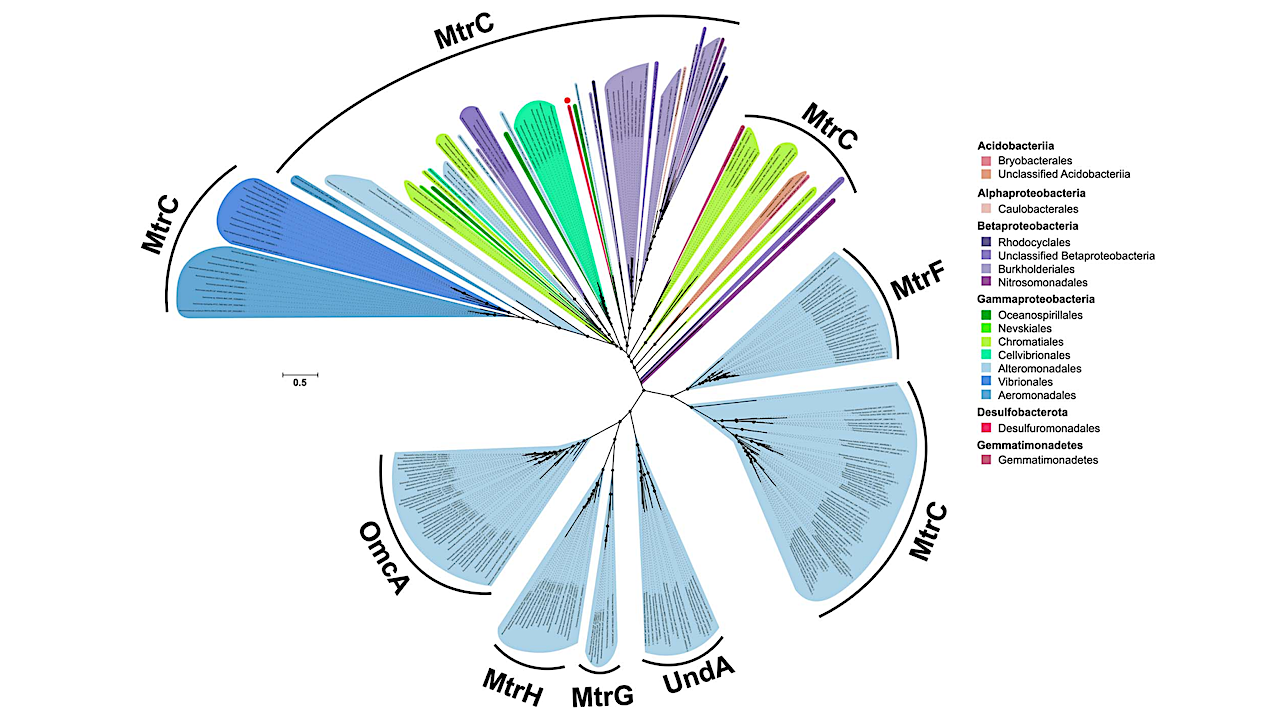
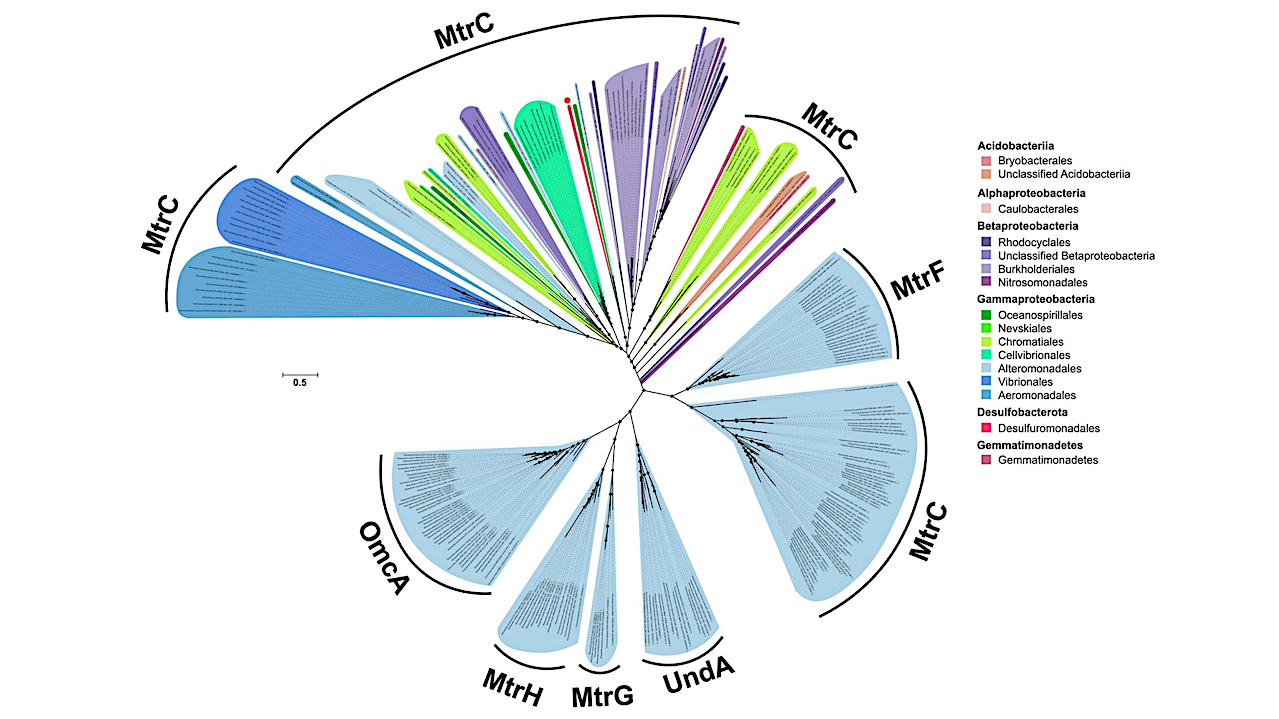
Phylogenetic relationship among known OmcA/MtrC decaheme c-type cytochromes from diverse bacteria and the newly identified D. acetexigens MtrC detected in this study. Maximum-likelihood phylogenetic tree constructed from a concatenated alignment of the known diversity of OmcA/MtrC decaheme c-type cytochromes and the D. acetexigens MtrC detected in this study. Color codes were assigned by taxonomic order. Bootstrap support values ≥90% from 1000 resamples are indicated with filled black circles. The scale bar represents average changes per amino acid position. MtrC, OmcA, MtrH, MtrG, UndA, and MtrF indicate members of the MtrC family of proteins. MtrC of D. acetexigens is indicated with a red dot. A full resolution image of the tree is available in Supplementary Fig. 11. — The ISME Journal
Editor’s note: as we delve further into the myriad of ways that life on Earth operates, modes of operation once thought to be rare or limited to small niches are now appearing in places where they were least expected. And these capabilities arise repeatedly and independently in various life forms. What may seem strange – alien – to use – may be commonplace elsewhere on Earth. The better we understand this and other variants on ‘traditional’ biology, the better equipped we wil be to model, predict, and search for life elsewhere – and understand how it works.
Microbes are masters of survival, evolving ingenious strategies to capture energy from their surroundings. For decades, scientists believed that only a handful of bacteria used specialized molecular “circuits” to shuttle electrons outside their cells — a process known as extracellular electron transfer (EET). This mechanism is critical for cycling carbon, sulfur, nitrogen, and metals in nature, and it underpins applications ranging from wastewater treatment to bioenergy and bioelectronics materials.
Now, KAUST researchers have discovered that this remarkable ability is far more versatile and widespread than previously imagined.
Working with Desulfuromonas acetexigens — a bacterium capable of generating high electrical currents — the team combined bioelectrochemistry, genomics, transcriptomics, and proteomics to map its electron transfer machinery[1]. To their surprise, D. acetexigens simultaneously activated three distinct electron transfer pathways previously thought to have evolved separately in unrelated microbes: the metal-reducing (Mtr), outer-membrane cytochrome (Omc), and porin-cytochrome (Pcc) systems.
“This is the first time we’ve seen a single organism express these phylogenetically distant pathways in parallel,” says first author Dario Rangel Shaw. “It challenges the long-held view that these systems were exclusive to specific microbial groups.”
The team also identified unusually large cytochromes, including one with a record-breaking 86 heme-binding motifs, which could enable exceptional electron transfer and storage capacity. Tests showed that the bacterium could channel electrons directly to electrodes and natural iron minerals, achieving current densities comparable to the model species Geobacter sulfurreducens.
By extending their analysis to publicly available genomes, the researchers identified more than 40 Desulfobacterota species carrying similar multipathway systems across diverse environments, from sediments and soils to wastewater and hydrothermal vents.
“This reveals an unrecognized versatility in microbial respiration,” explains Krishna Katuri, co-author of the study. “Microbes with multiple electron transfer routes may gain a competitive advantage by tapping into a wider range of electron acceptors in nature.”
The implications go well beyond ecology. Harnessing bacteria that can employ multiple electron transfer strategies could accelerate innovations in bioremediation, wastewater treatment, bioenergy production, and bioelectronics. For instance, electroactive biofilms like those formed by D. acetexigens could help recover energy from waste streams while simultaneously treating pollutants.
“Our findings expand the known diversity of electron transfer proteins and highlight untapped microbial resources,” adds Pascal Saikaly, who led the study. “This opens the door to designing more efficient microbial systems for sustainable biotechnologies.”
As researchers delve deeper into the microbial world, the discovery that a single bacterium can use multiple pathways underscores how much remains to be explored and how these hidden strategies could power a cleaner, more sustainable future.
Shaw D.R., Katuri K.P., Sapireddy V., Douvropoulou O., Gralnick J.A., Saikaly P.E. Independently evolved extracellular electron transfer pathways in ecologically diverse Desulfobacterota. The ISME Journal, 19, wraf097 (2025). (open access)
Astrobiology,










Related Posts
Stay Informed With the Latest & Most Important News
Previous Post
Next Post




Advertisement
-
 01Two Black Holes Observed Circling Each Other for the First Time
 -
 02From Polymerization-Enabled Folding and Assembly to Chemical Evolution: Key Processes for Emergence of Functional Polymers in the Origin of Life
 -
 03Astronomy 101: From the Sun and Moon to Wormholes and Warp Drive, Key Theories, Discoveries, and Facts about the Universe (The Adams 101 Series)
 -
 04True Anomaly hires former York Space executive as chief operating officer
 -
 05Φsat-2 begins science phase for AI Earth images
 -
 06Hurricane forecasters are losing 3 key satellites ahead of peak storm season − a meteorologist explains why it matters
 -
 07Binary star systems are complex astronomical objects − a new AI approach could pin down their properties quickly