
Now Reading: Cloudy With A Chance Of Metals: Indications Of CO2 In The Atmosphere Of GJ 1214 b From High-resolution K-band Spectroscopy
-
01
Cloudy With A Chance Of Metals: Indications Of CO2 In The Atmosphere Of GJ 1214 b From High-resolution K-band Spectroscopy

Cloudy With A Chance Of Metals: Indications Of CO2 In The Atmosphere Of GJ 1214 b From High-resolution K-band Spectroscopy

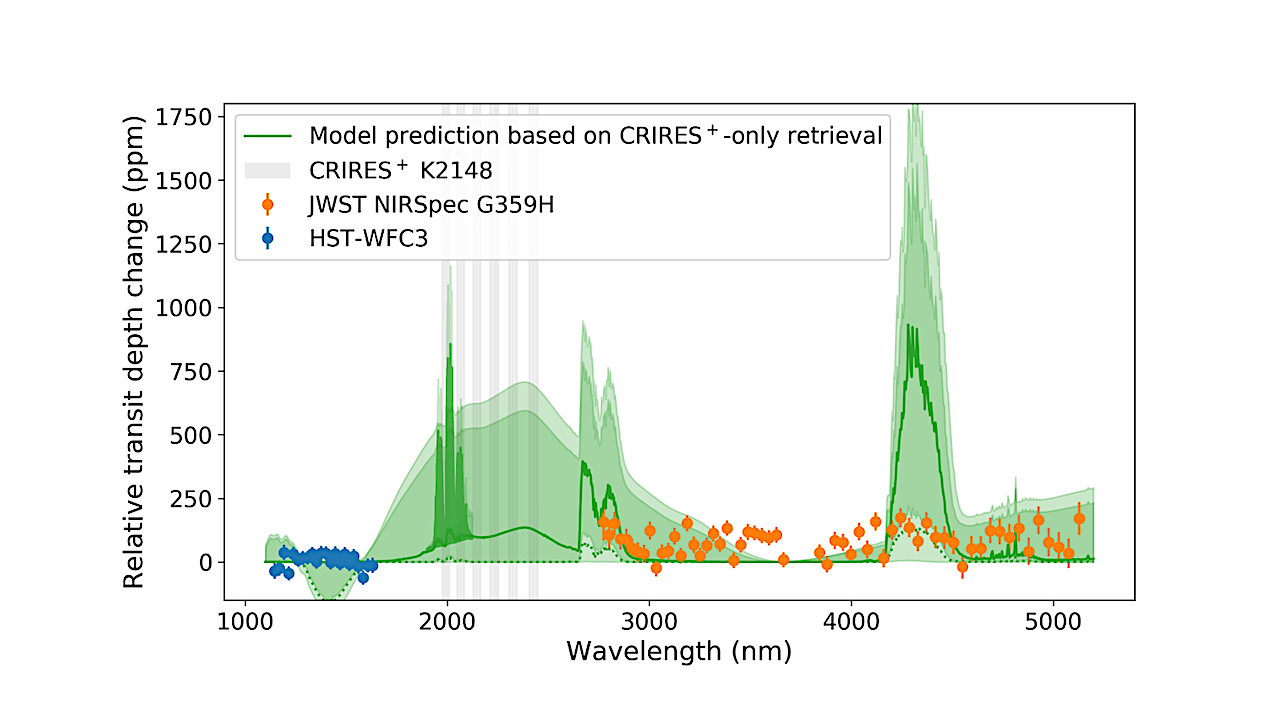
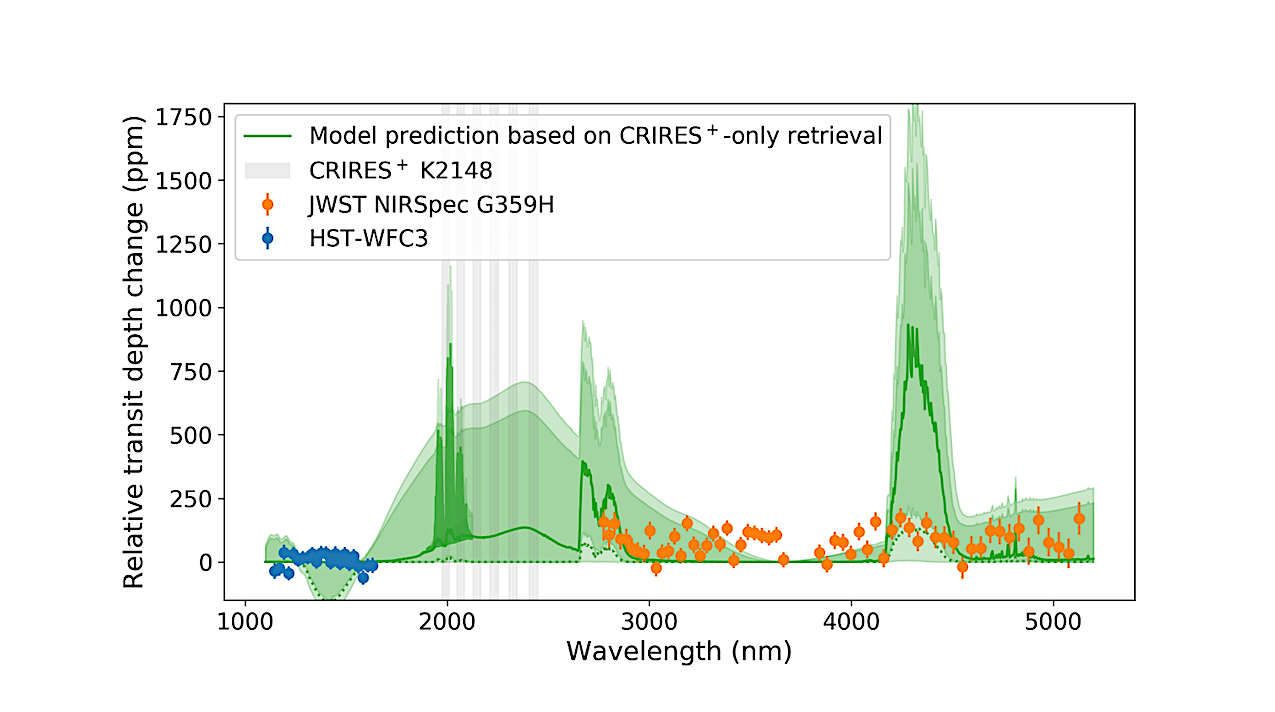
Predicted relative transit depth change from the equilibrium chemistry CO2-only model retrieved for CRIRES+ data (green). The model predictions are plotted in high-resolution in the wavelength region overlapping with the CRIRES+ measurements indicated by the grey shaded areas and in low-resolution for the rest of the wavelength range. Space-based measurements from HST (blue) and JWST (orange) are also shown. The 1σ and 1.5σ uncertainties of the model are indicated as darker and lighter green shaded areas, respectively. We also mark the lower 1.1σ uncertainty boundary with a dotted green line as a potential match to the amplitude of the CO2 bump in the JWST measurements at 4200 nm. The HST-WFC3 and JWST NIRSpec G359H measurements were taken from the online data provided by Schlawin et al. (2024) containing the HST data adapted from Kreidberg et al. (2014).– astro-ph.EP
Sub-Neptune exoplanets frequently exhibit muted transmission spectra, with GJ 1214 b being the most prominent example. Following years of intense observing campaigns yielding featureless planetary spectra, recent observations with JWST revealed the first possible atmospheric signatures. We present high-resolution transmission spectroscopy of GJ 1214 b based on eight transits obtained with the CRIRES+ spectrograph in the K band.
We used SYSREM to remove telluric and stellar signals and searched for signatures of H2O, CO, CH4, H2S, NH3, and CO2 using the cross-correlation technique. We obtained non-detections for the first five molecules and used injection recovery tests to derive upper limits on the atmosphere. For CO2 we measure a CCF signal at S/N ~ 3.6, with a detailed investigation showing no obvious indication that it is caused by correlated noise.
A Welch t-test confirmed the in-trail and out-of-trail distributions to be different at 3.4σ confidence. A Bayesian retrieval framework with free chemistry, resulted in volume mixing ratios corresponding to a metallicity of [M/H]=0.48+0.89−1.70, an opacity deck pressure of log10(Pc)=−3.04+2.52−1.53 and a planet temperature of Tiso=398+283−197 K, consistent with a value intermediate between the day- and night-side T-p’s derived from JWST data.
While these values correspond to relatively large signal amplitudes predicted for CO2 features in the mid-infrared, they are compatible with JWST NIRSpec observations within the models’ 1.5σ uncertainties.
Further modelling and additional data are required to confirm the atmospheric signatures and obtain a comprehensive interpretation of low- and high-resolution data. Overall, our results support previous findings that CO2 is likely to be a significant component of the atmosphere of GJ 1214 b.
L. Nortmann, D. Cont, F. Lesjak, A. D. Rains, A. Lavail, L. Boldt-Christmas, E. Nagel, A. Reiners, N. Piskunov, F. Yan, A. Hatzes, O. Kochukhov, D. Shulyak, U. Seemann, M. Rengel, A. Hahlin
Comments: 24 pages, 21 figures (16 main text, 8 appendix), Accepted for publication in A&A
Subjects: Earth and Planetary Astrophysics (astro-ph.EP)
Cite as: arXiv:2604.15292 [astro-ph.EP] (or arXiv:2604.15292v1 [astro-ph.EP] for this version)
https://doi.org/10.48550/arXiv.2604.15292
Focus to learn more
Submission history
From: Lisa Nortmann
[v1] Thu, 16 Apr 2026 17:54:55 UTC (11,905 KB)
https://arxiv.org/abs/2604.15292
Astrobiology, Exoplanet,










Related Posts
Stay Informed With the Latest & Most Important News
Previous Post
Next Post


Advertisement
-
 01Two Black Holes Observed Circling Each Other for the First Time
 -
 02From Polymerization-Enabled Folding and Assembly to Chemical Evolution: Key Processes for Emergence of Functional Polymers in the Origin of Life
 -
 03Astronomy 101: From the Sun and Moon to Wormholes and Warp Drive, Key Theories, Discoveries, and Facts about the Universe (The Adams 101 Series)
 -
 04True Anomaly hires former York Space executive as chief operating officer
 -
 05Φsat-2 begins science phase for AI Earth images
 -
 06Hurricane forecasters are losing 3 key satellites ahead of peak storm season − a meteorologist explains why it matters
 -
 07Binary star systems are complex astronomical objects − a new AI approach could pin down their properties quickly