
Now Reading: Equifinality Of Venus-like CO2 Atmospheres
-
01
Equifinality Of Venus-like CO2 Atmospheres


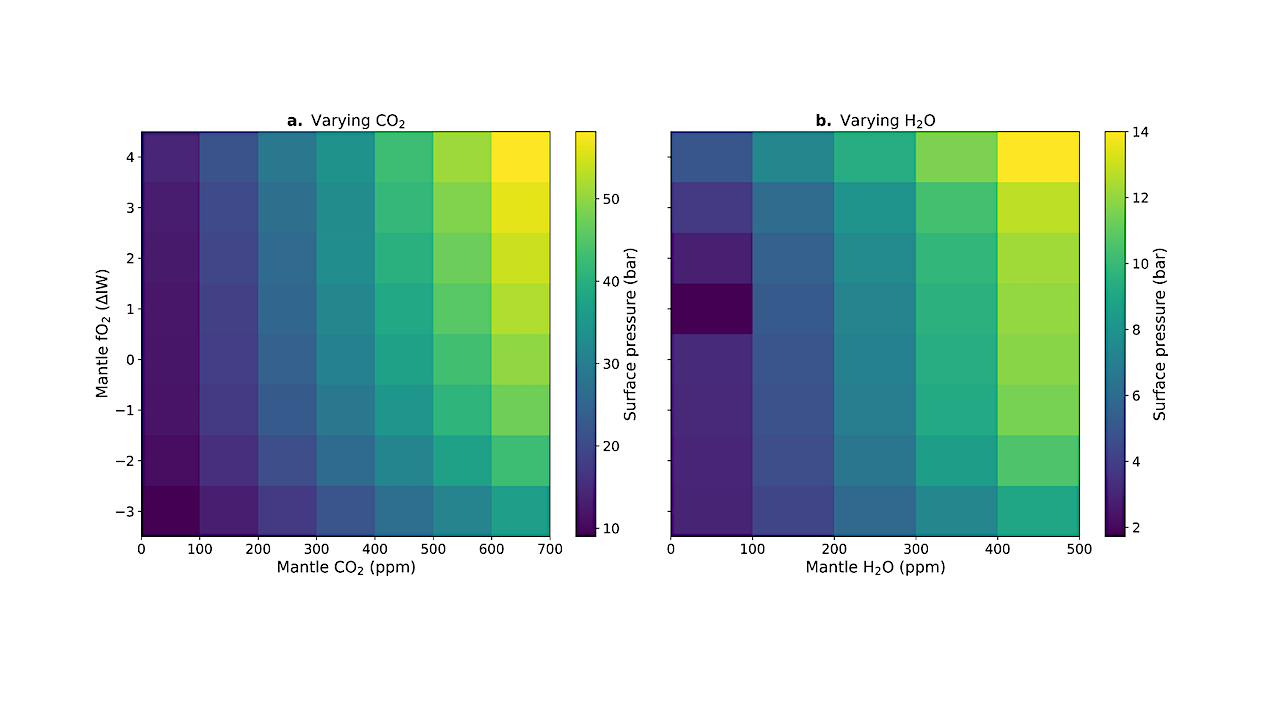
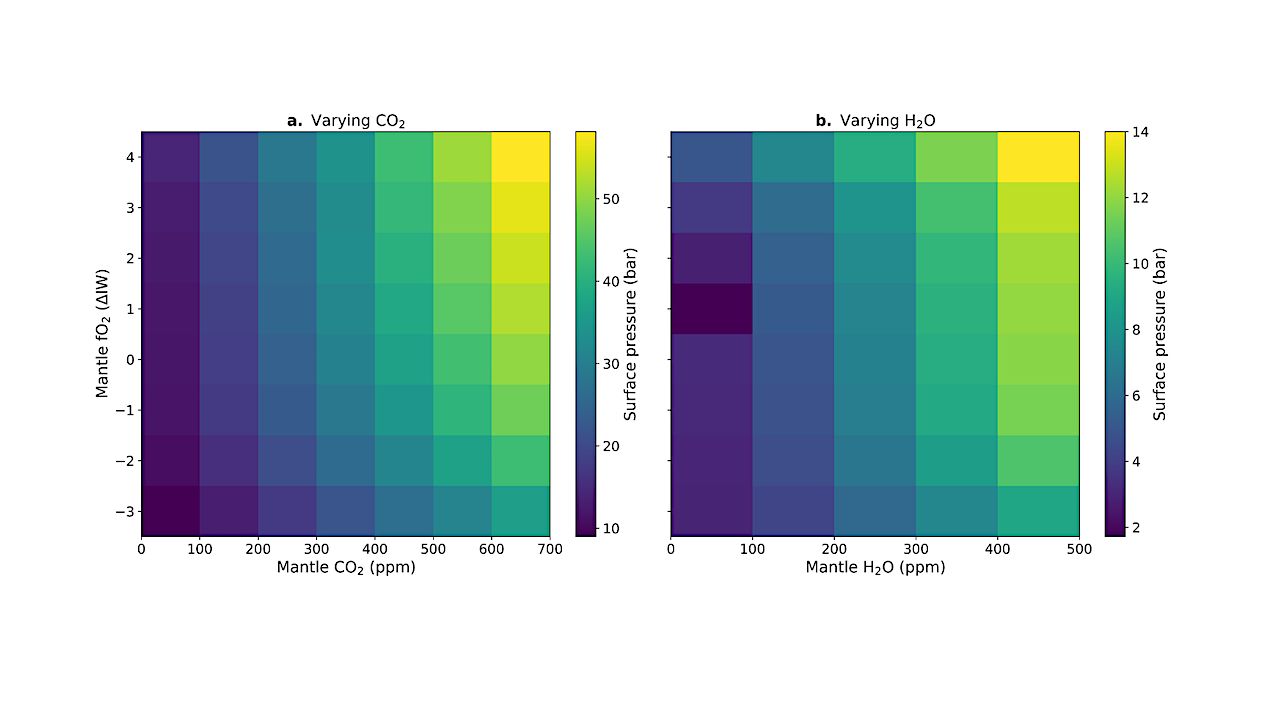
A1. Final surface atmospheric pressure after 4 Gyr of volcanic degassing, shown as a function of mantle oxygen fugacity (fO2) and a. initial mantle CO2 content, b. initial mantle H2O content. Other mantle volatiles are held constant at fiducial values: 450 ppm H2O (Elkins-Tanton 2008), 50 ppm CO2 (Elkins-Tanton 2008), 54 ppm S, and 1 ppm N (scaled to the CO2 content of Earth’s depleted MORB; Ding & Dasgupta (2017); Marty & Dauphas (2003); Le Voyer et al. (2017) respectively). — astro-ph.EP
While Earth locks much of its carbon in its crust as carbonates, Venus retains a comparable carbon inventory almost entirely in its atmosphere as CO2.
On Earth, the geological carbon cycle that has produced this vast crustal carbonate inventory is regulated by biology, liquid water, and plate tectonics, which together have stabilised climate over geological timescales. Venus presently lacks all these processes.
We test whether Venus’s massive CO2 atmosphere is diagnostic of a specific evolutionary pathway by quantifying three routes: primary magma-ocean outgassing, secondary volcanic degassing in a stagnant-lid regime, and remobilisation of crustal carbonates after climate destabilisation. Using a coupled climate–weathering framework, we find that a past habitable Venus could have stored ∼20 bar of CO2 as crustal carbonates. Following transition to runaway conditions, crustal heating releases this reservoir over tens of Myr.
In stagnant-lid secondary-degassing models with a MORB-like mantle, outgassing reaches only ∼25 bar CO2, limited by progressive mantle volatile depletion. However, Venus-like inventories can be achieved through: (i) magmatic carbon enrichment, (ii) increased magmatic delivery to the surface (high extrusion or melt production), and (iii) the recycling of undegassed carbon back into the planet’s interior.
Primary magma-ocean outgassing can generate >102 bar CO2, but the retained fraction after early escape remains uncertain. Ultimately, a Venus-like massive CO2 atmosphere is an equifinal outcome and does not uniquely diagnose a temperate past.
Tereza Constantinou, Oliver Shorttle, Harrison Nicholls
Comments: Accepted for publication in MNRAS
Subjects: Earth and Planetary Astrophysics (astro-ph.EP)
Cite as: arXiv:2604.25810 [astro-ph.EP] (or arXiv:2604.25810v1 [astro-ph.EP] for this version)
https://doi.org/10.48550/arXiv.2604.25810
Focus to learn more
Submission history
From: Tereza Constantinou
[v1] Tue, 28 Apr 2026 16:20:19 UTC (12,947 KB)
https://arxiv.org/abs/2604.25810
Astrobiology, exoplanet,










Related Posts

Stay Informed With the Latest & Most Important News
Previous Post
Next Post

Advertisement
-
 01Two Black Holes Observed Circling Each Other for the First Time
 -
 02From Polymerization-Enabled Folding and Assembly to Chemical Evolution: Key Processes for Emergence of Functional Polymers in the Origin of Life
 -
 03Astronomy 101: From the Sun and Moon to Wormholes and Warp Drive, Key Theories, Discoveries, and Facts about the Universe (The Adams 101 Series)
 -
 04True Anomaly hires former York Space executive as chief operating officer
 -
 05Φsat-2 begins science phase for AI Earth images
 -
 06Hurricane forecasters are losing 3 key satellites ahead of peak storm season − a meteorologist explains why it matters
 -
 07Binary star systems are complex astronomical objects − a new AI approach could pin down their properties quickly