
Now Reading: European Space Agency’s Proba-3 Mission Unveils Unprecedented Insights into Solar Wind and Corona Dynamics
-
01
European Space Agency’s Proba-3 Mission Unveils Unprecedented Insights into Solar Wind and Corona Dynamics

European Space Agency’s Proba-3 Mission Unveils Unprecedented Insights into Solar Wind and Corona Dynamics

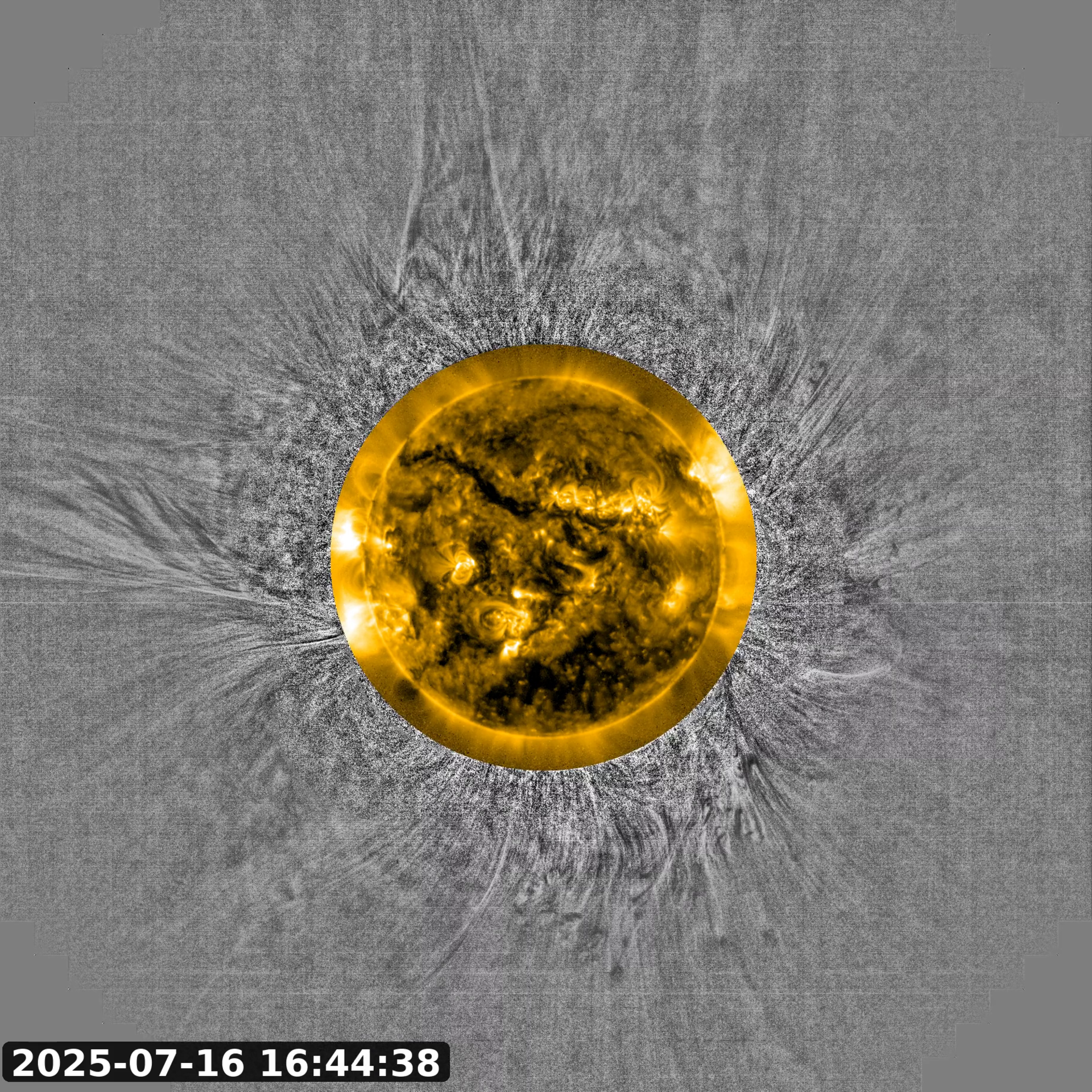

Since its launch in December 2024, the European Space Agency’s Proba-3 mission, which comprises two satellites, has successfully generated 57 artificial solar eclipses, yielding over 250 hours of high-resolution video data of the Sun’s corona. This impressive collection of observational material is equivalent to what would be gained from approximately 5,000 total solar eclipse events on Earth. The findings from Proba-3 have already begun to reshape scientists’ understanding of the solar wind, revealing that structures within the inner corona can travel at speeds three to four times greater than previously estimated.
Traditionally, total solar eclipses viewed from Earth provided the primary means to study the inner corona, as the Moon temporarily obscures the Sun’s light and allows solar scientists to capture detailed images. However, such astronomical events are infrequent, occurring roughly every 18 months and lasting at most a few minutes. Proba-3 addresses this limitation by positioning its two spacecraft in a highly precise formation, with one satellite, known as the Occulter, blocking the Sun’s light for approximately five hours. This allows the second satellite, the Coronagraph, to study the solar corona with unprecedented detail, observing as close as 70,000 kilometers from the Sun’s surface, significantly closer than other space-based coronagraphs.
Through its advanced ASPIICS instrument, Proba-3 captures one or two images each minute, constructing videos that showcase dynamic movements within the inner corona. According to Joe Zender, the project scientist for Proba-3, the intricate motions observed are unprecedented in the optical spectrum at such low altitudes in the Sun’s corona.
The mission’s capability to monitor the solar wind, a stream of particles expelled from the Sun, has also yielded significant scientific insights. Zender noted that the data from Proba-3 enables scientists to observe how the solar wind accelerates near the Sun, revealing speeds previously deemed unattainable for slow solar winds. This previously poorly understood phenomenon may be influenced by how the Sun’s magnetic field lines interact, leading to the ejection of plasma in what are known as “streamers.”
Andrei Zhukov, principal investigator for Proba-3’s ASPIICS instrument, highlighted the unexpected speeds of slow solar wind gusts, which were found to reach rates of 250 to 500 kilometers per second, compared to earlier assumptions of around 100 kilometers per second. The research, published recently in The Astrophysical Journal Letters, underscores the complex and non-uniform nature of slow solar wind dynamics.
While the initial findings are promising, researchers emphasize that this data marks just the beginning of a comprehensive investigation into the mysteries of solar activity and its impact on space weather. Proba-3’s dataset remains largely untapped, with ongoing analysis expected to tackle profound questions about solar wind acceleration, the mechanics behind coronal mass ejections, and the reasons for the temperature discrepancy between the corona and the Sun itself.
Proba-3 represents a cornerstone of the European Space Agency’s commitment to advancing solar and heliophysics research, having accomplished its technological goals and achieving precise formation flying. Beyond the ASPIICS coronagraph, Proba-3 is equipped with additional instruments, including a Digital Absolute Radiometer, which continuously measures fluctuations in the Sun’s energy output, and a 3D Energetic Electron Spectrometer that investigates the dynamics of Earth’s radiation belts influenced by solar activity.










Related Posts

Stay Informed With the Latest & Most Important News
Previous Post
Next Post
Advertisement
-
 01Two Black Holes Observed Circling Each Other for the First Time
 -
 02From Polymerization-Enabled Folding and Assembly to Chemical Evolution: Key Processes for Emergence of Functional Polymers in the Origin of Life
 -
 03Astronomy 101: From the Sun and Moon to Wormholes and Warp Drive, Key Theories, Discoveries, and Facts about the Universe (The Adams 101 Series)
 -
 04True Anomaly hires former York Space executive as chief operating officer
 -
 05Φsat-2 begins science phase for AI Earth images
 -
 06Hurricane forecasters are losing 3 key satellites ahead of peak storm season − a meteorologist explains why it matters
 -
 07Binary star systems are complex astronomical objects − a new AI approach could pin down their properties quickly