
Now Reading: Evolutionary Origin Of The Bipartite Architecture Of Dissipative Cellular Networks
-
01
Evolutionary Origin Of The Bipartite Architecture Of Dissipative Cellular Networks

Evolutionary Origin Of The Bipartite Architecture Of Dissipative Cellular Networks

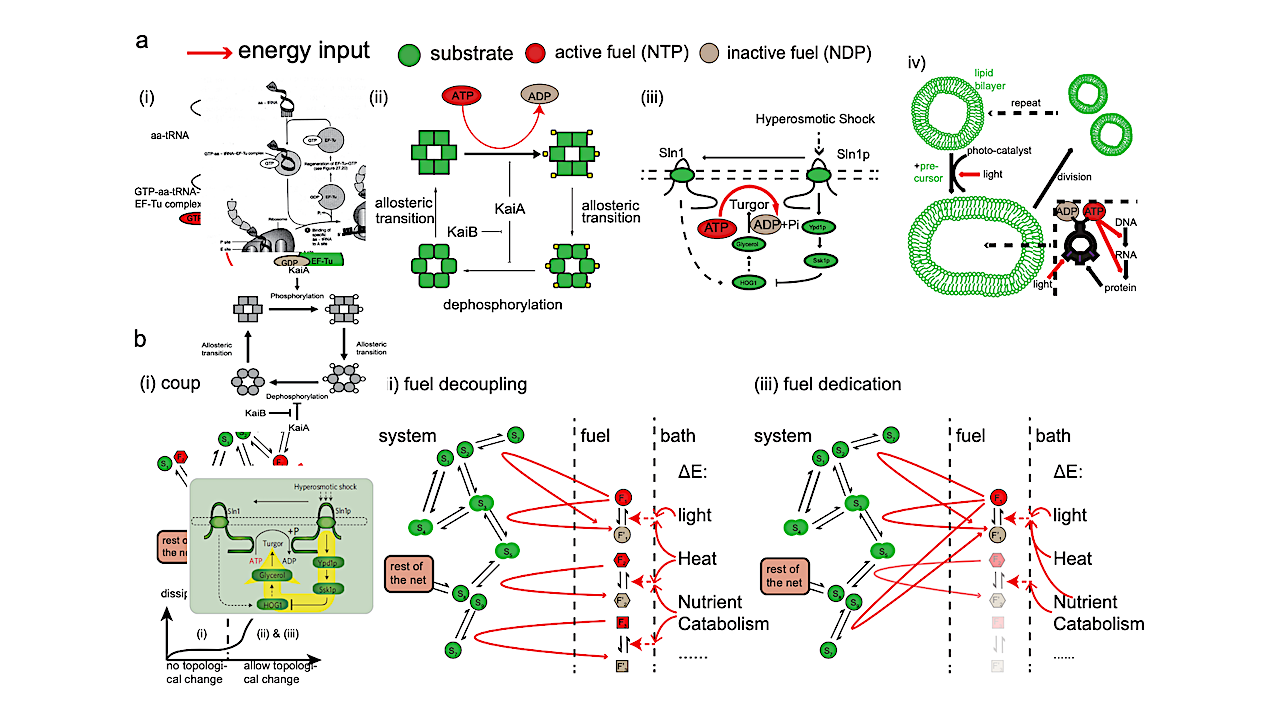

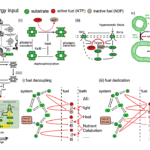
Conceptual demonstration of fuel decoupling and dedication. (a) Representative non-equilibrium biological and prebiotic motifs driven by external energy input (red arrows). (i) Elongation of a protein polymer in mRNA translation and the corresponding kinetic proofreading model [4]; (ii) Circadian oscillation by KaiC and its simplified activator–inhibitor oscillatory model [5], yellow dots represent the phosphorylated state of KaiC; (iii) Osmotic adaptation by Sln1/Sln2 and the abstract adaptive response model [6]; (iv) A synthetic minimal cell model using a photo-catalyst and visible light as the energy source to replicate liposome vesicles [12]. (b) Schematic illustration of network evolution under different topological constraints. Substrates and fuel molecules, as well as energy inputs, are represented in the same symbols as in (a). (i) When the reaction topology is fixed, the system remains in a stable dissipative state with limited energy flux. The lower panel shows the potential increase in maximal achievable dissipation when a static topology (state i) is allowed to undergo topological evolution (states ii and iii). (ii) Schematic for fuel decoupling, where energetically rich fuels become isolated from direct substrate interconversions and are solely used for transducing energy from the external heat bath. (iii) Schematic for fuel dedication, in which energy input from diverse sources (light, heat, nutrient catabolism) converges onto a few specialized fuel molecules (e.g., ATP and GTP). — q-bio.MN
Recently, plenty research has been done on discovering the role of energy dissipation in biological networks, most of which focus on the relationship of dissipation and functionality.
However, the development of networks science urged us to fathom the systematic architecture of biological networks and their evolutionary advantages. We found the dissipation of biological dissipative networks is highly related to their structure. By interrogating these well-adapted networks, we find that the energy producing module is relatively isolated in all situations.
We applied evolutionary simulation and analysis on premature networks of classic dissipative networks, namely kinetic proofreading, activator-inhibitor oscillator and two typical adaptative response models.
We found despite that selection was imposed merely on the network function, the networks tended to decouple high energy molecules as fuels from the functional module, to achieve higher overall dissipation during the course of evolution. Furthermore, we find that decoupled fuel modules can increase the robustness of the networks towards parameter or structure perturbations.
We provide theoretical analysis on the kinetic proofreading networks and the general case of energy-driven networks. We find fuel decoupling can guarantee higher dissipation and, in most cases when considering dissipative networks, higher performance. We conclude that fuel decoupling is an evolutionary outcome and bears benefits during evolution.
Bowen Shi, Long Qian, Qi Ouyang
Comments: 12 pages, 6 figures
Subjects: Biological Physics (physics.bio-ph); Molecular Networks (q-bio.MN)
Cite as: arXiv:2410.09447 [physics.bio-ph] (or arXiv:2410.09447v2 [physics.bio-ph] for this version)
https://doi.org/10.48550/arXiv.2410.09447
Focus to learn more
Submission history
From: Bowen Shi
[v1] Sat, 12 Oct 2024 09:01:51 UTC (27,197 KB)
[v2] Thu, 7 May 2026 01:51:57 UTC (20,952 KB)
https://arxiv.org/abs/2410.09447
Astrobiology, genomics,










Related Posts

Stay Informed With the Latest & Most Important News

Advertisement
-
 01Two Black Holes Observed Circling Each Other for the First Time
 -
 02From Polymerization-Enabled Folding and Assembly to Chemical Evolution: Key Processes for Emergence of Functional Polymers in the Origin of Life
 -
 03Astronomy 101: From the Sun and Moon to Wormholes and Warp Drive, Key Theories, Discoveries, and Facts about the Universe (The Adams 101 Series)
 -
 04True Anomaly hires former York Space executive as chief operating officer
 -
 05Φsat-2 begins science phase for AI Earth images
 -
 06Hurricane forecasters are losing 3 key satellites ahead of peak storm season − a meteorologist explains why it matters
 -
 07Binary star systems are complex astronomical objects − a new AI approach could pin down their properties quickly