
Now Reading: Experimental And Numerical Modeling Of Liposome Congregation In Meteorite Craters Of Early Earth
-
01
Experimental And Numerical Modeling Of Liposome Congregation In Meteorite Craters Of Early Earth

Experimental And Numerical Modeling Of Liposome Congregation In Meteorite Craters Of Early Earth

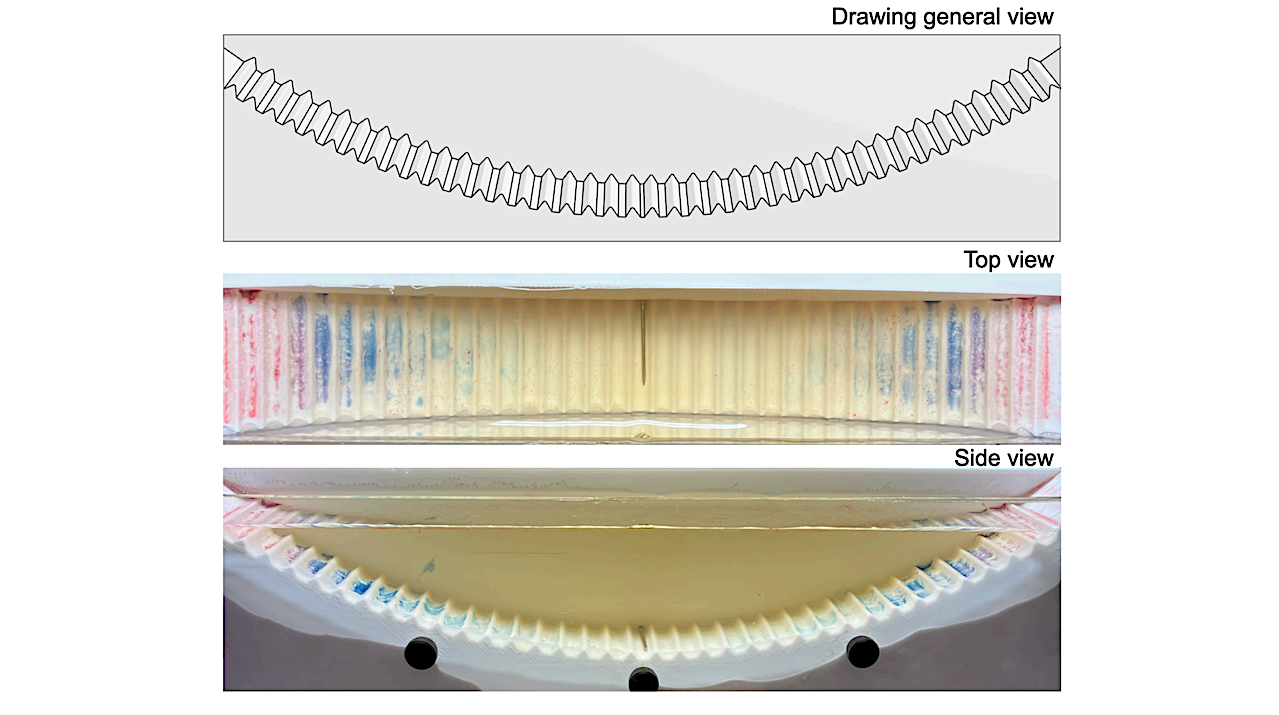
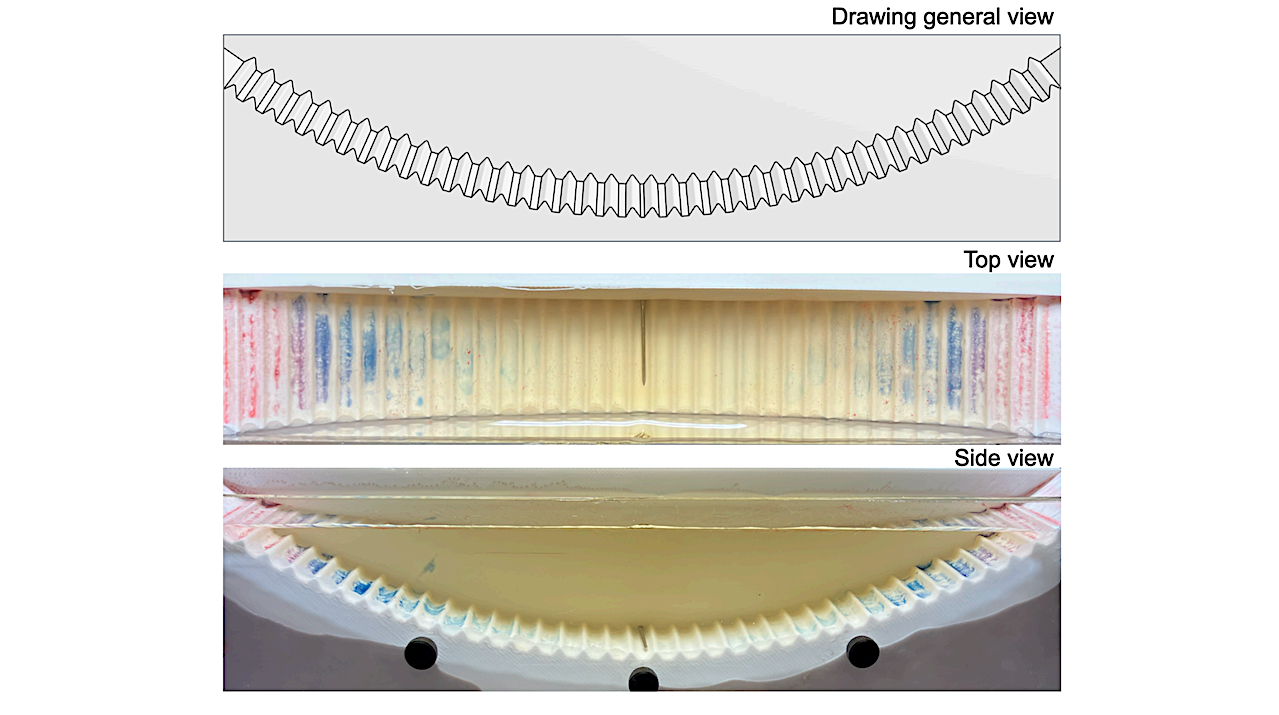
Illustration of liposome protection from UV. The top panel shows a drawing of the crater. The top- and sideview photographs show the intensity distribution of the blue color after UV exposure. When subjected to UV radiation, the liposomes go through a color change from the original white to blue, with the color intensity correlated with the level of physical destruction of the liposomes. Furthermore, the liposomes change to red when exposed to high heat. The experiment shows that liposomes located at the edges and not covered by the solution turn to blue and then to red within the first few seconds of UV exposure, likely due to the combined effects of UV and heat emitted from the lamp. Liposomes covered by the solution demonstrate a gradual change of the blue color from deep-blue for those at the edge to less intense and almost transparent, deeper toward the center. Even after more than two hours of UV exposure, the liposomes in the crater’s center stayed intact. — astro-ph.EP
This paper provides experimental and numerical evidence supporting the occurrence of liposome congregation at the floors of meteor craters on Early Earth.
This work builds on our earlier research, which demonstrated that liposomes submerged in a shallow Archean pond are protected from harmful UV radiation.
This protection allows them to survive long enough for autocatalytic replication of amphiphiles and for mutation and selection of assemblies that maximize membrane stability.
For liposomes to fuse, grow, exchange contents and membranes, and divide, they need to establish a population, which means forming a dense conglomerate that enables close physical contact.
The study demonstrates that such a congregation is feasible in bowl-shaped meteor craters on Early Earth, especially under periodic seismic disturbances.
Vladimir M. Subbotin, Benjamin A. Turner, Brian A. Davies, Alric G. Lopez, Gennady Fiksel
Comments: 6 pages, 7 figures
Subjects: Earth and Planetary Astrophysics (astro-ph.EP); Instrumentation and Methods for Astrophysics (astro-ph.IM); Populations and Evolution (q-bio.PE)
Cite as: arXiv:2602.18510 [astro-ph.EP] (or arXiv:2602.18510v1 [astro-ph.EP] for this version)
https://doi.org/10.48550/arXiv.2602.18510
Focus to learn more
Submission history
From: Vladimir Subbotin
[v1] Thu, 19 Feb 2026 01:27:21 UTC (5,503 KB)
https://arxiv.org/abs/2602.18510
Astrobiology,











Related Posts
Stay Informed With the Latest & Most Important News

Advertisement
-
 01Two Black Holes Observed Circling Each Other for the First Time
 -
 02From Polymerization-Enabled Folding and Assembly to Chemical Evolution: Key Processes for Emergence of Functional Polymers in the Origin of Life
 -
 03Astronomy 101: From the Sun and Moon to Wormholes and Warp Drive, Key Theories, Discoveries, and Facts about the Universe (The Adams 101 Series)
 -
 04True Anomaly hires former York Space executive as chief operating officer
 -
 05Φsat-2 begins science phase for AI Earth images
 -
 06Hurricane forecasters are losing 3 key satellites ahead of peak storm season − a meteorologist explains why it matters
 -
 07Binary star systems are complex astronomical objects − a new AI approach could pin down their properties quickly