
Now Reading: Falcon Heavy launches final ViaSat-3 terabit-class satellite
-
01
Falcon Heavy launches final ViaSat-3 terabit-class satellite


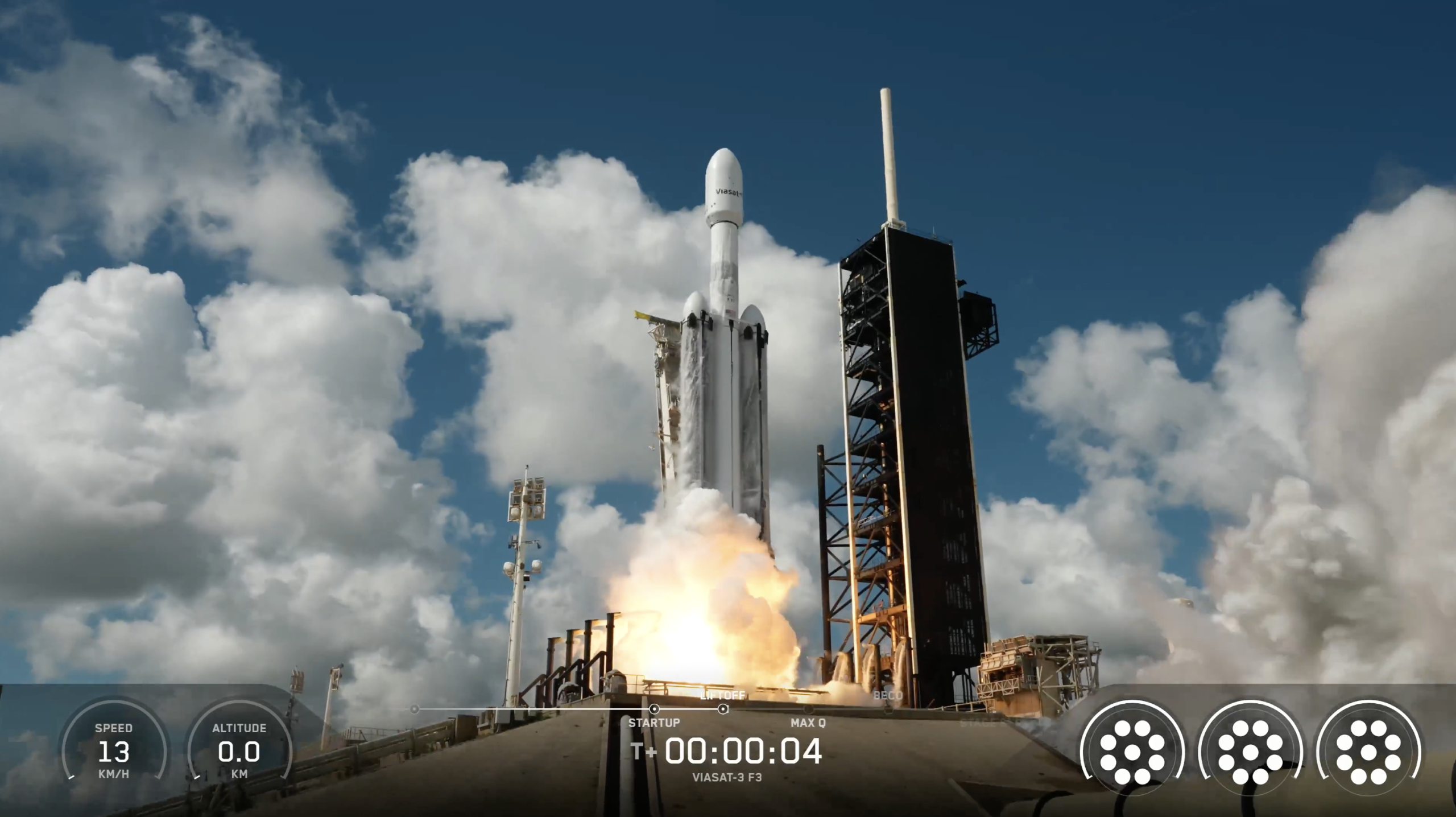

April 29 update: Viasat confirmed initial signal acquisition shortly after the satellite separated from the rocket, just under five hours after liftoff.
TAMPA, Fla. — A SpaceX Falcon Heavy launched the third and final terabit-class ViaSat-3 broadband satellite toward geostationary orbit April 29, putting Viasat on course to finish a constellation more than a decade in the making.
The first flight of a Falcon Heavy in more than 18 months lifted off at 10:13 a.m. Eastern from Kennedy Space Center, Florida, with its two side boosters returning to nearby Cape Canaveral Space Force Station about eight minutes later for reuse.
The roughly 6,400-kilogram ViaSat-3 F3 satellite is due to separate from the rocket nearly five hours after liftoff, then use onboard electric propulsion to reach geostationary orbit over Asia Pacific several months later.
Viasat expects F3 to enter commercial service late summer, following extensive health checks on the operator’s payload and spacecraft bus from Boeing.
“We see a lot of mobility opportunity in Asia Pacific, partly because there’s so much ocean there,” Viasat chairman, CEO and cofounder Mark Dankberg said, pointing to demand across maritime and aeronautic markets in particular, with “more national security business coming.”
Antenna architecture
F3 carries an antenna from L3Harris with a different architecture from the first two ViaSat-3 satellites, which were built with large deployable reflectors from Northrop Grumman.
ViaSat-3 F1 launched on a Falcon Heavy in 2023 but later lost more than 90% of its planned terabit capacity after its reflector failed to deploy properly.
ViaSat-3 F2, launched in November on a United Launch Alliance Atlas 5, has a similar reflector that Viasat modified following the F1 anomaly.
The F2 had initially been slated to cover Europe, the Middle East and Africa, but Viasat moved the satellite to the Americas to help compensate for F1’s reduced capacity.
Dankberg declined to comment beyond Viasat’s April 20 update on F2, when the operator said in-orbit testing was advancing after the satellite successfully completed “bloom,” the stage when its stowed reflector begins unfolding in space, although power constraints from the spring eclipse season had slowed progress.
The company said final deployments are scheduled to be completed over the next several weeks.
ViaSat-3 was originally due to start providing terabit-per-second (Tbps) services in 2019, but production delays, supply chain disruption and the COVID-19 pandemic pushed the first launch to 2023 — only for the antenna deployment failure to wipe out most of that planned capacity.
F3’s antenna is not packed under tension for release in the same way as the first two ViaSat-3 satellites, Dankberg told SpaceNews, enabling it to avoid the bloom step involved in the F1 anomaly.
“It’s deployed under control the entire time,” he said. “It’s a fairly minor difference, but it actually helps a lot with what was the anomaly for F1.”
That meant F3 did not need the same kind of modifications made to F2, although Dankberg said the satellite still took longer than expected because of the extensive testing needed for large deployable antennas.
“We didn’t have to fix anything, but it’s still … fragile technology,” he added.
“In order to avoid those anomalies, often schedule turns out to be the dimension that you trade off — and we don’t want that anymore, so that’s why we’re going into much simpler concepts.”
Following the F1 anomaly, Viasat scrapped plans for a ViaSat-4 as part of a move away from giant deployable antennas and large, expensive geostationary satellites that defined ViaSat-3 and earlier high-throughput spacecraft.
Instead, Dankberg said Viasat is exploring smaller spacecraft that individually deliver less total capacity than a ViaSat-3, but at far lower cost and on faster timelines.
Still, he said next-generation spacecraft will draw on key ViaSat-3 technologies such as beam-forming, spectrum-handling and the ability to follow moving planes and ships with concentrated bandwidth.
“If we could get one tenth of the bandwidth for one tenth of the capital investment, at a third of the deployment time, it’s a big improvement in return on capital,” he said.
“And it also gives us a lot more flexibility to focus the bandwidth … where there’s actual demand.”
He said geostationary orbit still has advantages for Viasat because broadband demand remains concentrated in relatively small parts of the world, although the rise of Starlink and other low Earth orbit (LEO) networks since ViaSat-3 was conceived has transformed the competitive landscape.
That said, the “dimensions of competition” remain largely the same as a decade ago, he added, centered on driving down the cost of airtime while delivering speed in high-density mobility markets.
Global expansion
ViaSat-3 F3 also marks a major global milestone for a business that was until recently heavily weighted toward providing satellite broadband over the Americas.
F2’s redeployment to the Americas delayed an original plan to extend ViaSat-3’s terabit-class coverage beyond the region, although Viasat’s acquisition of Inmarsat in 2023 came with an international fleet of satellites and a global distribution presence across aviation, maritime and government markets.
If F2 and F3 come online as planned, they would bring around 2 Tbps of additional deployable bandwidth, tripling Viasat’s global network capacity after years of supply constraints.
SpaceX was initially due to launch ViaSat-3 F3 April 27, but called off the mission seconds before lift-off because of bad weather.










Related Posts
Stay Informed With the Latest & Most Important News
Previous Post
Next Post

Advertisement
-
 01Two Black Holes Observed Circling Each Other for the First Time
 -
 02From Polymerization-Enabled Folding and Assembly to Chemical Evolution: Key Processes for Emergence of Functional Polymers in the Origin of Life
 -
 03Astronomy 101: From the Sun and Moon to Wormholes and Warp Drive, Key Theories, Discoveries, and Facts about the Universe (The Adams 101 Series)
 -
 04True Anomaly hires former York Space executive as chief operating officer
 -
 05Φsat-2 begins science phase for AI Earth images
 -
 06Hurricane forecasters are losing 3 key satellites ahead of peak storm season − a meteorologist explains why it matters
 -
 07Binary star systems are complex astronomical objects − a new AI approach could pin down their properties quickly