
Now Reading: Gypsum Sustains Microbial Life Under Extreme Conditions – This Could Help Us Study Mars
-
01
Gypsum Sustains Microbial Life Under Extreme Conditions – This Could Help Us Study Mars

Gypsum Sustains Microbial Life Under Extreme Conditions – This Could Help Us Study Mars

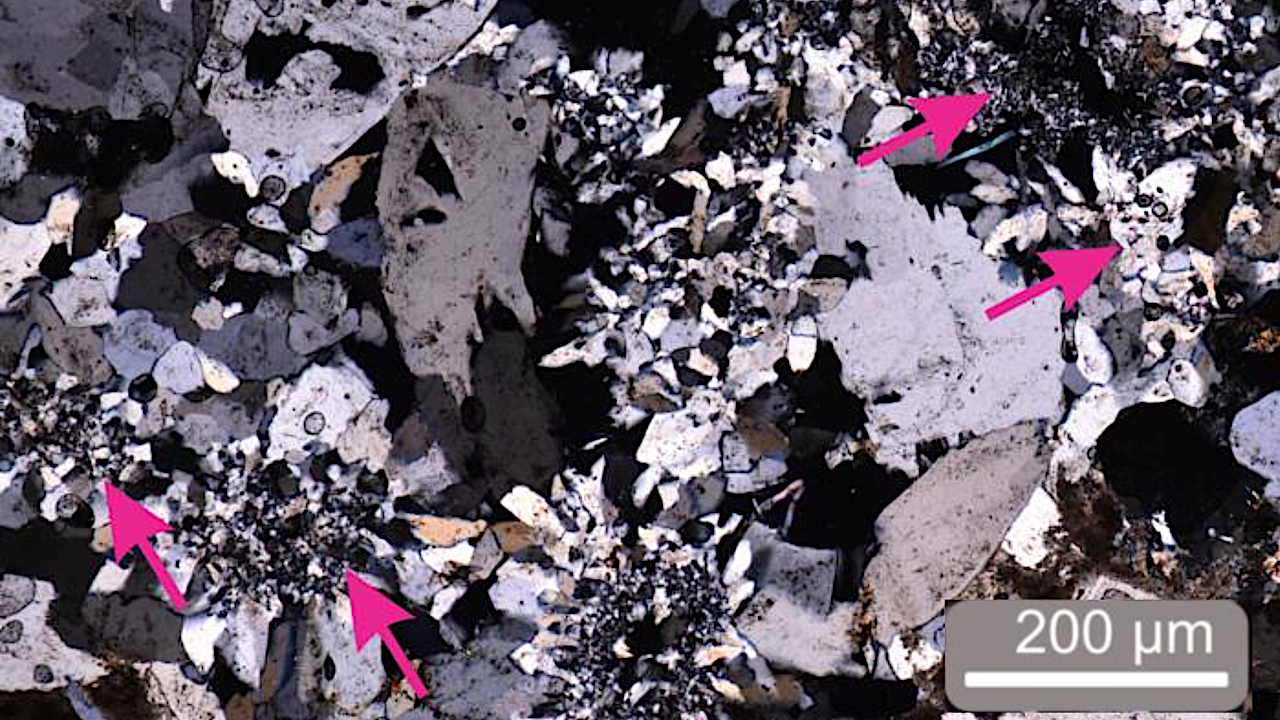
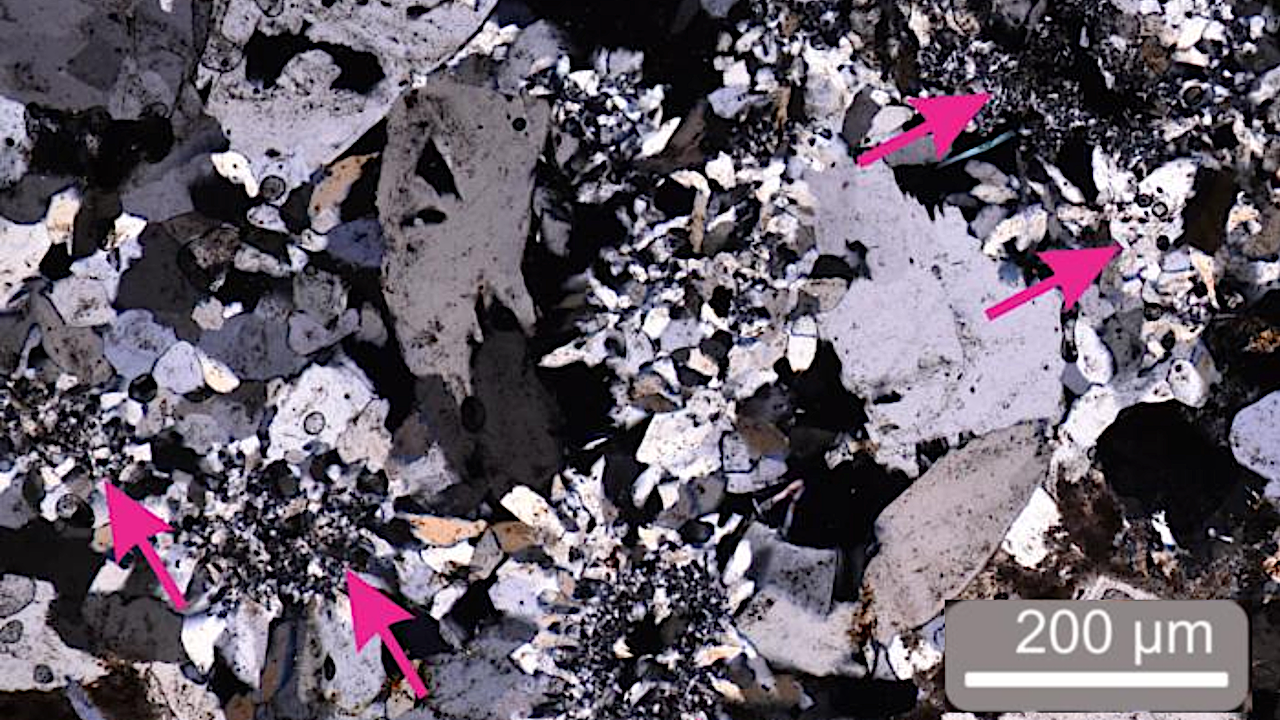
Pink arrows point to spherical, radiating aggregates of gypsum crystals observed in the lower part of stromatolitic sample from Salar de Pajonales in northern Chile. These structures illustrate gypsum mineralization associated with microbial biosignatures. Credit Tebes-Cayo et al., 2026. — Frontiers in Astronomy and Space Sciences
Terraces near Flamencos Lagoon in the southeastern Salar de Pajonales (Chile), located at 3,517 m above sea level in the arid Altiplano, host relic gypsum stromatolites and crusts formed under extreme desiccation, intense solar radiation, and episodic hydration.
These gypsum-rich environments provide a natural analog for Martian evaporitic settings, where habitability and biosignature preservation may coexist. By combining meteorological, geochemical, isotopic, and microbiological data from 19 gypsum-dominated microhabitats, we identified strong environmental controls on mineral formation and microbial community structure.
Climate data confirmed prolonged aridity punctuated by potential short-lived wetting events, which provided conditions favorable for microbial reactivation and long-term biosignature retention within gypsum. Fossil stromatolites exhibited laminated fabrics, micritic filaments, and Fe‒Si-rich laminae, together with diatom frustules, indicating long-term biosignature entrapment.
Microbial diversity varied with mineralogy and moisture availability: stromatolites hosted specialized cyanobacteria and archaea, whereas crusts and sediments contained more diverse photoautotrophic and heterotrophic assemblages. Lipid biomarkers and δ13C signatures indicated active carbon fixation via the Calvin cycle, dominated by cyanobacteria, photoautotrophs, and archaea in gypsum stromatolites and crusts.
Fluorescence signals of chlorophyll a and carotenoids confirmed photosynthetic activity in near-surface layers. In contrast, signatures of the reverse tricarboxylic acid cycle were less common in gypsum samples and were mostly restricted to unconsolidated sediments near the lagoon.
Overall, the gypsum evaporitic systems of the Salar de Pajonales preserve both molecular and morphological biosignatures while sustaining microbial life under extreme conditions.
The spatial separation between fossil and extant signatures underscores gypsum’s exceptional capacity to entomb and protect biological evidence, reinforcing its importance as a prime target for astrobiological exploration on Mars.
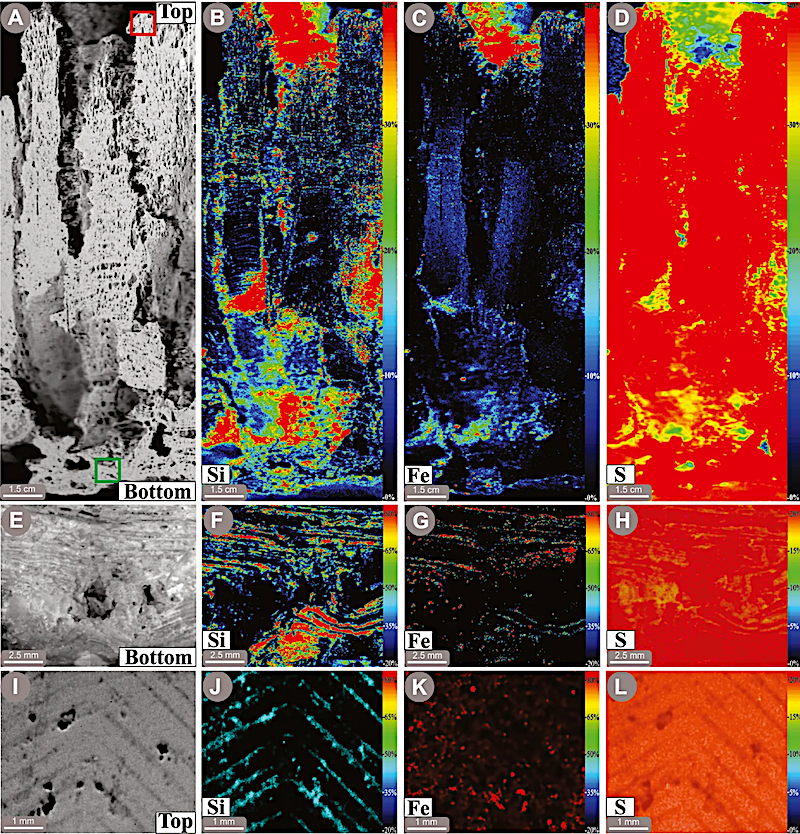
µXRF maps of the entire (A–D), bottom (E–H), and top (I–L) sections of the stromatolitic structure in sample PAJ-15, illustrating the distribution of iron (Fe), silicon (Si), and sulfur (S). The color scale indicates background intensity with blue representing values below the detection limit and red indicating the maximum measured intensity. The map dimensions are 250 μm × 150 μm, and mapping was conducted using incremental steps of 0.5 μm × 0.75 μm. — Frontiers in Astronomy and Space Sciences
Gypsum as a repository of extinct and extant biosignatures at Salar de Pajonales, northern Chile, Frontiers in Astronomy and Space Sciences (open access)
Astrobiology, Astrogeology,










Related Posts
Stay Informed With the Latest & Most Important News
Previous Post
Next Post





Advertisement
-
 01Two Black Holes Observed Circling Each Other for the First Time
 -
 02From Polymerization-Enabled Folding and Assembly to Chemical Evolution: Key Processes for Emergence of Functional Polymers in the Origin of Life
 -
 03Astronomy 101: From the Sun and Moon to Wormholes and Warp Drive, Key Theories, Discoveries, and Facts about the Universe (The Adams 101 Series)
 -
 04True Anomaly hires former York Space executive as chief operating officer
 -
 05Φsat-2 begins science phase for AI Earth images
 -
 06Hurricane forecasters are losing 3 key satellites ahead of peak storm season − a meteorologist explains why it matters
 -
 07Binary star systems are complex astronomical objects − a new AI approach could pin down their properties quickly