
Now Reading: Homogeneous Accretion Of The Earth In The Inner Solar System
-
01
Homogeneous Accretion Of The Earth In The Inner Solar System


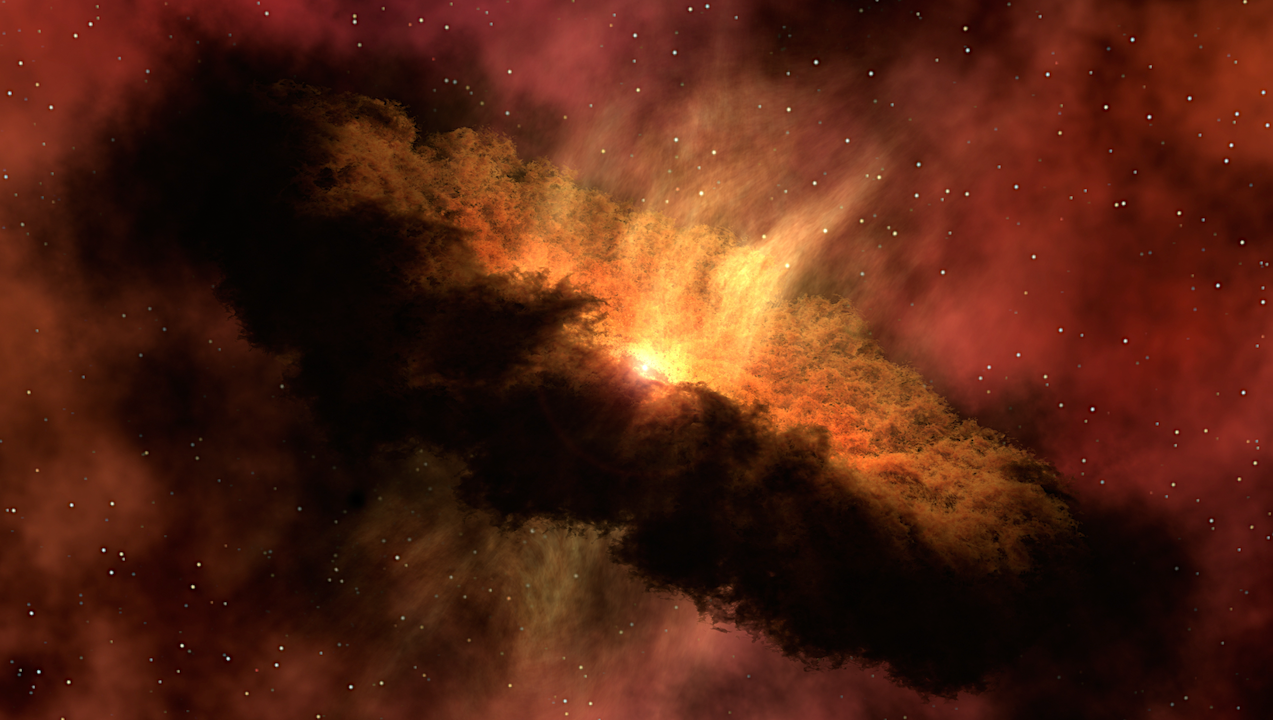
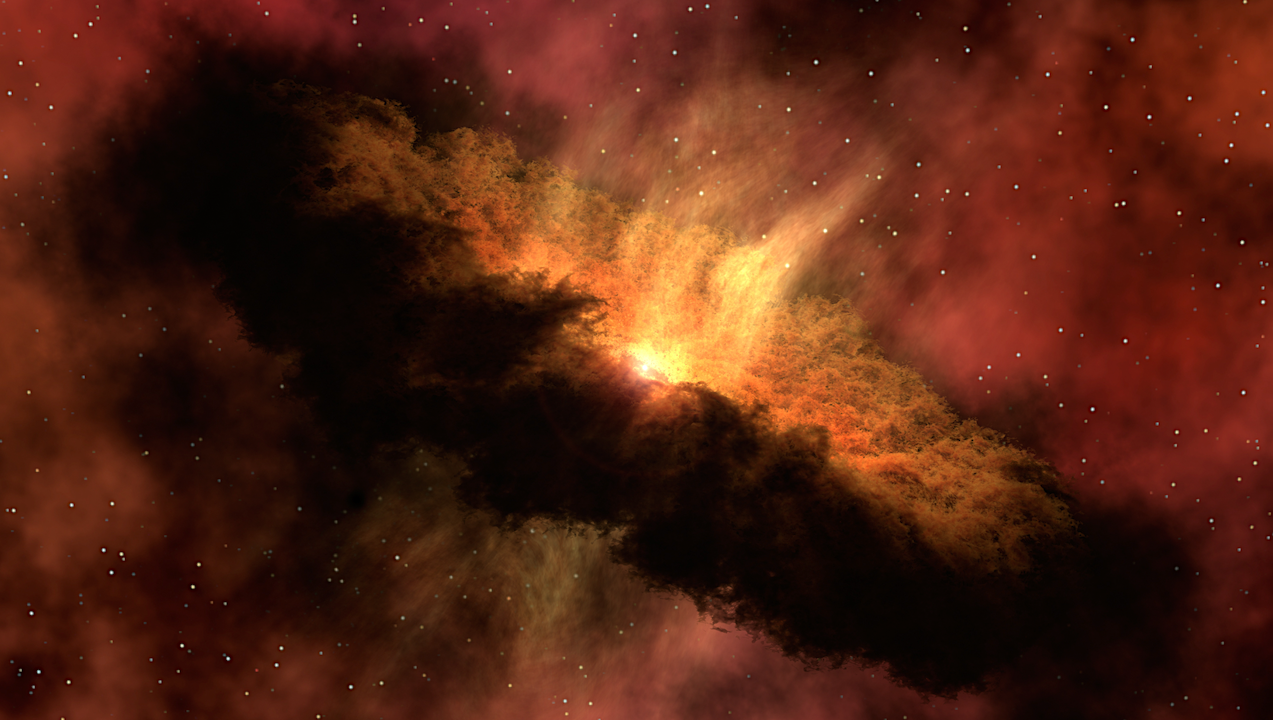
An artist’s concept illustrates a dusty planet-forming disk — NASA
Meteorites are classified as either non-carbonaceous- (NC) or carbonaceous (CC), representing bodies that likely formed in the inner- or outer solar system, respectively. Despite its location in the inner solar system, the Earth is thought to contain either minor- (~6 %) or substantial amounts (~40 %) of outer solar system material.
However, because neither interpretation leverages variations among multiple isotopic systems simultaneously, Earth’s provenance remains equivocal. Here, we examine variations in 10 nucleosynthetic isotope anomalies among planetary- and meteorite parent bodies to show that the linear extension of an array defined by NC bodies in any two isotopic anomalies always intersects the observed isotopic composition of the bulk silicate Earth to within 1 standard deviation.
The Earth therefore formed exclusively from inner solar system material whose composition did not vary over the course of accretion and was, on average, unlike that of any chondrite. Extension of the NC array yields isotopic compositions for Mercury and Venus that are more extreme than for Earth, implying a spatial or temporal gradient during the formation of the terrestrial planets.
Paolo A. Sossi, Dan J. Bower
Comments: Nature Astronomy (2026)
Subjects: Earth and Planetary Astrophysics (astro-ph.EP)
Cite as: arXiv:2604.12039 [astro-ph.EP] (or arXiv:2604.12039v1 [astro-ph.EP] for this version)
https://doi.org/10.48550/arXiv.2604.12039
Focus to learn more
Related DOI:
https://doi.org/10.1038/s41550-026-02824-7
Focus to learn more
Submission history
From: Paolo Sossi
[v1] Mon, 13 Apr 2026 20:27:02 UTC (1,461 KB)
https://arxiv.org/abs/2604.12039
Astrobiology, exoplanet,











Related Posts

Stay Informed With the Latest & Most Important News
Advertisement
-
 01Two Black Holes Observed Circling Each Other for the First Time
 -
 02From Polymerization-Enabled Folding and Assembly to Chemical Evolution: Key Processes for Emergence of Functional Polymers in the Origin of Life
 -
 03Astronomy 101: From the Sun and Moon to Wormholes and Warp Drive, Key Theories, Discoveries, and Facts about the Universe (The Adams 101 Series)
 -
 04True Anomaly hires former York Space executive as chief operating officer
 -
 05Φsat-2 begins science phase for AI Earth images
 -
 06Hurricane forecasters are losing 3 key satellites ahead of peak storm season − a meteorologist explains why it matters
 -
 07Binary star systems are complex astronomical objects − a new AI approach could pin down their properties quickly