
Now Reading: Ice Planet Recon: Glacier Surface Lowering And Subglacial Outflow Coincide With Blood Falls Discharge In The McMurdo Dry Valleys
-
01
Ice Planet Recon: Glacier Surface Lowering And Subglacial Outflow Coincide With Blood Falls Discharge In The McMurdo Dry Valleys

Ice Planet Recon: Glacier Surface Lowering And Subglacial Outflow Coincide With Blood Falls Discharge In The McMurdo Dry Valleys

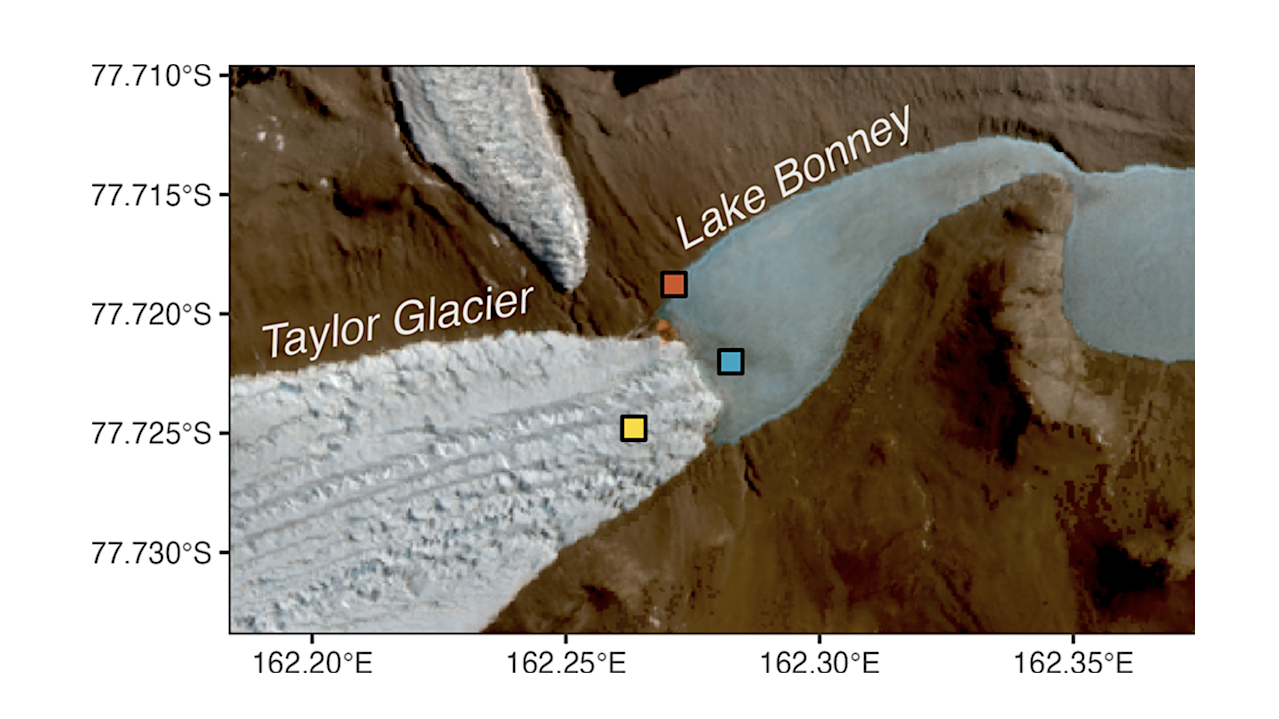
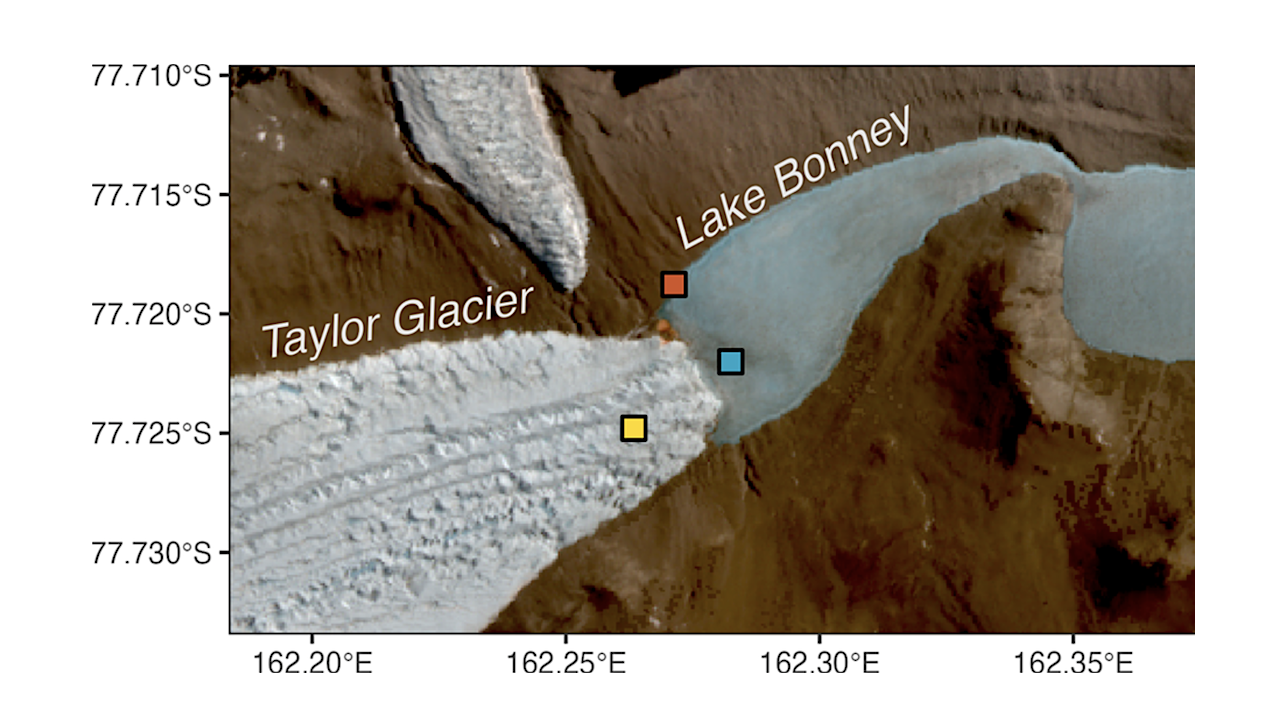
Location of TYLG Global Positioning System (GPS) station (yellow), the in-lake thermistor string (blue) and the time-lapse camera (red). Iron oxide staining of the ice surface from Blood Falls is observable south of the Blood Falls camera. Base imagery: Sentinel−2, 10 m resolution (acquired 18 November 2019), Copernicus/ESA.
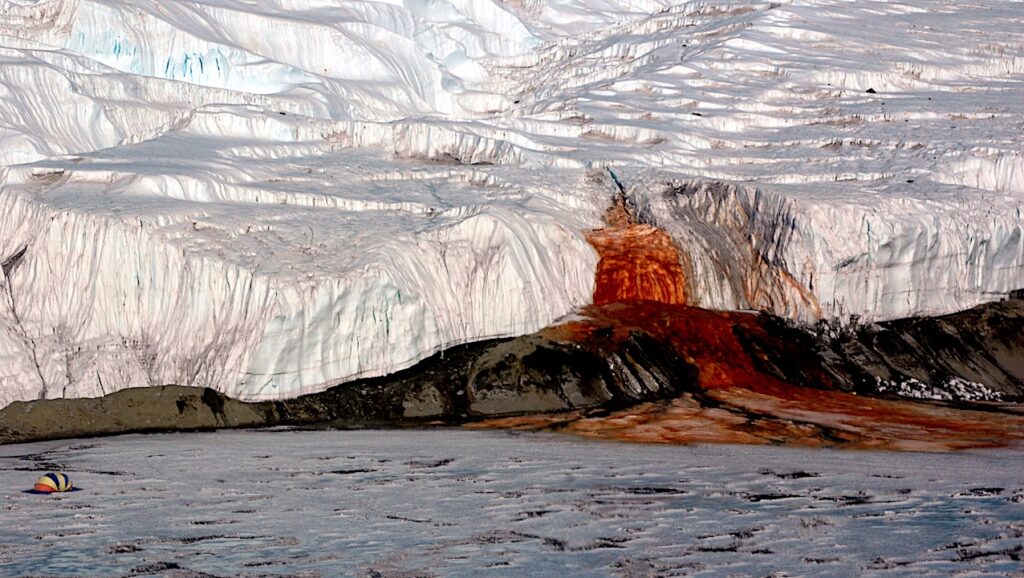
Blood Falls is a unique feature that appears at the snout of the Taylor Glacier in the upper Taylor Valley, East Antarctica.
It is an iron-rich brine that occasionally gets expulsed from a subglacial source due to the weight and movement of the overlying glacier. The brine that emanates stains the glacier as it oxidizes at the surface and flows towards the West Lobe of Lake Bonney (WLB).
Recent work (Spigel et al. 2018, Lawrence et al. 2020) has shown that, besides the Blood Falls contribution, the brine enters the WLB all along the front of Taylor Glacier, creating cold water anomalies at the depth where this subglacial brine’s density is matched by the surrounding lake water.
Mikucki et al. (2015) detected substantial brine at the base of Taylor Glacier using an airborne transient electromagnetic sensor. Badgeley et al. (2017) used radio echo sounding to delineate the brine further and to show that there are subglacial flow pathways that direct the brine to the centre and south side of Taylor Glacier’s snout, in addition to what flows from Blood Falls.
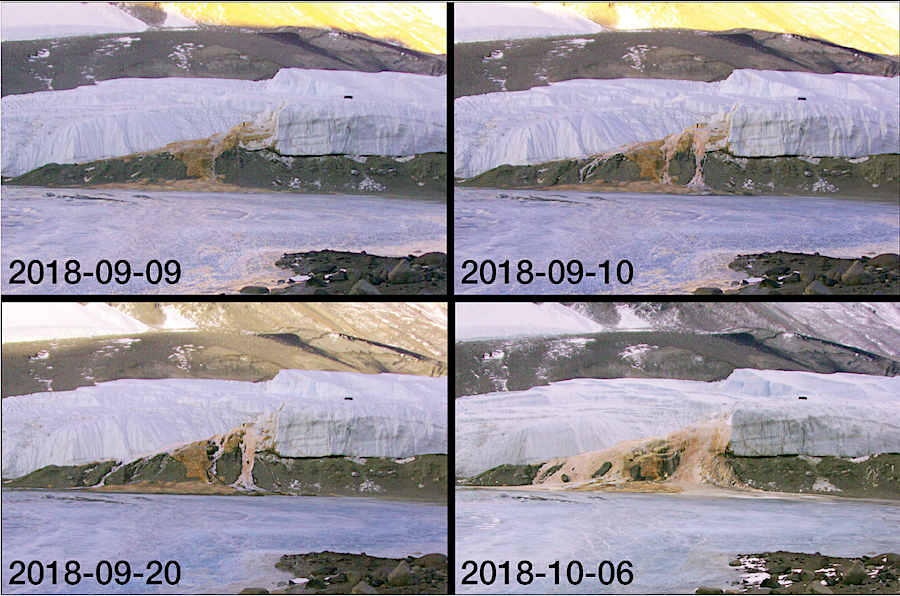
The serendipitous recording of three different datasets provides a rare, coherent signal of a subglacial brine drainage event. These observations demonstrate that an extended brine discharge event, characterized by episodic pulses of brine sourced from beneath Taylor Glacier over ~1 month, reduces subglacial water pressure, which lowers the surface and reduces ice velocity. The GPS elevation data also increase faster before the event than after, potentially indicating how transient pressure buildup beneath Taylor Glacier can periodically open flow pathways and initiate brine outflow to both the glacier surface and proglacial lake. Such events perturb lake temperature stratification and may alter nutrient transport, underscoring the tight coupling between glacier dynamics, subglacial hydrology and ecosystem processes in the McMurdo Dry Valleys. Although limited in spatial resolution by data coming from only a single GPS station, a single time-lapse camera and a single thermistor string, this synchronous record highlights the importance of multi-sensor monitoring for resolving short-lived but high-impact subglacial processes. Continued (and spatially expanded) high-frequency glacial and limnological monitoring will provide a robust dataset capable of enabling the detection of changes in the frequency and magnitude of events driven by long-term environmental change. — Antarctic Science
Doran, P. T., Siegfried, M. R., Dugan, H. A., Hubbard, K. A., & Lawrence, J. P. (2026). Glacier surface lowering and subglacial outflow coincide with Blood Falls discharge in the McMurdo Dry Valleys. Antarctic Science
Astrobiology,










Related Posts

Stay Informed With the Latest & Most Important News
Previous Post
Next Post




Advertisement
-
 01Two Black Holes Observed Circling Each Other for the First Time
 -
 02From Polymerization-Enabled Folding and Assembly to Chemical Evolution: Key Processes for Emergence of Functional Polymers in the Origin of Life
 -
 03Astronomy 101: From the Sun and Moon to Wormholes and Warp Drive, Key Theories, Discoveries, and Facts about the Universe (The Adams 101 Series)
 -
 04True Anomaly hires former York Space executive as chief operating officer
 -
 05Φsat-2 begins science phase for AI Earth images
 -
 06Hurricane forecasters are losing 3 key satellites ahead of peak storm season − a meteorologist explains why it matters
 -
 07Binary star systems are complex astronomical objects − a new AI approach could pin down their properties quickly