
Now Reading: Interstellar turbulence in the Milky Way distorts light
-
01
Interstellar turbulence in the Milky Way distorts light


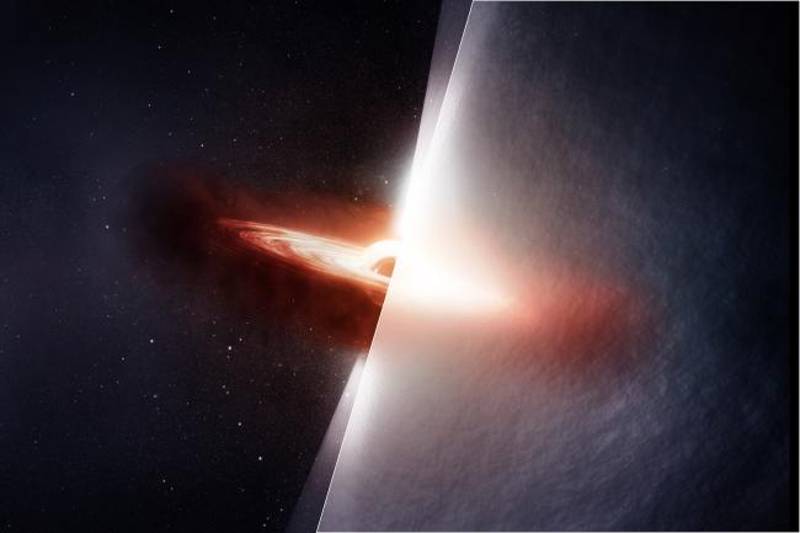
- For the first time, astronomers have directly detected how turbulent gas between stars distorts light.
- These turbulent structures occur at scales roughly the size of our solar system.
- Understanding this distortion could help scientists “de-blur” images of the supermassive black hole at the center of our galaxy, Sagittarius A*.
The Center for Astrophysics published this original article on May 13, 2026. Edits by EarthSky.
Detecting interstellar turbulence
The space between stars in our galaxy, known as the interstellar medium, is churning with clouds of ionized gas and electrons. When waves of light from distant objects pass through this turbulent material, they are bent and distorted in the same way heat haze rising above a fire distorts our view of everything behind it. That distortion has long allowed astronomers to infer that the turbulence exists, but understanding its structure has remained out of reach … until now.
Now, astronomers say they have made the first direct detection of interstellar turbulence distorting light. And they say the findings will help us produce clearer images of the supermassive black hole at the center of the Milky Way Galaxy.
The researchers, led by the Harvard and Smithsonian’s Center for Astrophysics, published their peer-reviewed research in The Astrophysical Journal Letters on May 13, 2026.
An insightful quasar
To measure the interstellar turbulence, astronomers set their sights on quasar TXS 2005+403, a bright radio source powered by a supermassive black hole that is located roughly 10 billion light-years away from Earth, in the constellation Cygnus the Swan.
As radio light from the quasar travels toward Earth, it passes through the Cygnus region of the galaxy. That’s one of the most turbulent and strongly scattering environments in the Milky Way. The turbulence deflects and distorts the radio waves.
Alexander Plavin, an astronomer at the CfA’s Black Hole Initiative and lead author of the new paper, said:
Most of what we see in the radio data isn’t coming from the quasar itself, it’s coming from the scattering caused by the turbulence in this region of the Milky Way. That scattering and the distortions that come with it are what allows us to study the turbulence and better understand and infer its structure.
Imagery revealed light patterns consistent with turbulence
To get a better look at the effects of interstellar turbulence on light from the quasar, scientists analyzed nearly a decade of archival observations from the U.S. National Science Foundation’s Very Long Baseline Array (NSF VLBA). Operated by NSF’s National Radio Astronomy Observatory (NSF NRAO), the NSF VLBA is a network of ten radio telescopes spread across the country.
Scientists expected that when radio light from TXS 2005+403 passed though the Milky Way, it would spread out into a smooth blur and fade away. Instead, they found persistent, distinct patterns, producing structured, patchy distortions in the light that could only have come from turbulence. Pavin said:
The most distant pairs of telescopes should not have seen the quasar image, but to our surprise, they clearly detected its signal, or faint glow.
It can’t be explained by simple blurring or by the quasar itself, and it behaves the way turbulence is expected to, which is how we know we’re seeing the effects of interstellar turbulence.
Plavin added that the scattering properties along this line of sight through the galaxy remain persistent over time.
Understanding how gas behaves in our galaxy
The findings have significant implications for future astronomical research. The turbulence the researchers detected exists at scales roughly the size of our solar system. Understanding it helps explain how energy moves through the galaxy and how gas behaves before collapsing to form new stars.
The findings may also directly inform efforts to sharpen images of black holes. The Event Horizon Telescope’s images of Sagittarius A*, the supermassive black hole at the center of the Milky Way, are degraded by this same interstellar scattering. Studying how turbulence scatters radio light over time and different frequencies provides a path toward removing its effects from those images.
The team has begun a follow-up observing campaign with the NSF VLBA running through 2026. They aim to measure the specific properties of the screen created by this turbulence and track how it changes as the gas moves relative to Earth.
Bottom line: For the first time, astronomers have directly detected how interstellar turbulence distorts the light from distant objects in our galaxy.
Via Harvard and Smithsonian’s Center for Astrophysics
Read more: Why no radio signals from aliens? Is space weather to blame?
The post Interstellar turbulence in the Milky Way distorts light first appeared on EarthSky.










Related Posts
Stay Informed With the Latest & Most Important News


Advertisement
-
 01Two Black Holes Observed Circling Each Other for the First Time
 -
 02From Polymerization-Enabled Folding and Assembly to Chemical Evolution: Key Processes for Emergence of Functional Polymers in the Origin of Life
 -
 03Astronomy 101: From the Sun and Moon to Wormholes and Warp Drive, Key Theories, Discoveries, and Facts about the Universe (The Adams 101 Series)
 -
 04True Anomaly hires former York Space executive as chief operating officer
 -
 05Φsat-2 begins science phase for AI Earth images
 -
 06Hurricane forecasters are losing 3 key satellites ahead of peak storm season − a meteorologist explains why it matters
 -
 07Binary star systems are complex astronomical objects − a new AI approach could pin down their properties quickly