
Now Reading: Intuitive Machines to buy ground station company
-
01
Intuitive Machines to buy ground station company


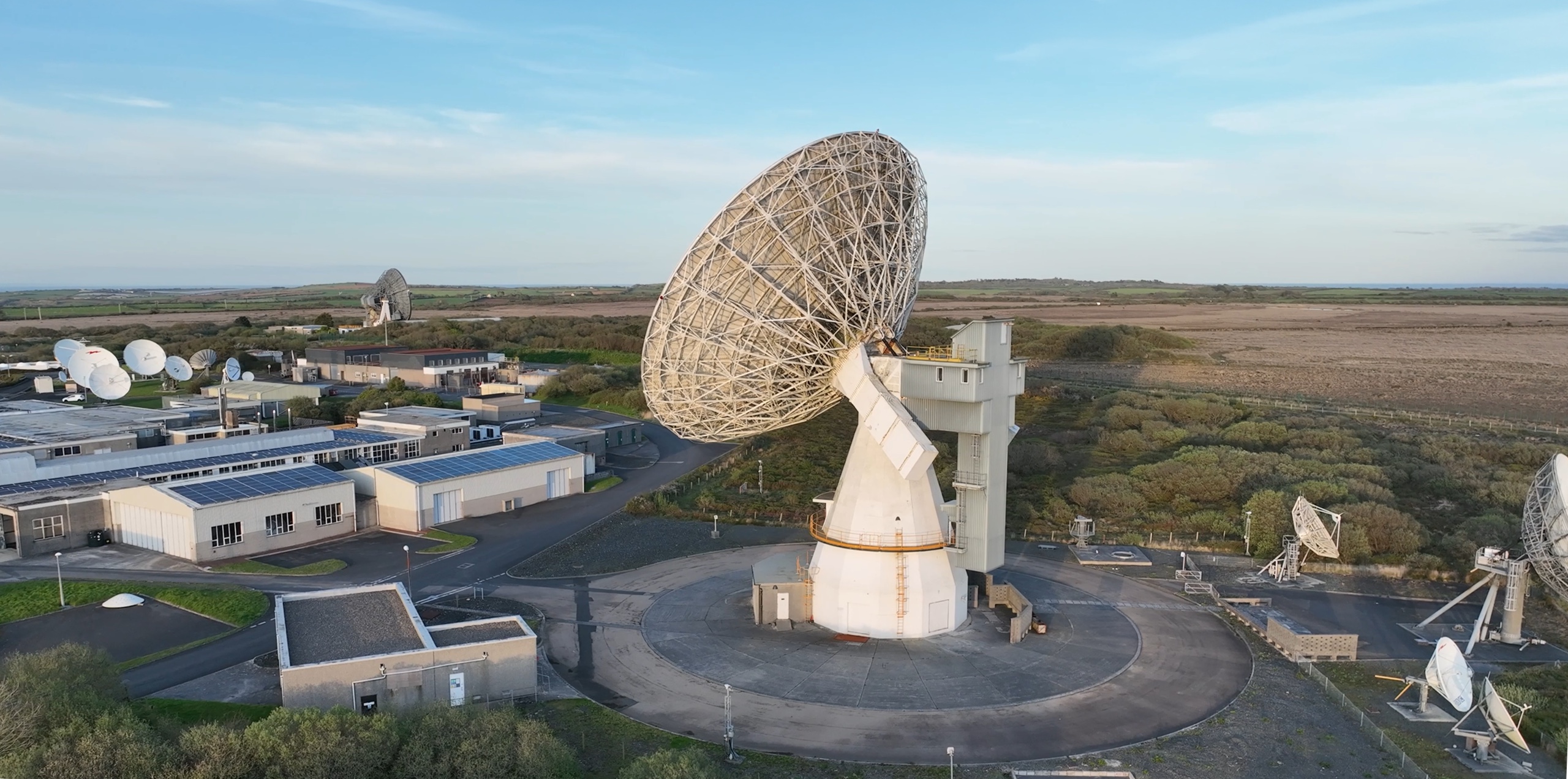

WASHINGTON — Intuitive Machines has agreed to purchase a company that operates ground stations in the United States and United Kingdom to help build out a lunar communications network.
Intuitive Machines announced May 14 that it entered into an agreement to acquire Goonhilly Earth Station Ltd. and its American subsidiary, Comsat. Intuitive Machines will pay 37 million pounds ($49.6 million) for Goonhilly, split equally between cash and stock, according to a Securities and Exchange Commission filing. The deal is expected to close in the third quarter pending regulatory approvals in the U.S. and U.K.
Goonhilly operates a ground station in Cornwall, England, that includes 30- and 32-meter antennas that have been used for lunar and deep-space communications. Through Comsat, it operates teleports in Southbury, Connecticut, and Santa Paula, California, that have dozens of antennas.
In a May 14 earnings call to discuss Intuitive Machines’ first-quarter financial results, Chief Executive Steve Altemus noted the company had been working with Goonhilly for several years, including support for its IM-1 and IM-2 lunar lander missions.
“They have been instrumental partners with us in our success to the moon, and it only made sense to broaden our relationship and integrate it, and set them up as the leader of our global ground segment,” he said.
Goonhilly provides only modest additional revenue for Intuitive Machines: about $14 million annually, Altemus estimated. However, he said it offers prospects of “incredible growth” by integrating it into Intuitive’s communications network, which includes both ground stations and a series of satellites it plans to start deploying around the moon with its next lunar lander mission.
“It will add deep-space-qualified assets and strengthen our ability to offer customers an integrated and reliable space-to-ground network for communications, data relay and position, navigation and timing,” he said.
“We believe customers want less friction in their mission architecture. They want a single, resilient, interoperable network that can help them communicate with, navigate and control spacecraft across low Earth orbit, lunar orbit and cislunar environments,” he said. “With Goonhilly, we are expanding our ability to provide that service now and scale it in parallel with demand.”
Altemus added that Goonhilly’s U.K. presence will also enable Intuitive Machines to pursue contracting opportunities with the European Space Agency. “So, all around, just a perfect fit,” he said.
New Artemis opportunities
Altemus emphasized other opportunities for the company offered by NASA’s revised approach to Artemis unveiled at its Ignition event March 24. Among them are plans for a much higher cadence of lunar lander missions.
He said the company has responded to a new Commercial Lunar Payload Services (CLPS) task order, designated CS-8, that was issued during Ignition. Unlike previous task orders, which were for a single lander, he suggested this one could select multiple landers.
“We put in a CS-8 proposal, which could select one, two or three lunar landers out of a single proposal and multiple awards,” he said. NASA does not release the task orders beyond the companies that are part of the CLPS contract.
Altemus said Intuitive Machines was prepared to increase the production rate of landers, using the capabilities of Lanteris Space Systems, the former Maxar Space Systems that Intuitive acquired last November.
“Leveraging the production capability of Lanteris, coupled with Intuitive Machines, gives us the ability to produce multiple landers in 24-month cycles at a time in parallel,” he said.
He said the company also expects to hear by the end of next week on its revised proposal for the Lunar Terrain Vehicle (LTV) program. At Ignition, NASA announced it asked the three companies participating in the program — Astrolab, Intuitive Machines and Lunar Outpost — to submit revised proposals for simpler rovers that could be built faster.
“We have rapidly aligned our proposal with NASA’s updated requirements through crewed and uncrewed mobility systems,” he said. “These vehicles are designed around the principles Ignition now demands: speed, survivability, repeatable production, autonomous and crewed operations, and persistent communications and navigation across the lunar south pole environment.”
He added the company also welcomed NASA’s decision to repurpose the lunar Gateway’s Power and Propulsion Element, built by Lanteris, for use in a nuclear electric propulsion demonstration mission called Space Reactor 1 Freedom, launching as soon as the end of 2028.
“We are committed to NASA’s vision of repurposing this incredible spacecraft to serve as the centerpiece of the U.S. flagship mission to Mars, the SR-1 Freedom,” he said, “helping repurpose proven spaceflight hardware for the next phase of exploration to Mars.”










Related Posts

Stay Informed With the Latest & Most Important News


Advertisement
-
 01Two Black Holes Observed Circling Each Other for the First Time
 -
 02From Polymerization-Enabled Folding and Assembly to Chemical Evolution: Key Processes for Emergence of Functional Polymers in the Origin of Life
 -
 03Astronomy 101: From the Sun and Moon to Wormholes and Warp Drive, Key Theories, Discoveries, and Facts about the Universe (The Adams 101 Series)
 -
 04True Anomaly hires former York Space executive as chief operating officer
 -
 05Φsat-2 begins science phase for AI Earth images
 -
 06Hurricane forecasters are losing 3 key satellites ahead of peak storm season − a meteorologist explains why it matters
 -
 07Binary star systems are complex astronomical objects − a new AI approach could pin down their properties quickly