
Now Reading: Investigation Of Venus’ Thermal History, Crustal Evolution, And Core Dynamics With A Coupled Interior-lithosphere-atmosphere Model
-
01
Investigation Of Venus’ Thermal History, Crustal Evolution, And Core Dynamics With A Coupled Interior-lithosphere-atmosphere Model

Investigation Of Venus’ Thermal History, Crustal Evolution, And Core Dynamics With A Coupled Interior-lithosphere-atmosphere Model

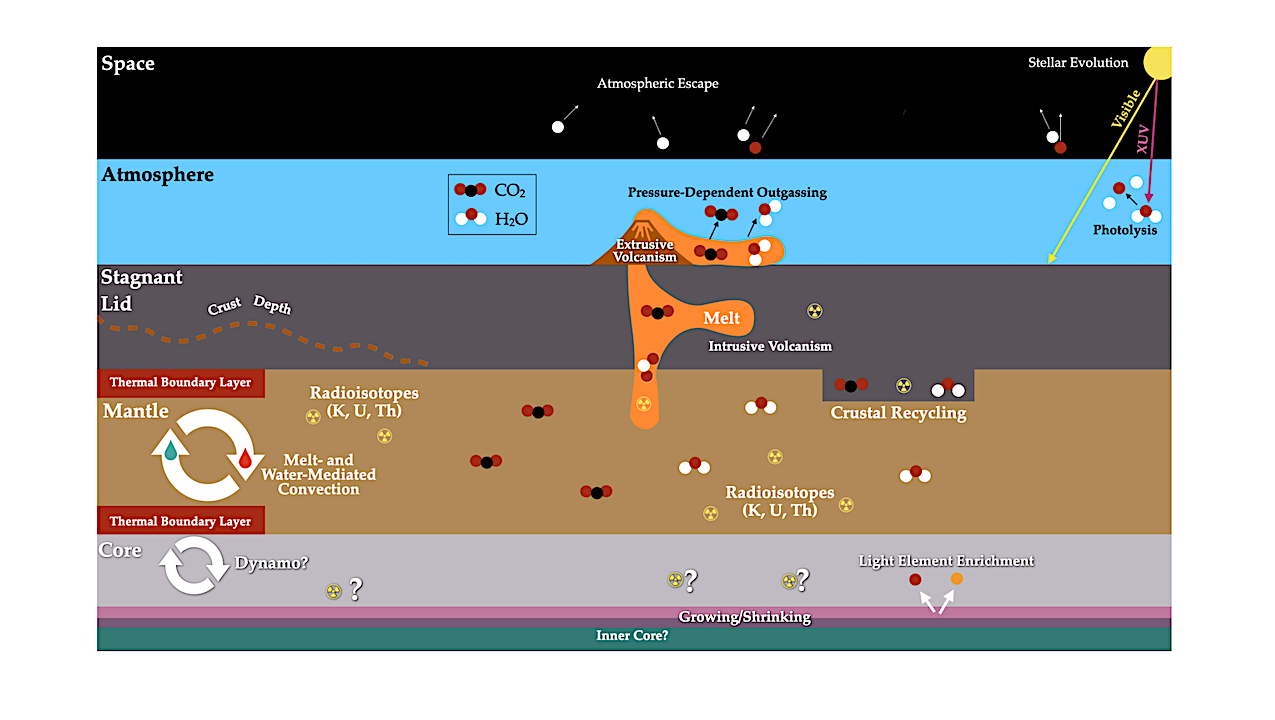

Illustration of the processes implemented in our model. Mantle convection is lubricated via the presence of water and melt; the vigor of the viscosity thus sets the boundary of the non-adiabatic thermal boundary layer and above that the conductive stagnant lid lithosphere, which consists of both a mantle and crust layer. Melting in the mantle transports radioisotopes and volatiles to the crust and atmosphere, where water is photolyzed and escapes. Radioisotopes and volatiles trapped in the crust due to intrusive volcanism are recycled back into the mantle through crustal delamination. The core is potentially heated by radioisotopes and cooled by convection with a vigor controlled by the temperature differential between the core-mantle boundary and the lower mantle. A cool enough core could potentially result in inner-core solidification, which, together with high enough convective vigor, can result in the generation of a core dynamo and planetary magnetic field. As the core solidifies, the outer core is enriched in light elements, resulting in a decrease in the outer core liquidus temperature. — astro-ph.EP
We simulate Venus’ evolution with a coupled one-dimensional solar-atmosphere-lithosphere-mantle-core model to predict currently unobservable features and its eruptive mass flux.
We identified four distinct evolutionary pathways that simultaneously match the atmospheric abundances of water and carbon dioxide as well as the lack of a core dynamo. These scenarios are characterized by I) generally monotonic cooling, II) a low mantle melt fraction in which Venus’ volcanically active phase is ending, III) a small inner core, and IV) oscillations of internal properties.
Through random forest classification we determined that the key parameters that distinguish these types are the initial mantle water abundance, the mantle viscosity, the dehydration stiffening strength, the eruption efficiency, and the melting point of the core.
In each of the plausible histories, Venus retains at least one Earth ocean’s worth of water in its mantle and remains volcanically active today. Venus’ lack of a current geodynamo allows thermal histories with an initially large inner core in our parameter sweep.
In 88% of plausible histories we found that Venus possessed a past magnetic field. The results strongly disfavor recent high eruption rate estimates, but are consistent with lower estimates. Current resurfacing estimates also strongly disfavor the low melt scenario, implying that Venus is not nearly volcanically “dead.”
These predictions are testable with anticipated data and the model can be applied to exoplanets to predict their properties.
Rodolfo Garcia, Rory Barnes, Peter E. Driscoll, Victoria S. Meadows, Megan Gialluca
Comments: 60 pages, 30 figures, 11 tables. Accepted to PSJ
Subjects: Earth and Planetary Astrophysics (astro-ph.EP)
Cite as: arXiv:2603.18070 [astro-ph.EP] (or arXiv:2603.18070v1 [astro-ph.EP] for this version)
https://doi.org/10.48550/arXiv.2603.18070
Focus to learn more
Submission history
From: Rodolfo Garcia
[v1] Wed, 18 Mar 2026 04:24:21 UTC (18,517 KB)
https://arxiv.org/abs/2603.18070
Astrobiology, Astrogeology,










Related Posts
Stay Informed With the Latest & Most Important News
Previous Post
Next Post




Advertisement
-
 01Two Black Holes Observed Circling Each Other for the First Time
 -
 02From Polymerization-Enabled Folding and Assembly to Chemical Evolution: Key Processes for Emergence of Functional Polymers in the Origin of Life
 -
 03Astronomy 101: From the Sun and Moon to Wormholes and Warp Drive, Key Theories, Discoveries, and Facts about the Universe (The Adams 101 Series)
 -
 04True Anomaly hires former York Space executive as chief operating officer
 -
 05Φsat-2 begins science phase for AI Earth images
 -
 06Hurricane forecasters are losing 3 key satellites ahead of peak storm season − a meteorologist explains why it matters
 -
 07Binary star systems are complex astronomical objects − a new AI approach could pin down their properties quickly