
Now Reading: Is Venus volcanically active? Big Hawaiian eruption in 2022 could help scientists find out
-
01
Is Venus volcanically active? Big Hawaiian eruption in 2022 could help scientists find out

Is Venus volcanically active? Big Hawaiian eruption in 2022 could help scientists find out

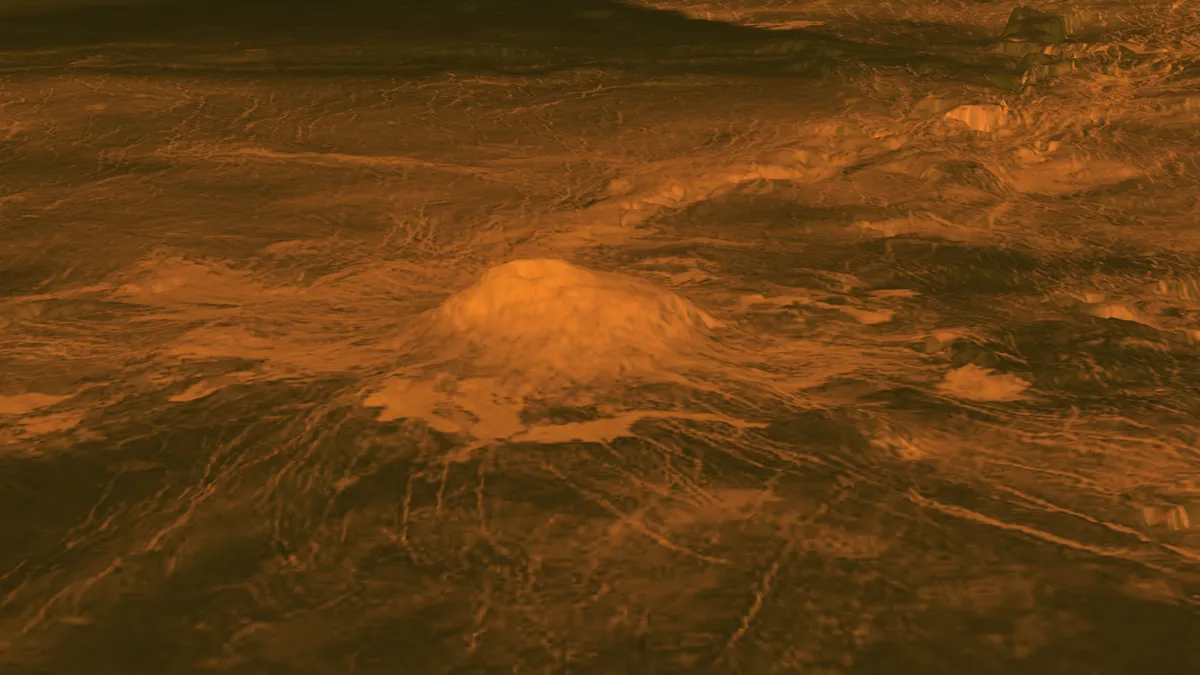
With evidence increasingly showing that volcanism is active on the surface of Venus today, a team of geologists have shown how satellite data intended to help scientists better understand volcanic eruptions on Earth could be applied to lava flows on Venus, too.
The vast majority of Venus has been resurfaced by volcanism over the past half-billion years, and more than 85,000 volcanoes have been identified on the Venusian surface in radar images. It had been thought that this volcanism took place all in one big burst 500 million years ago, but a recent new look at old radar data from NASA’s Magellan mission to Venus in the 1990s has identified what seems to be active volcanism. Additional evidence comes from atmospheric gases (excesses of carbon dioxide, sulfur dioxide and molecular nitrogen), although no direct evidence in the form of volcanic plumes, for example, has been found yet.
“When we search for active lava flows on other planets, knowing how long it takes for lava to cool on Earth will help us better understand what’s happening if we see a hot flow on Venus,” said geologist Ian Flynn of the University of Pittsburgh in a statement.
Flynn’s involvement stems from his work studying Mauna Loa, a volcanic island in Hawaii that is the most active large volcano on Earth, having erupted 34 times since 1843, according to the U.S. Geological Survey. The most recent eruption lasted 13 days in November and December 2022, when lava flows came within 1.7 miles (2.8 kilometers) of the Daniel K. Inouye State Highway 200, also known as Saddle Road, which is a major thoroughfare on the island.
The proximity of the volcano’s lava flows to human activity made monitoring the eruption crucial. Usually scientists use government-funded monitoring satellites to do this, but they are few in number. So Flynn’s colleague Michael Ramsay suggested using data from privately owned satellites, which have been launching into space in great numbers recently.
Flynn was able to monitor the creeping lava flow using the private and public data combined, but its usefulness didn’t stop there. Knowing when a volcano will erupt is the holy grail of vulcanism, but until now geologists have not found the secret of predicting when a volcano will explode.
However, working with Claudia Corradino of the Italian National Institute of Geophysics and Volcanology, Flynn and his colleagues were able to look back at the data leading up to Mauna Loa’s 2022 eruption. By applying machine learning, they noticed a buildup in underground heat one month before the beginning of the eruption.
Why stop there? When looking down at an eruption from low Earth orbit, the observations are presented in flat 2D. Yet the thickness of a lava flow has a large say on how long it flows for and how quickly it cools. So Flynn then teamed up with Shashank Bhushan from NASA’s Goddard Space Flight Center in Maryland. Bhushan had previously measured the thickness of flowing glaciers using data from satellites, and with his expertise they were able to measure the thickness of the Mauna Loa lava flows and turn the data from 2D to 3D.
“Getting visible data helped us understand where it’s going,” said Flynn. “Now we can also generate flow thickness and understand how much material is coming out.”
They found that lava flows thicker than 20 meters (66 feet) took about 21 months to cool.
This information helps tell scientists whether an eruption has just begun or is one the wane, while the cooling rate can also inform us as to the elemental and mineral composition of the lava. This has clear importance for the possibility of identifying lava flows on Venus and wanting to learn their history, and in turn figure out just how volcanically active Venus is today.
“Knowing how lava cools enables scientists to better constrain our models when we find active volcanoes on other planets,” said Flynn.
The findings will appear in the June 2026 issue of the Journal of Volcanology and Geothermal Research.










Related Posts

Stay Informed With the Latest & Most Important News
Previous Post
Next Post



Advertisement
-
 01Two Black Holes Observed Circling Each Other for the First Time
 -
 02From Polymerization-Enabled Folding and Assembly to Chemical Evolution: Key Processes for Emergence of Functional Polymers in the Origin of Life
 -
 03Astronomy 101: From the Sun and Moon to Wormholes and Warp Drive, Key Theories, Discoveries, and Facts about the Universe (The Adams 101 Series)
 -
 04True Anomaly hires former York Space executive as chief operating officer
 -
 05Φsat-2 begins science phase for AI Earth images
 -
 06Hurricane forecasters are losing 3 key satellites ahead of peak storm season − a meteorologist explains why it matters
 -
 07Binary star systems are complex astronomical objects − a new AI approach could pin down their properties quickly