
Now Reading: Live coverage: NASA, SpaceX to launch 34th Cargo Dragon mission to the space station
-
01
Live coverage: NASA, SpaceX to launch 34th Cargo Dragon mission to the space station

Live coverage: NASA, SpaceX to launch 34th Cargo Dragon mission to the space station

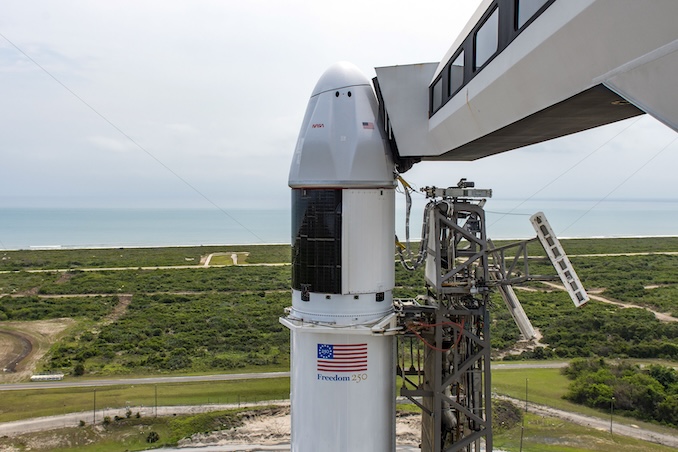
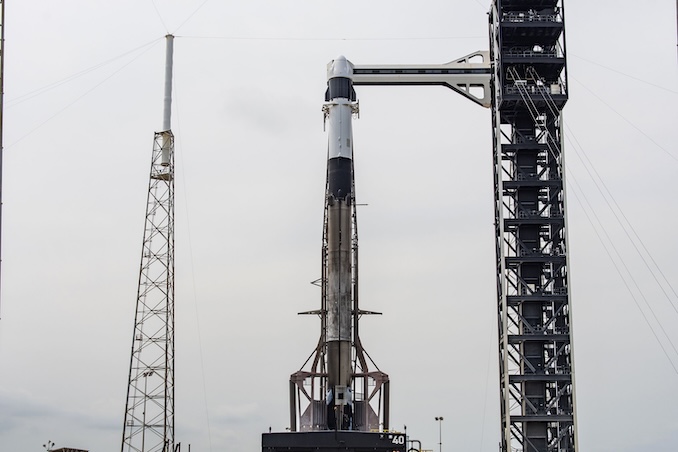
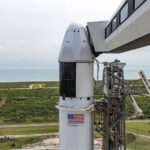
SpaceX is getting ready to launch a Cargo Dragon loaded with 6,500 pounds of science and supplies to the International Space Station from Cape Canaveral Space Force Station on Tuesday evening, weather permitting.
Liftoff of the CRS-34 mission, atop a Falcon 9 rocket from Space Launch Complex 40 (SLC-40), is scheduled for precisely 7:16:31 p.m. EDT (2316:31 UTC), with the rocket flying on a northeasterly trajectory to target a rendezvous with the orbiting space station. SpaceX’s 34th mission for NASA as part of its Commercial Resupply Services (CRS) contracts.
Spaceflight Now will have live coverage beginning about an hour prior to liftoff.
The 45th Weather Squadron forecast a 35 percent chance for acceptable weather on Tuesday evening, thanks to a slow moving front moving across the State of Florida. During a media briefing on Monday, Launch Weather Officer Brian Cizek said that the forecast has been trending worse these past few days.
“The big difference in the forecast that we’ve seen today compared to the last few days is the models are really slowing down the progression of that front moving from north to south,” Cizek said. “So that will help pool more moisture over East Central Florida for tomorrow, which will lead to higher shower and storm coverage tomorrow afternoon into the evening hours.”
He said as the week goes on, there’s a “slight drying trend,” which offers a better outlook on Wednesday and better still on Thursday.
SpaceX will launch the CRS-34 mission using the Falcon 9 first stage booster B1096. This will be its sixth flight following the launches of NASA’s IMAP, GPS III-9, NROL-77, Kuiper Falcon 01, and Starlink Group 6-87.
Less than eight minutes after liftoff, B1096 will return for a touchdown at Landing Zone 40 (LZ-40) adjacent to the launch pad at SLC-40. This will be the fourth booster recovery at this site and the 74th landing across the three pads SpaceX has used since 2015.
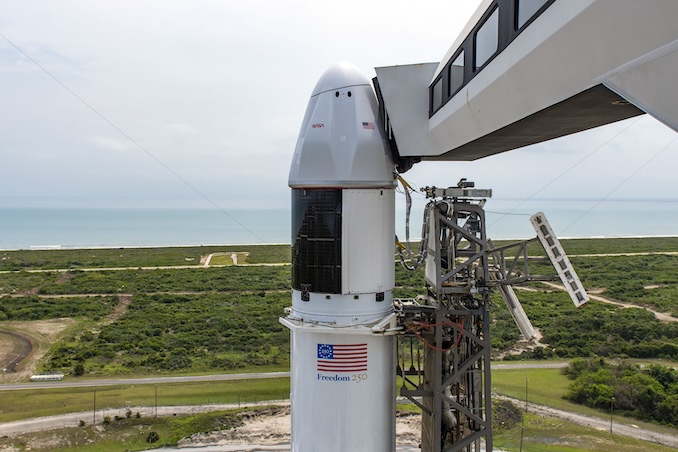
This will also be the sixth flight for the Cargo Dragon spacecraft, serial number C209. It launched the CRS-22, -24, -27, -30, and -32 missions. This is the first time that a Cargo Dragon spacecraft will launch for a sixth time, but the second for the Dragon-2 program overall. The Crew Dragon Endeavour has already flown for a sixth time.
“We completed similar life extension qualification for the crew vehicles, reviewing all hardware components across the vehicle, and ensuring we had at least six-flight qualification rationale for the crew capsule,” said Lee Echerd, SpaceX’s senior mission manager for its Government and Commercial Mission Management division.
“And then for the cargo qualification for this flight, it was essentially a delta certification with looking at the hardware items that are unique to the cargo configuration and completing a similar at least 6x qualification for for this mission.”
Cargo Dragon will separate from the Falcon 9 second stage about 9.5 minutes into the mission, kicking off a nearly 50-hour period during which the spacecraft plays catch up with the ISS. It’s set to dock with the orbiting outpost at about 9:50 a.m. EDT (1350 UTC) on Thursday, May 14).
M+40: So what is it like to load a space cargo vehicle? It’s not too different from what you would do to pack for a move or ship a lot of cargo. It reminds me of building pallets before deployments.
First, we work off a synchronized checklist that our amazing @NASA inventory… pic.twitter.com/WQ40LaR3As
— Jonny Kim (@JonnyKimUSA) May 22, 2025
Busy year in LEO
The arrival of the newest cargo spacecraft comes about two weeks before the next scheduled spacewalk on the Russian segment of the ISS.
Over the summer, there are spacewalks on the U.S. side scheduled in June and August. Between those, on July 14, the Soyuz MS-29 mission is scheduled to launch from the Baikonur Cosmodrome, carrying Cosmonaut and Commander Pyotr Dubrov, alongside fellow cosmonaut Anna Kikina and NASA astronaut Anil Menon.
Less than two weeks after the arrival of MS-29, MS-28 will depart. Before that happens, NASA astronaut Jessica Meir will become the commander of the space station.
The next crewed Dragon mission will launch in September with the Crew-13 quartet, led by NASA astronaut Jessica Watkins. She becomes the first active NASA astronaut to fly for a second time on a Dragon spacecraft.
The last quarter of the year will include another Cargo Dragon mission and the next Northrop Grumman Cygnus spacecraft.
A lingering question though is whether Boeing’s troubled Starliner spacecraft will make a cargo run to the ISS. NASA previously said it was hoping to fly the spaceship in 2026, without a crew to check the numerous problems encountered during its 2024 flight were resolved.
“Obviously, there’s a process that we go through. We continue to maintain as close to launch readiness as possible on Starliner-1 for all of our other factors that play into it,” said Bill Spetch, operations and integration manager for NASA’s ISS Program, in response to a question from Spaceflight Now on Monday.
“We’re continuing on to investigate the issues that that we saw, and so we’re working very close with our Boeing colleagues on that, and we will end up flying it when it’s ready. Some of that will determine exactly how much notice we have in front of the launch. As you know, our our schedule is pretty busy, but we’re trying to maintain windows where we can go, where we can go fly that.”










Related Posts

Stay Informed With the Latest & Most Important News
Previous Post
Next Post

Advertisement
-
 01Two Black Holes Observed Circling Each Other for the First Time
 -
 02From Polymerization-Enabled Folding and Assembly to Chemical Evolution: Key Processes for Emergence of Functional Polymers in the Origin of Life
 -
 03Astronomy 101: From the Sun and Moon to Wormholes and Warp Drive, Key Theories, Discoveries, and Facts about the Universe (The Adams 101 Series)
 -
 04True Anomaly hires former York Space executive as chief operating officer
 -
 05Φsat-2 begins science phase for AI Earth images
 -
 06Hurricane forecasters are losing 3 key satellites ahead of peak storm season − a meteorologist explains why it matters
 -
 07Binary star systems are complex astronomical objects − a new AI approach could pin down their properties quickly