
Now Reading: Long-period Transiting Exoplanets: Advances In Detection And Characterization
-
01
Long-period Transiting Exoplanets: Advances In Detection And Characterization


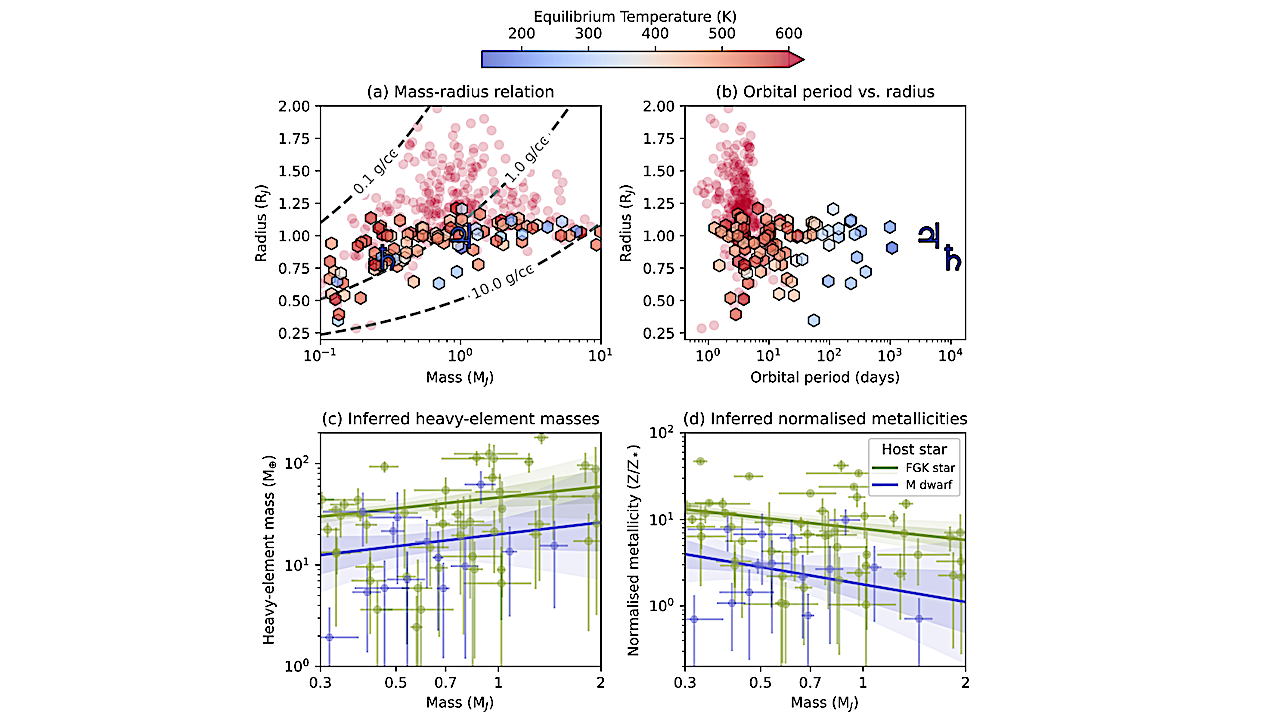
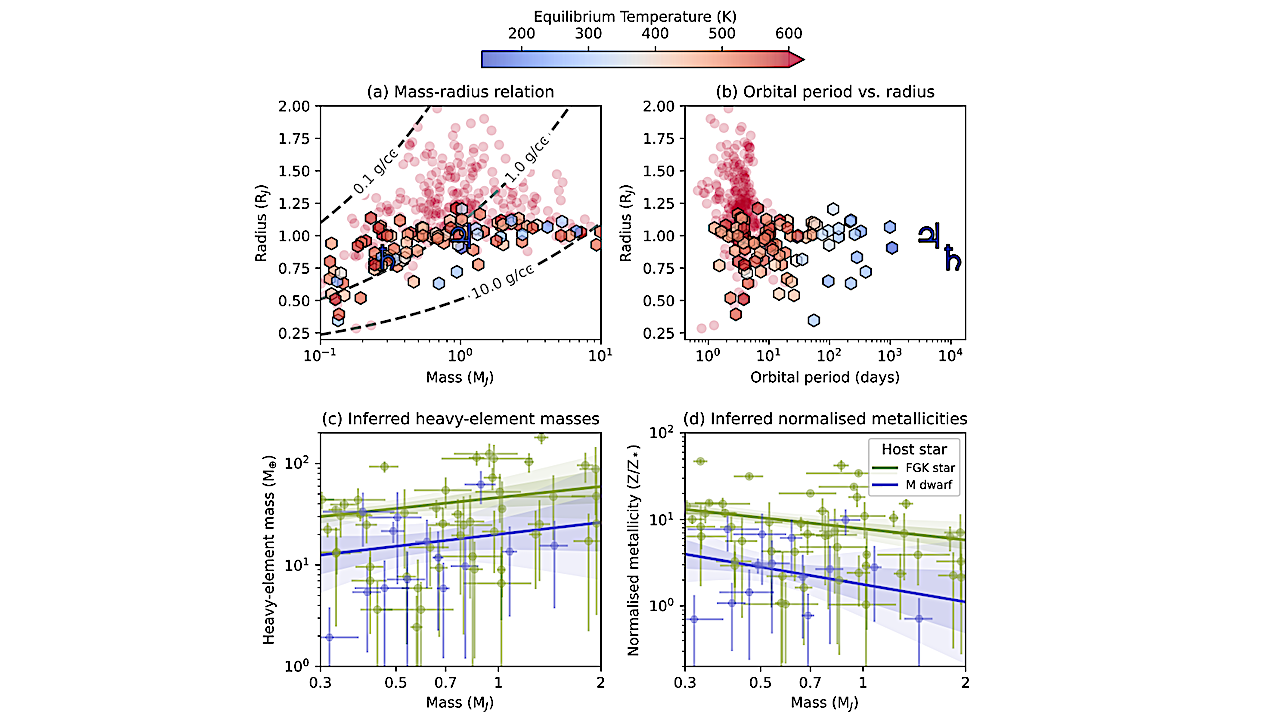
Mass-radius relation (a) and orbital period vs. radius (b) of observed giant exoplanets with masses between 0.1 and 10 M𝐽 . The data is coloured according to the equilibrium temperature. Hexagons show the warm giant exoplanets with 𝑇eq 1000 K, and hot Jupiters are shown as small circles in the background. The mass-radius diagram shows the 0.1, 1 and 10 g/cc isochores for reference. For a comparison, Jupiter (X) and Saturn (Y) are drawn with their respective symbols. Panels (c) and (d) show the inferred relation between the planet mass (between 0.3 and 2 M𝐽 ) and their heavy-element masses and metallicities. The symbols and colours indicate the host-star type: Green circles for FGK stars and blue hexagons for M dwarfs. The lines and shaded regions show the best fit and the 1 to 2 𝜎 contours. The data were taken from the PlanetS catalog (Parc et al. 2024) and M¨uller & Helled (2025). — astro-ph.EP
Most detected transiting planets have orbits which would fit within the one of Mercury, exposing them to intense stellar irradiation and interactions that significantly alter their properties.
In contrast, colder planets with longer orbital periods are less affected, offering crucial insights into their formation and migration histories. Characterizing transiting warm and temperate planets is a key missing piece in the exoplanet puzzle.
Dedicated photometric and spectroscopic follow-up of transiting events detected in space-based photometric data opened the way to detecting long-period transiting exoplanets. The wealth of information available for these transiting planets makes them golden targets for in-depth characterization.
For giant planets, combining precise masses, radii, and ages with state-of-the-art planetary evolution models allows the estimation of their planetary bulk compositions, a crucial element to explore their formation and evolution pathways.
Furthermore, these planets are compelling candidates for hosting moons and circumplanetary rings-features that could illuminate dynamical histories, satellite formation processes, and even potential habitable environments.
Solène Ulmer-Moll, Babatunde Akinsanmi, Simon Müller
Comments: Chapter accepted for publication in the NCCR PlanetS Legacy Book: Benz, W. et al. (Eds), The National Center for Competence in Research, PlanetS: A Swiss-wide network expanding planetary sciences. Springer (2026), 26 pages, 3 figures
Subjects: Earth and Planetary Astrophysics (astro-ph.EP); Instrumentation and Methods for Astrophysics (astro-ph.IM)
Cite as: arXiv:2604.09254 [astro-ph.EP] (or arXiv:2604.09254v1 [astro-ph.EP] for this version)
https://doi.org/10.48550/arXiv.2604.09254
Focus to learn more
Submission history
From: Solène Ulmer-Moll
[v1] Fri, 10 Apr 2026 12:09:10 UTC (908 KB)
https://arxiv.org/abs/2604.09254
Astrobiology, Astronomy, exoplanet,











Related Posts
Stay Informed With the Latest & Most Important News
Previous Post
Next Post


Advertisement
-
 01Two Black Holes Observed Circling Each Other for the First Time
 -
 02From Polymerization-Enabled Folding and Assembly to Chemical Evolution: Key Processes for Emergence of Functional Polymers in the Origin of Life
 -
 03Astronomy 101: From the Sun and Moon to Wormholes and Warp Drive, Key Theories, Discoveries, and Facts about the Universe (The Adams 101 Series)
 -
 04True Anomaly hires former York Space executive as chief operating officer
 -
 05Φsat-2 begins science phase for AI Earth images
 -
 06Hurricane forecasters are losing 3 key satellites ahead of peak storm season − a meteorologist explains why it matters
 -
 07Binary star systems are complex astronomical objects − a new AI approach could pin down their properties quickly