
Now Reading: NATO governance policies need updating
-
01
NATO governance policies need updating


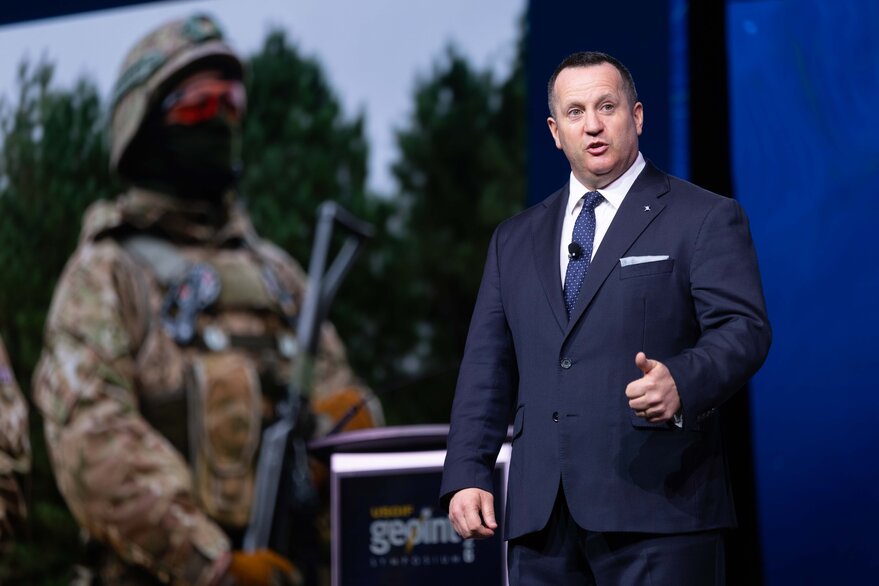

DENVER – NATO must update policies and strengthen relationships among allies to accelerate the fusion of commercial and national geospatial intelligence, Maj. Gen. Paul Lynch, NATO deputy assistant secretary general for intelligence, said May 4 at the GEOINT Symposium.
The war in Ukraine demonstrated the promise of “rapid continuous fusion of national intelligence across 32 allies” with commercial satellite imagery and open-source intelligence “for decision-making in hours, not days,” Lynch said.
When the entire process works well, it produces sophisticated multi-source intelligence, Lynch said. “When it hasn’t worked, the failure has almost never been a collection failure, it’s been an integration one.”
Integration is more complicated than ever due to the expansion of the commercial geospatial industry, which “is now an integral part of the intelligence enterprise, including NATO operations,” Lynch said.
NATO needs standards that enable commercial, national and NATO-partner data processed by AI to contribute to the same operational picture. The new standards should cover metadata, model documentation and “common interfaces that don’t require bespoke integration every time a new partner or new source joins the enterprise,” Lynch said.
Updating policies
NATO decision cycles were not designed to take advantage of the wealth of available data.
“What the operational environment demands now is a framework in which commercial geospatial data, collected, processed and analyzed by industry, can be fused with national imagery, partner data and open-source intelligence and delivered to a commander at the speed of operational need, across 32 national classification systems and a set of legal contractual frameworks that were written before most of those capabilities existed,” Lynch said. “It’s not easy.”
One challenge is updating policies that determine “who can share what, with whom,” under what authority and at what speed, Lynch said.
The National Geospatial-Intelligence Agency’s Luno program, which pairs commercial geospatial imagery with AI-driven analytics, is a promising approach, Lynch said. “The Alliance needs a parallel evolution.”
Without a program like Luno, “commercial data enters NATO intelligence systems, mostly through exceptions and workarounds, not designed pathways,” Lynch said. Redesigning pathways will require modifications to “data-use policies, security-classification guides, contract frameworks and releasability rules.”
Tackling governance issues “may be the highest return on intelligence infrastructure investment NATO makes in the next five years,” Lynch said.
AI complexity
AI-enabled technology further exacerbates the governance challenge because NATO analysts must understand the underlying model, training data, assumptions and confidence threshold.
“The AI interoperability challenge is not simply technical,” Lynch said. “It’s governance and it has an allied dimension. No single nation can solve it.”
“AI-enabled exploitation, imagery analysis, change detection and multi-source fusion is genuinely changing what is possible, reducing the time from collection to action and enabling allies to focus on tasks that require human judgment,” Lynch said.
Fortifying Relationships
NATO allies also need to continue to build relationships through exercises and exchange programs, Lynch said.
Relationships among allies proved essential for NATO intelligence-sharing during the early days of the Russian invasion of Ukraine. “Decisions that should have taken weeks, happened in days,” Lynch said. “Imagery and assessments moved through channels that, on paper, required approvals.”
Intelligence was shared quickly “because of trust, because the people on either end of the data request knew each other,” Lynch said. “They trusted each other’s judgment and understood each other’s constraints well enough to move forward without waiting for the framework to catch up.”
No policy framework can produce those results, Lynch said, “only years of exercises, exchanges and working in the same rooms on less consequential problems produces that.”










Related Posts


Stay Informed With the Latest & Most Important News
Previous Post
Next Post


Advertisement
-
 01Two Black Holes Observed Circling Each Other for the First Time
 -
 02From Polymerization-Enabled Folding and Assembly to Chemical Evolution: Key Processes for Emergence of Functional Polymers in the Origin of Life
 -
 03Astronomy 101: From the Sun and Moon to Wormholes and Warp Drive, Key Theories, Discoveries, and Facts about the Universe (The Adams 101 Series)
 -
 04True Anomaly hires former York Space executive as chief operating officer
 -
 05Φsat-2 begins science phase for AI Earth images
 -
 06Hurricane forecasters are losing 3 key satellites ahead of peak storm season − a meteorologist explains why it matters
 -
 07Binary star systems are complex astronomical objects − a new AI approach could pin down their properties quickly