
Now Reading: New NGA head makes industry debut at GEOINT Symposium 2026
-
01
New NGA head makes industry debut at GEOINT Symposium 2026


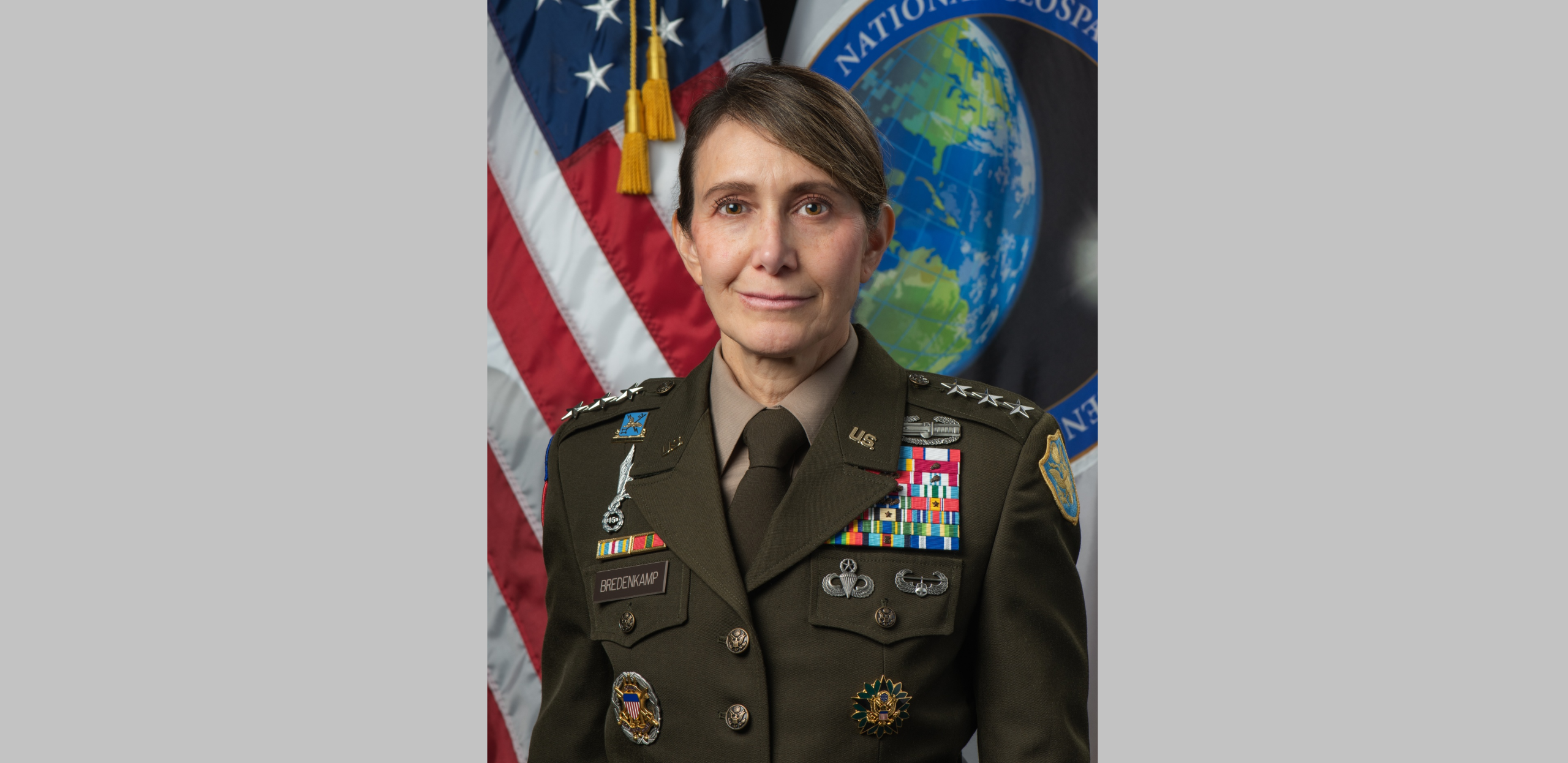

When Lt. Gen. Michele Bredenkamp takes the stage for the closing keynote at GEOINT Wednesday, it will mark her first as the director of the National Geospatial-Intelligence Agency (NGA) — a role she assumed with little fanfare during the government shutdown in November. The appearance will also serve as an opportunity for industry to learn about the agency leader’s new priorities.
“I have personally observed how [geospatial intelligence], delivered by NGA professionals, provided clarity, understanding and increased decision advantage for commanders and policymakers,” Bredenkamp said Nov. 5 during a change-of-directorship ceremony at NGA headquarters. “GEOINT is indispensable today and will continue to be an essential dominant intelligence function.”
Bredenkamp is the ninth director to helm NGA since its inception in 2003. She replaced U.S. Navy Vice Adm. Frank Whitworth, who had served as NGA director since June 2022. The job will position her with senior military and intelligence leadership, coordinating the government’s development and use of geospatial intelligence.
Bredenkamp most recently served as Director of National Intelligence Tulsi Gabbard’s adviser for military affairs at the Office of the Director of National Intelligence, where she oversaw intelligence integration across the Defense Department and the intelligence community. She began her 30 year career in the military in frontline roles in tactical units before assuming leadership roles in intelligence. Bredenkamp also served as director of intelligence for U.S. Forces Korea, served on the Joint Staff at the Pentagon and served as head of U.S. Army Intelligence and Security Command.
With ongoing wars and conflicts around the world, Bredenkamp has had to hit the ground running in the new role.
“For a new director of NGA, the world doesn’t stop,” said Jerry Laurienti, NGA account manager at Leidos. “So, what Gen. Bredenkamp has been focused on [from day one] is mission in a tumultuous world, with multiple battle spaces and combat support that can’t stop and has to evolve fast.”
Luke Fischer, co-founder and CEO of SkyFi, applauded the appointment, citing the depth of Bredenkamp’s military experience. “The GEOINT community has had directors with policy depth, with technical depth, with managerial depth. Operational depth at this level is rarer, and it changes what an agency optimizes for,” he said.
Susanne Hake, executive vice president and general manager of Vantor’s U.S. government business echoed the sentiment, “NGA is a combat support agency and Lt. Gen. Bredenkamp has held several senior command positions directly responsible for making sure warfighters had the actionable intelligence necessary to be mission effective … Her field assignments give her a tremendous amount of operational experience across all the various ‘INTs.’ She knows what works and what more is needed for the U.S. to maintain its intelligence superiority.”
What remains to be seen is whether Bredenkamp can effectively convey the needs of NGA’s customers to NGA’s partners, said Brian Monheiser, vice president of strategic programs at the visual data integration firm Larx. “You can build a hammer that’s looking for a nail, but we all know that’s not going to work,” he said. “What we need from [NGA and the new director] is … an understanding of where they’re at and what they’re doing, and why the things we’re building either are or aren’t a fit for that.”
Laurienti added that the industry is particularly interested in Bredenkamp’s approach to artificial intelligence. “NGA … is leading the charge for intelligence community adoption, but [AI is] moving faster than we’ve ever seen a technological aspect of intelligence move. A lot of industry partners want to see what the key pieces are that NGA will put in place to get ahead and stay ahead.”
To that end, Fischer hopes Bredenkamp will be a director who’s “willing to break some institutional habits” by integrating commercial providers more directly into operational GEOINT workflows. “Lt. Gen. Bredenkamp inherited an agency with enormous talent and serious institutional weight,” he said. “The question is whether she uses that weight to preserve what NGA has always done well, or to accelerate the enterprise toward the speed and scale the next conflict will demand. Her background suggests the latter.”










Related Posts

Stay Informed With the Latest & Most Important News
Previous Post
Next Post


Advertisement
-
 01Two Black Holes Observed Circling Each Other for the First Time
 -
 02From Polymerization-Enabled Folding and Assembly to Chemical Evolution: Key Processes for Emergence of Functional Polymers in the Origin of Life
 -
 03Astronomy 101: From the Sun and Moon to Wormholes and Warp Drive, Key Theories, Discoveries, and Facts about the Universe (The Adams 101 Series)
 -
 04True Anomaly hires former York Space executive as chief operating officer
 -
 05Φsat-2 begins science phase for AI Earth images
 -
 06Hurricane forecasters are losing 3 key satellites ahead of peak storm season − a meteorologist explains why it matters
 -
 07Binary star systems are complex astronomical objects − a new AI approach could pin down their properties quickly