
Now Reading: NordSpace nets Canadian defense funding for VLEO satellite development
-
01
NordSpace nets Canadian defense funding for VLEO satellite development


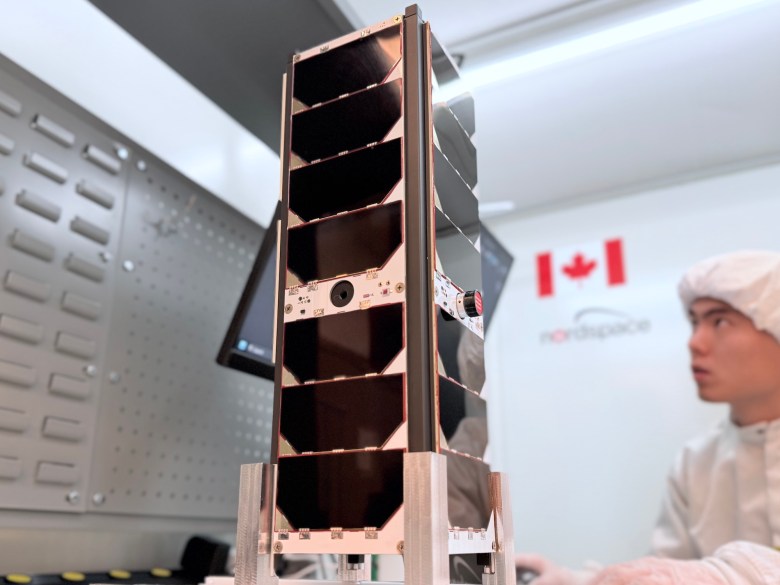
TAMPA, Fla. — NordSpace has secured early defense funding to develop a very low Earth orbit (VLEO) satellite, further broadening the Canadian startup’s push to build sovereign space capabilities beyond launch.
The company announced a one-year contract April 21 worth around $183,000 from Canada’s Department of National Defence to advance conceptual technologies toward hardware tests.
A NordSpace spokesperson said the technologies are critical for a proposed VLEO constellation called Kestrel that it aims to begin deploying from 2028 to provide low-latency, 10-centimeter spatial resolution imaging.
“This is enabled by the much lower orbital altitudes and would be a game changer for defense and civilian applications,” the spokesperson said via email.
“No commercial product offers this resolution today,” the spokesperson added, as U.S.-based Albedo and Redwire pursue similar VLEO capabilities.
Key hurdles for VLEO include maintaining orbit against atmospheric drag and building an architecture that can support rapid satellite replenishment for sustainable operations.
Initial Kestrel designs have a lifespan of around three years before burning up in the atmosphere, compared with about five years typically for satellites in low Earth orbit (LEO). The NordSpace spokesperson said future versions with improved propulsion and station-keeping could remain operational for much longer.
The startup plans to lean on the launch capability it is developing to help replenish VLEO satellites, along with its dedicated spaceport in eastern Canada.
NordSpace’s Tundra orbital rocket is slated to fly for the first time in 2028, while the maiden flight of its suborbital Taiga rocket is due in the coming months.
Entering another orbital regime
Founded in 2022, NordSpace is also preparing to deploy its self-built Terra Nova LEO imaging pathfinder this fall via a SpaceX rideshare mission.
“Terra Nova is testing some of the key technologies we would deploy in our various orbital environments of interest, including VLEO,” the Nordspace spokesperson said.
“It is launching with our own proprietary NVIDIA powered imaging system called Chronos with edge-AI image processing to reduce downlinked data by 100x, and our Zephyr in-space thruster to test station keeping.”

Plans to follow up the pathfinder with a Terra Nova constellation remain under wraps.
Bolstering Canadian sovereignty
Owning orbital launch capability would support broader efforts to strengthen Canada’s sovereign access to space, while reducing NordSpace’s reliance on third-party rideshare missions for constellation replenishment.
“Those same rideshare opportunities, however, are what allow NordSpace to fly and validate its space systems today while we develop our own orbital launch systems,” NordSpace founder and CEO Rahul Goel told SpaceNews.
“This brings our two divisions together in a way that simply wasn’t available to launch startups until very recently, and we’re taking full advantage of building a resilient space missions company today versus 10 or 20 years ago.”
The VLEO funding comes through the Department of National Defence’s Innovation for Defence Excellence and Security (IDEaS) program.
The venture has received more than 10 million Canadian dollars ($7.3 million) in grants so far, mostly from Launch the North, a Canadian defense initiative to boost sovereign launch-related capabilities.
“Larger private capital investments in the company have been contributed by the founder and CEO, as a goal of the company is to achieve orbital flight with minimal dilutive financing,” the spokesperson added.
NordSpace recently also created a venture capital arm to back domestic space companies, including Earth observation operator Wyvern.










Related Posts


Stay Informed With the Latest & Most Important News

Advertisement
-
 01Two Black Holes Observed Circling Each Other for the First Time
 -
 02From Polymerization-Enabled Folding and Assembly to Chemical Evolution: Key Processes for Emergence of Functional Polymers in the Origin of Life
 -
 03Astronomy 101: From the Sun and Moon to Wormholes and Warp Drive, Key Theories, Discoveries, and Facts about the Universe (The Adams 101 Series)
 -
 04True Anomaly hires former York Space executive as chief operating officer
 -
 05Φsat-2 begins science phase for AI Earth images
 -
 06Hurricane forecasters are losing 3 key satellites ahead of peak storm season − a meteorologist explains why it matters
 -
 07Binary star systems are complex astronomical objects − a new AI approach could pin down their properties quickly