
Now Reading: One-dimensional And Time-dependent Modelling Of Complex Organic Molecules In Protostars
-
01
One-dimensional And Time-dependent Modelling Of Complex Organic Molecules In Protostars

One-dimensional And Time-dependent Modelling Of Complex Organic Molecules In Protostars

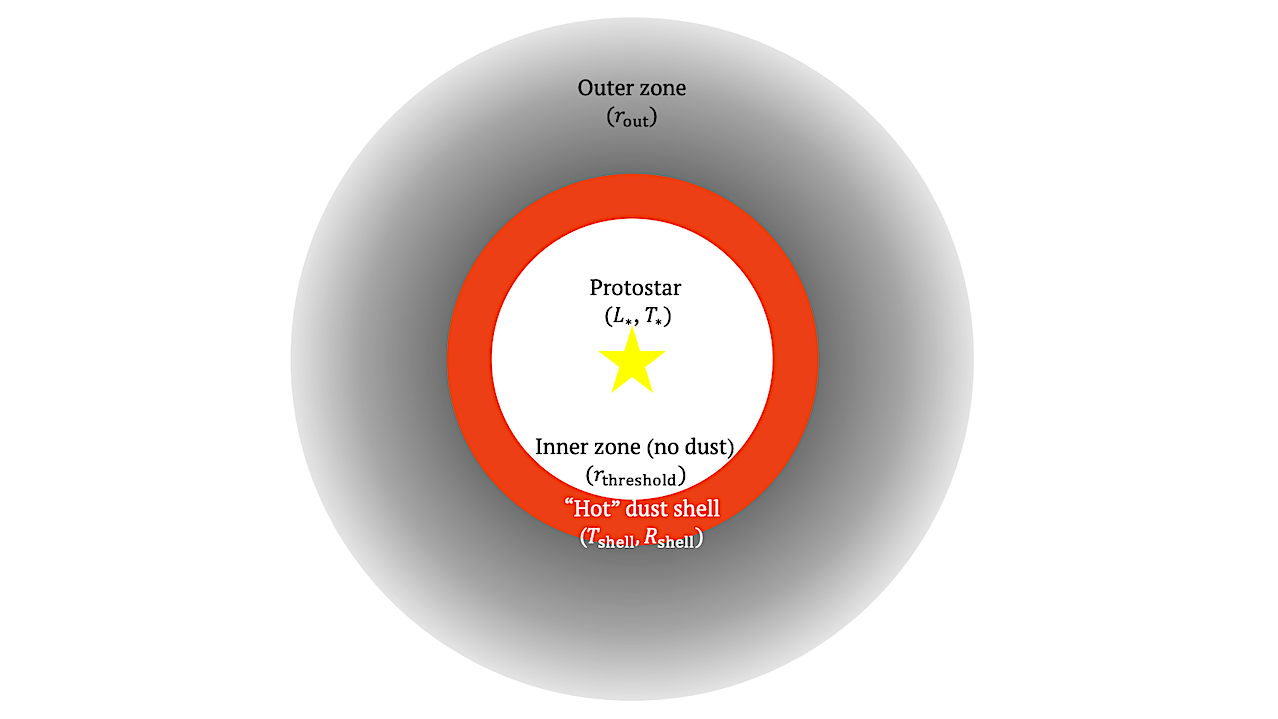

The sketch of the protostellar core adopted in this model, including a central source characterised by the bolometric luminosity (L∗) and the stellar temperature (T∗). The inner zone is characterised by the sublimation threshold of dust grains (Tsub) and the threshold radius (rthreshold). The thin shell of hot dust is determined by the shell temperature (Tshell) and its radius (Rshell). The outer region is given by the outer radius (rout). — astro-ph.GA
Complex organic molecules (COMs), the building blocks of life, have been extensively detected under various physical conditions, from quiescent clouds to star-forming regions.
They therefore serve as excellent tracers for the local physical and chemical properties of these environments. Proper models that are capable of grasping the formation and destruction of COMs are crucial to understanding observations.
However, given that distinct COMs may be detected from different locations and at varying times, we improve UCLCHEM – a gas-grain chemical code – to a one-dimensional, time-dependent model, tailored to protostars. In this update, we examine two stages of a protostar: the prestellar and heating stages, incorporating a simple radiative mechanism for both the internal and external radiation fields of the cloud.
This approach relies on the key assumption that the dust and gas temperatures are completely coupled. Ultimately, we implement an updated version of our model to interpret observations obtained through both single-dish and interferometry under varying conditions, including a SgrB2(N1) hot core, massive Galactic clumps and a hot core in Orion.
We show that our model could reproduce these observations well, highlighting that some COMs are positioned at a higher temperature in the envelope, whereas others are from the lower temperature, potentially leading to misinterpretation when using a single-point model.
In a particular case of SgrB2(N1), the best model indicates that the cosmic-ray ionisation rate significantly exceeds the value typically used for the standard interstellar medium. Our model shows as an efficient computational tool particularly useful for better insights into observations of COMs.
Le Ngoc Tram, Serena Viti, Katarzyna M. Dutkowska, Gijs Vermariën, Tobias Dijkhuis, Audrey Coutens, Timea Csengeri, Thiem Hoang
Comments: 14 pages, 13 figures, 3 tables, accepted to A&A
Subjects: Astrophysics of Galaxies (astro-ph.GA)
Cite as: arXiv:2601.00731 [astro-ph.GA] (or arXiv:2601.00731v1 [astro-ph.GA] for this version)
https://doi.org/10.48550/arXiv.2601.00731
Focus to learn more
Submission history
From: Le Ngoc Tram
[v1] Fri, 2 Jan 2026 16:21:16 UTC (3,585 KB)
https://arxiv.org/abs/2601.00731
Astrobiology, Astrochemistry,










Related Posts
Stay Informed With the Latest & Most Important News
Previous Post
Next Post





Advertisement
-
 01Two Black Holes Observed Circling Each Other for the First Time
 -
 02From Polymerization-Enabled Folding and Assembly to Chemical Evolution: Key Processes for Emergence of Functional Polymers in the Origin of Life
 -
 03Astronomy 101: From the Sun and Moon to Wormholes and Warp Drive, Key Theories, Discoveries, and Facts about the Universe (The Adams 101 Series)
 -
 04True Anomaly hires former York Space executive as chief operating officer
 -
 05Φsat-2 begins science phase for AI Earth images
 -
 06Hurricane forecasters are losing 3 key satellites ahead of peak storm season − a meteorologist explains why it matters
 -
 07Binary star systems are complex astronomical objects − a new AI approach could pin down their properties quickly