
Now Reading: Prebiotic Magnetite Enables Chirality-magnetic Surface Feedback
-
01
Prebiotic Magnetite Enables Chirality-magnetic Surface Feedback


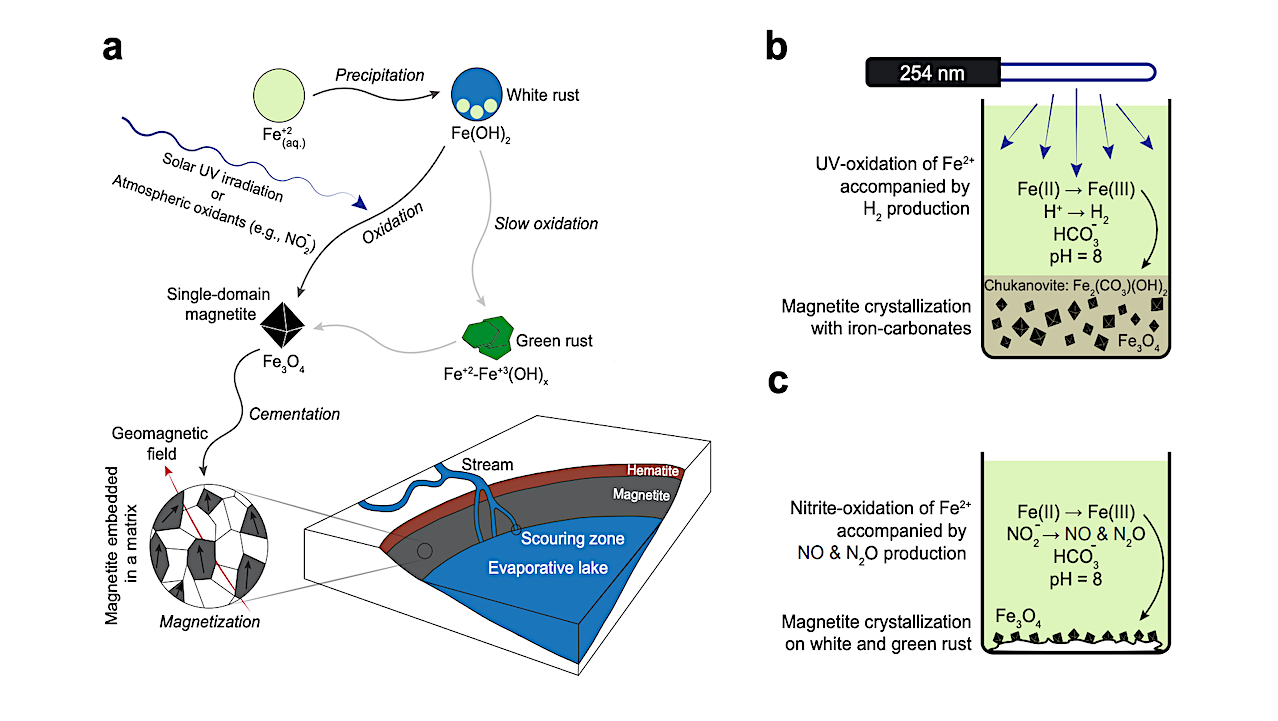
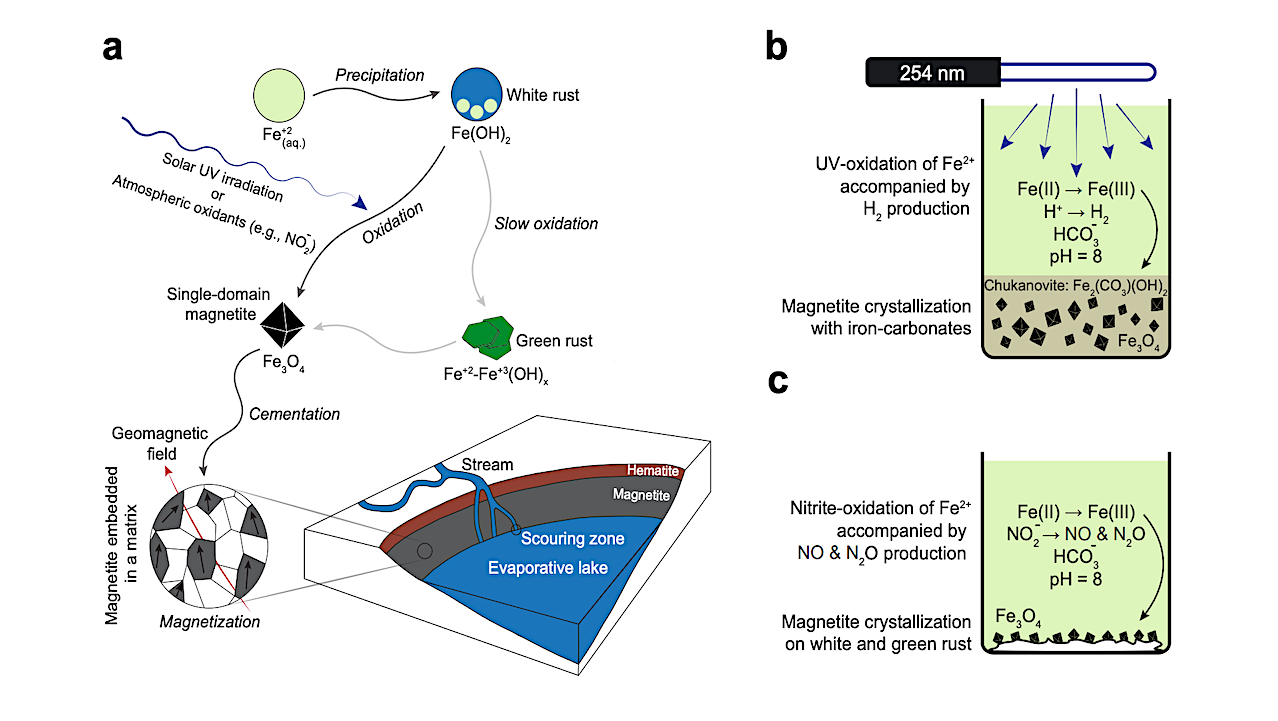
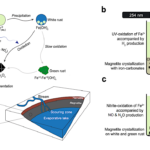
Magnetite formation under prebiotically plausible conditions. a Envisioned evaporative lake setting on early Earth, where magnetite likely formed via authigenic precipitation facilitated either by solar irradiation or nitrogen oxide from the decomposition of abiotic nitrogen fixation products [62]. As these magnetite particles form, they acquire a natural remanent magnetization under the geomagnetic field. b Experimental setup used to reproduce early Earth conditions and investigate magnetite formation under UV-facilitated synthesis (samples UV1 to UV3) and c via nitrite oxidation of Fe(II) (samples NUV8 and NUV9). Samples NUV5 to NUV7 were synthesized by mixing Fe(II) and Fe(III) with different proportions (10%/90%, 50%/50% and 90%/10% of Fe(II)/Fe(III), respectively). — physics.chem-ph
The emergence of biomolecular homochirality requires both an initial symmetry-breaking event and a mechanism to amplify and preserve a chiral imbalance.
Magnetic minerals have been shown to function as chiral agents through the chiral-induced spin selectivity (CISS) effect and may have enabled homochirality on early Earth, yet the magnetic properties of magnetite formed under realistic prebiotic conditions remain unexplored.
Here we show that magnetite synthesized through two geochemically plausible pathways – UV-driven photo-oxidation and nitrite-mediated oxidation of Fe(II) – produces particles dominated by single-vortex and multi-vortex magnetic domain states.
Magnetic measurements and electron microscopy confirm that these populations differ markedly from the nano-fabricated thin-film substrates conventionally used in previous CISS experiments. Using 3D micromagnetic simulations, we demonstrate that single-domain and vortex-state grains undergo irreversible, exchange-driven re-magnetization when interacting with spin-polarized homochiral compounds.
This magnetic irreversibility provides a robust mechanism for storing and reinforcing weak chiral bias, suggesting that prebiotic magnetite could have contributed to the emergence and stabilization of persistent chiral bias on the early Earth.
Jose A. P. M. Devienne, Ziwei Liu, Clancy Z. Jiang, Nicholas J. Tosca, Thomas Ginnis, Dimitar D. Sasselov, Richard J. Harrison, S. Furkan Ozturk
Subjects: Chemical Physics (physics.chem-ph); Mesoscale and Nanoscale Physics (cond-mat.mes-hall)
Cite as: arXiv:2605.19387 [physics.chem-ph] (or arXiv:2605.19387v1 [physics.chem-ph] for this version)
https://doi.org/10.48550/arXiv.2605.19387
Focus to learn more
Submission history
From: S. Furkan Ozturk
[v1] Tue, 19 May 2026 05:34:07 UTC (10,249 KB)
https://arxiv.org/abs/2605.19387
Astrobiology, Astrochemistry,










Related Posts
Stay Informed With the Latest & Most Important News

Advertisement
-
 01Two Black Holes Observed Circling Each Other for the First Time
 -
 02From Polymerization-Enabled Folding and Assembly to Chemical Evolution: Key Processes for Emergence of Functional Polymers in the Origin of Life
 -
 03Astronomy 101: From the Sun and Moon to Wormholes and Warp Drive, Key Theories, Discoveries, and Facts about the Universe (The Adams 101 Series)
 -
 04True Anomaly hires former York Space executive as chief operating officer
 -
 05Φsat-2 begins science phase for AI Earth images
 -
 06Hurricane forecasters are losing 3 key satellites ahead of peak storm season − a meteorologist explains why it matters
 -
 07Binary star systems are complex astronomical objects − a new AI approach could pin down their properties quickly