
Now Reading: Protoplanetary Disk Cavities With JWST-MIRI: A Dichotomy In Molecular Emission
-
01
Protoplanetary Disk Cavities With JWST-MIRI: A Dichotomy In Molecular Emission


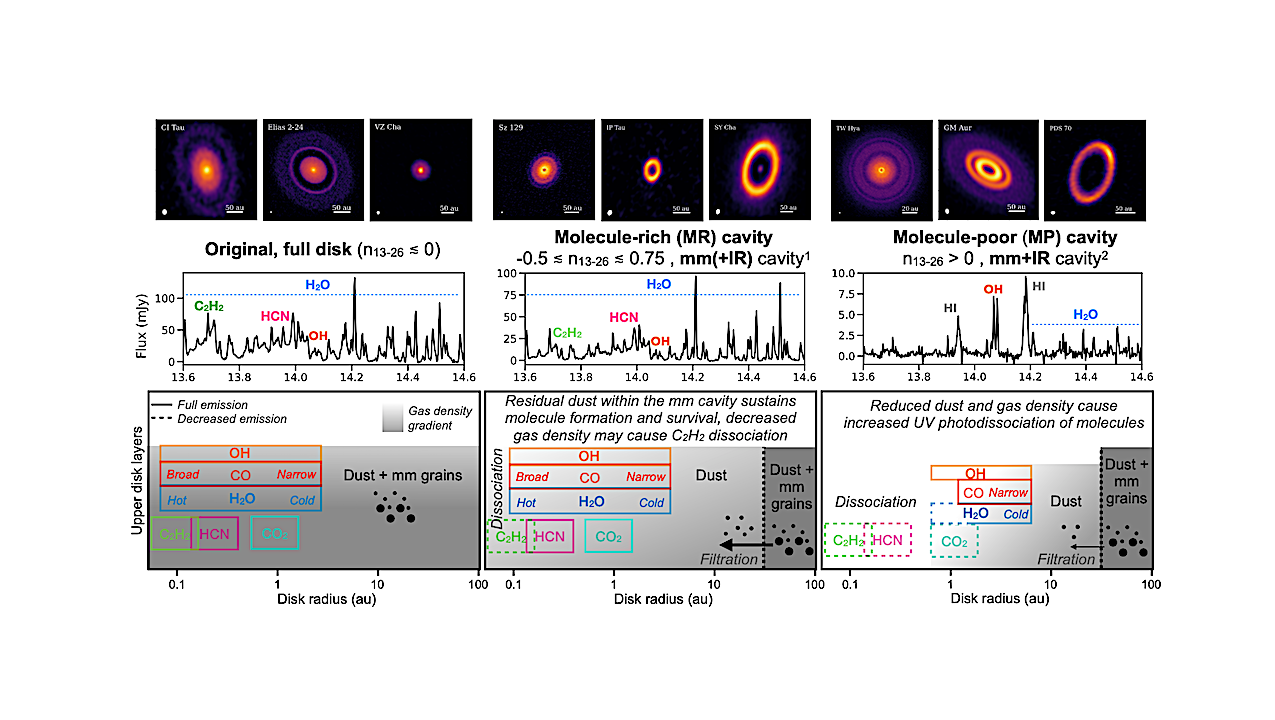
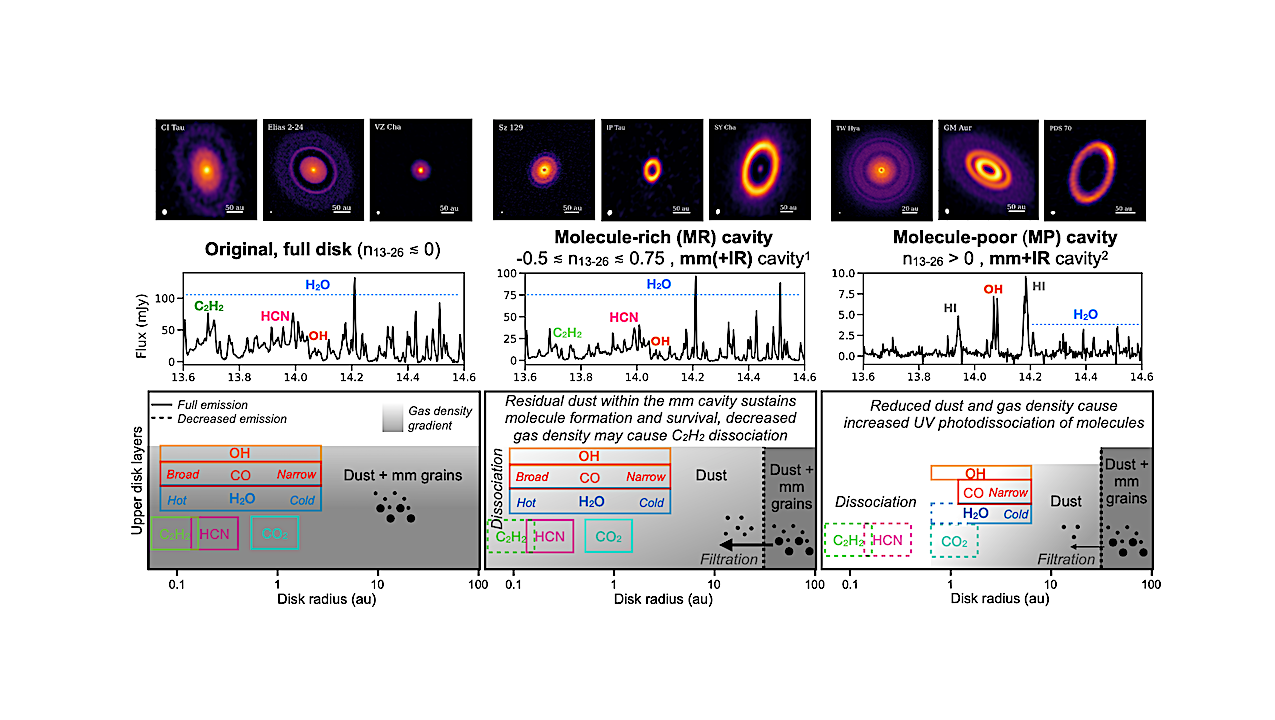
Schematic illustration of the properties and relative distribution of µm-size dust, mm grains, and molecular gas in the two cavity types presented in this work in comparison to a full disk (with representative molecular emitting regions adopted from Woitke et al. 2024). The illustration includes several simplifications and is not meant to reproduce the exact geometry of the inner disk nor which process is opening the mm cavity; see Section 4 for a discussion of each dust and gas component in the different cavity types. Some gradients observed in the data are labeled for reference, including the temperature gradient in H2O and line-broadening gradient in CO. The reduced C2H2 emission in MR cavities is interpreted as due to a decrease in gas density (Figure 9 and Section 4.3). Representative portions of MIRI spectra at 13.6–14.6 µm are included above each disk type for reference; spectra for the entire sample are reported in Appendix A. ALMA continuum images are reported to the top with examples for each disk type (see Section 2.2). NOTES: 1 – MR cavities are of mixed dust type but they clearly show a larger IR dust contribution at any mm cavity size (Figure 8); 2 – MP cavities are predominantly mm+IR dust cavities, with the exception of PDS 70. — astro-ph.EP
The evolution of planet-forming regions in protoplanetary disks is of fundamental importance to understanding planet formation. Disks with a central deficit in dust emission, a “cavity”, have long attracted interest as potential evidence for advanced disk clearing by protoplanets and/or winds.
Before JWST, infrared spectra showed that these disks typically lack the strong molecular emission observed in full disks. In this work, we combine a sample of 12 disks with millimeter cavities of a range of sizes (∼2-70 au) and different levels of millimeter and infrared continuum deficits.
We analyze their molecular spectra as observed with MIRI on JWST, homogeneously reduced with the new JDISCS pipeline. This analysis demonstrates a stark dichotomy in molecular emission where “molecule-rich” (MR) cavities follow global trends between water, CO, and OH luminosity and accretion luminosity as in full disks, while “molecule-poor” (MP) cavities are significantly sub-luminous in all molecules except sometimes OH. Disk cavities generally show sub-luminous organic emission, higher OH/H2O ratios, and suggest a lower water column density.
The sub-thermal excitation of CO and water vibrational lines suggests a decreased gas density in the emitting layer in all cavities, supporting model expectations for C2H2 photodissociation. We discover a bifurcation in infrared index (lower in MR cavities) suggesting that the molecular dichotomy is linked to residual μm-size dust within millimeter disk cavities.
Put together, these results suggest a feedback process between dust depletion, gas density decrease, and molecule dissociation. Disk cavities may have a common evolutionary sequence where MR switch into MP over time.
Patrick Mallaney, Andrea Banzatti, Colette Salyk, Ilaria Pascucci, Paola Pinilla, Joan Najita, Klaus M. Pontoppidan, Sebastiaan Krijt, Geoffrey A. Blake, Benoit Tabone, Till Kaeufer, Ke Zhang, Feng Long, Jane Huang, Giovanni Rosotti, Karin I. Oberg, Maria Jose Colmenares, Andrew Lay, Lucas A. Cieza, L. Ilsedore Cleeves, Joe Williams, Chengyan Xie, Miguel Vioque, Mayank Narang, Nicholas P. Ballering, Minjae Kim, the JDISCS Collaboration
Comments: Accepted for publication on the Astrophysical Journal
Subjects: Earth and Planetary Astrophysics (astro-ph.EP)
Cite as: arXiv:2601.02344 [astro-ph.EP] (or arXiv:2601.02344v1 [astro-ph.EP] for this version)
https://doi.org/10.48550/arXiv.2601.02344
Focus to learn more
Submission history
From: Andrea Banzatti Dr.
[v1] Mon, 5 Jan 2026 18:40:59 UTC (9,947 KB)
https://arxiv.org/abs/2601.02344
Astrobiology, Astrochemistry,










Related Posts
Stay Informed With the Latest & Most Important News
Previous Post
Next Post



Advertisement
-
 01Two Black Holes Observed Circling Each Other for the First Time
 -
 02From Polymerization-Enabled Folding and Assembly to Chemical Evolution: Key Processes for Emergence of Functional Polymers in the Origin of Life
 -
 03Astronomy 101: From the Sun and Moon to Wormholes and Warp Drive, Key Theories, Discoveries, and Facts about the Universe (The Adams 101 Series)
 -
 04True Anomaly hires former York Space executive as chief operating officer
 -
 05Φsat-2 begins science phase for AI Earth images
 -
 06Hurricane forecasters are losing 3 key satellites ahead of peak storm season − a meteorologist explains why it matters
 -
 07Binary star systems are complex astronomical objects − a new AI approach could pin down their properties quickly