
Now Reading: Space Rider drop model ready to glide
-
01
Space Rider drop model ready to glide



22/04/2026
571 views
9 likes
In brief
- The first full-size test model of the European Space Agency’s reusable spacecraft Space Rider is complete
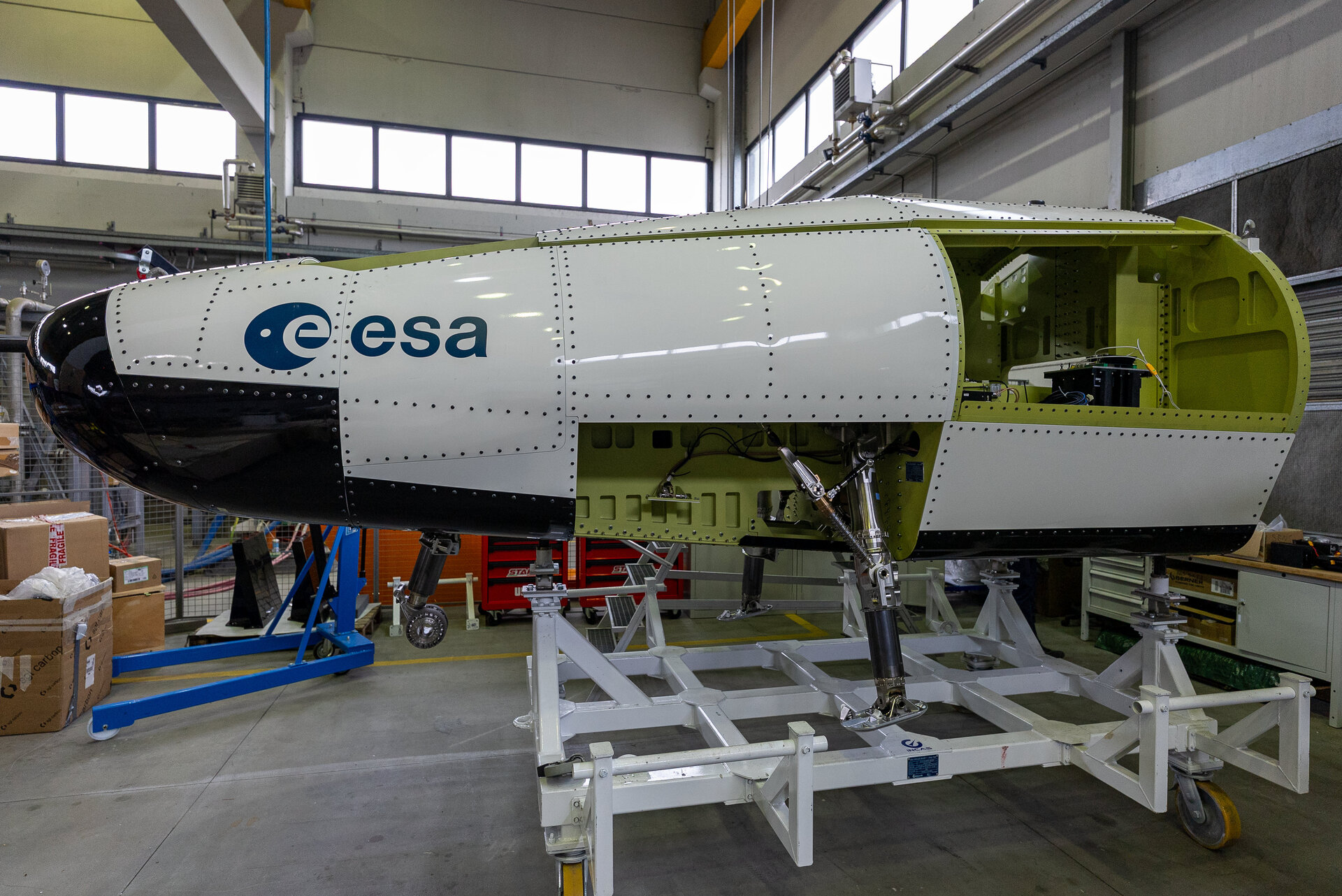
- The model was finalised at the Italian Aerospace Research Centre in Capua, Italy
- The model will be dropped from a helicopter later this year and glide to a landing to reenact the final approach from orbit
In-depth
Space Rider is set to be the first reusable European spacecraft. The uncrewed robotic laboratory will stay in low orbit for about two months. Space Rider’s cargo bay will allow for all manner of experiments and operations to be run. At the end of its missions, Space Rider reentry module will return to Earth, gliding under a parafoil to land on a runway.
No operational spacecraft has ever been designed for a targeted landing with a parafoil, so extensive tests are being prepared. The drop-test model was built in Craiova, Romania, at Romania’s National Institute for Aerospace Research ‘Elie Carafoli’ (INCAS) before being shipped to the Italian Aerospace Research Centre (CIRA) in Capua, Italy. CIRA is responsible for the design, integration, and implementation of the drop test.
The avionics – Space Rider’s ‘brain’ – were installed in the second week of March. This computer hosts the Guidance, Navigation and Control algorithms that will steer the parafoil, adapting to the wind – including any gusts– to guide Space Rider to a soft landing.
Roughly the size of a mini-van, the drop-test model is a full-size stand-in for the 4.6-m long reentry module, Space Rider lands on skis with the landing gear permanently open on this model as the mechanism is not part of the drop test.
Perfectly folded
To complete the drop test model, the parafoil was folded and integrated. The enormous parafoil is 27 m long and 10 m wide – around 10 times larger than a human paraglider would need – as it needs to support Space Rider’s 2950 kg as it glides to Earth.
The intricate folding and integration took three weeks using a custom-built machine to press and pack the parachutes and parafoils – if the unfurling and deployment goes wrong during free-fall kilometres above Earth there will be no soft touchdown for Space Rider.
Two winches pull the parafoil’s steering lines that are completely controlled by the spacecraft’s avionics: no human’s involved.
“It is wonderful to see Space Rider reentry module taking shape like this, the teams have been working years on this project and although this is a test model, it looks and weighs much like the real thing,” says ESA’s Space Rider Space Segment manager Aldo Scaccia, “the teams cannot wait to put this model through its paces and see it model fly and glide.”
To test the final landing approach Space Rider will be dropped multiple times later this year from a helicopter flying up to 3 km altitude over the test range of Salto di Quirra in Sardinia, Italy.
Thales Alenia Space Italy is the industrial lead for the tests and co-prime together with Avio for the Space Rider Programme.










Related Posts
Stay Informed With the Latest & Most Important News
Previous Post
Next Post



Advertisement
-
 01Two Black Holes Observed Circling Each Other for the First Time
 -
 02From Polymerization-Enabled Folding and Assembly to Chemical Evolution: Key Processes for Emergence of Functional Polymers in the Origin of Life
 -
 03Astronomy 101: From the Sun and Moon to Wormholes and Warp Drive, Key Theories, Discoveries, and Facts about the Universe (The Adams 101 Series)
 -
 04True Anomaly hires former York Space executive as chief operating officer
 -
 05Φsat-2 begins science phase for AI Earth images
 -
 06Hurricane forecasters are losing 3 key satellites ahead of peak storm season − a meteorologist explains why it matters
 -
 07Binary star systems are complex astronomical objects − a new AI approach could pin down their properties quickly