
Now Reading: SpaceX IPO filing casts Starlink Mobile as future wireless challenger
-
01
SpaceX IPO filing casts Starlink Mobile as future wireless challenger


TAMPA, Fla. — SpaceX’s IPO prospectus casts Starlink Mobile as more than a remote-area backup, with next-generation direct-to-smartphone services designed to be “on par with terrestrial mobile networks” even in urban areas.
The company’s May 20 regulatory filing outlined how upgraded satellites and the spectrum it is acquiring from U.S.-based EchoStar would greatly improve services currently limited to messaging and light voice and data services.
“While we expect Starlink Mobile service today to be most impactful for customers in remote areas uncovered by terrestrial mobile networks, as our constellation grows and our product performance continues to improve, we will compete to be the preferred connectivity experience to our customers no matter where they are located,” SpaceX said, “whether in rural, suburban, or urban areas.”
That ambition contrasts with a more cautious view from telcos, including anchor mobile network operator (MNO) partner T-Mobile, which provides the wireless spectrum Starlink Mobile satellites currently use to plug terrestrial coverage gaps across the United States.
Satellite represented 0.0002% of total network usage in May, T-Mobile CEO Srini Gopalan said May 18 during the JP Morgan Global Technology, Media and Communications Conference, concentrated in national parks.
“Pretty much no one buys satellite standalone,” Gopalan said. “They buy it as part of the premium package, which gives you a bunch of other benefits: global roaming, ad-free Netflix, etc., etc.”
T-Mobile’s Starlink-powered satellite service is included in some premium plans and otherwise sold as a $10-per-month add-on, including to customers of rival carriers.
The company recently teamed up with telco rivals AT&T and Verizon to explore a joint venture to help improve direct-to-device capabilities by pooling spectrum and standardizing services.
However, SpaceX executives have criticized the potential joint venture, amid questions over whether regulators would scrutinize coordination among the country’s three largest wireless carriers.
Starlink Mobile financials
Last month, The Information reported that T-Mobile has agreed to pay SpaceX $100 million over multiple years to provide Starlink Mobile services, subject to certain milestones.
T-Mobile did not respond to a request for comment.
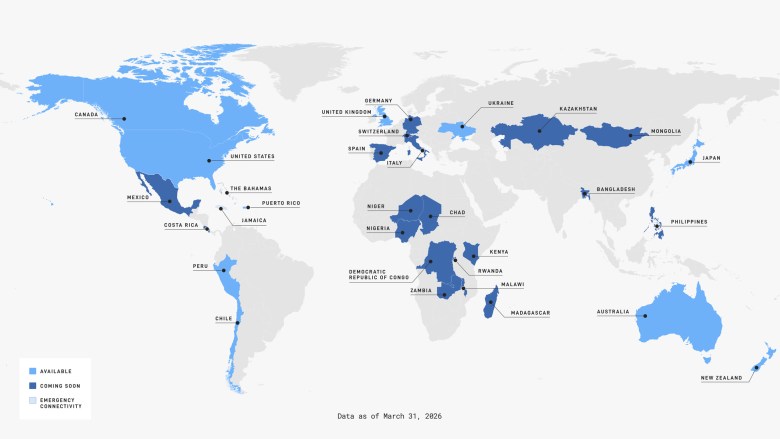
Meanwhile, SpaceX’s S1 registration filing appeared to show Starlink Mobile generated $632 million last year from what the company described as its “mobile connectivity business,” after partnering with more than 30 MNOs across six continents.
The company recorded $11.4 billion in revenue for its entire connectivity segment in 2025, encompassing broader services from around 9,600 Starlink broadband and mobile satellites in low Earth orbit.
According to SpaceX, Starlink Mobile will become a significant new contributor to connectivity segment revenue as next-generation satellites improve capabilities.

There were around 650 V1 Mobile satellites as of March 31, providing satellite-to-mobile texting and over-the-top voice services via apps such as WhatsApp to roughly 7.4 million monthly unique devices.
More comprehensive satellite-to-mobile services are in the works, SpaceX said, including broadband data and connectivity for Internet of Things (IoT) devices, “which are expected to deliver resilient, infrastructure-independent connectivity worldwide and enable 5G connectivity.”
Those services would be enabled by V2 Mobile satellites that SpaceX plans to start deploying on Starship in 2027. A single Starship launch would be able to carry up to 50 V2 Mobile satellites, compared with the much smaller V1 Mobile satellites now flying on Falcon 9.
The IPO filing outlined a $740 billion total addressable market for Starlink Mobile, close to the $870 billion TAM opportunity SpaceX sees for Starlink Broadband.
Still, SpaceX only assumes a monthly mobile average revenue per user (ARPU) of $8 worldwide, from $18 in high-income markets to $2 in areas with substantially less consumer spending power.
The company has previously floated the possibility of “creating a hybrid satellite/terrestrial network” that would help extend coverage into buildings and other areas satellite signals struggle to penetrate, although it was not mentioned in the IPO prospectus.
Pushing Starlink Mobile into denser markets could also raise fresh spectrum interference concerns.
Expansion obstacles
The S1 filing cautioned that expanding Starlink Mobile globally depends on maintaining partnerships with telcos and spectrum licensees, while securing country-by-country approvals to provide the services.
“In the United States, we expect to be able to provide 5G-like connectivity to a meaningful portion of existing unmodified devices through our Starlink Mobile Gen2 service utilizing our V2 Mobile satellites, either by operating on spectrum leased to us by MNO partners or by utilizing our own domestic spectrum holdings,” SpaceX said.
“However, achieving full 5G NR-NTN compliance and optimal performance would likely require handset manufacturers to implement hardware and software modifications, primarily to the radio-frequency front end, in future devices.”
SpaceX does not have direct contractual arrangements with handset makers, meaning it falls to MNOs as major purchasers of the devices to help drive adoption.
“There can be no assurance that these modifications will be adopted on our preferred timeline, or at all,” SpaceX added.
“Internationally, we face similar constraints until handset manufacturers implement hardware and software modifications to support the international spectrum authorizations to be obtained from EchoStar.
“As a result, our near-term international service strategy depends on our ability to establish MNO spectrum partnerships on a market-by-market basis, which does not require device hardware modifications but is subject to the successful negotiation and execution of commercial agreements in each jurisdiction.”
Bigger AI opportunity
While direct-to-device promises to be a significant new market for SpaceX, the company’s filing points to a much larger $26.5 trillion TAM opportunity in artificial intelligence, following its merger with Elon Musk’s xAI.

Underlining the scale of that opportunity, the company detailed a compute agreement with xAI rival Anthropic that could be worth $1.25 billion per month through May 2029, although either party can terminate the arrangement on 90 days’ notice.
But as with Starlink Mobile, launching large orbital data center satellites to fuel broader AI compute ambitions depends heavily on Starship, which is preparing for a 6:30 p.m. Eastern test flight following a scrub yesterday over a problem with ground equipment.










Related Posts
Stay Informed With the Latest & Most Important News



Advertisement
-
 01Two Black Holes Observed Circling Each Other for the First Time
 -
 02From Polymerization-Enabled Folding and Assembly to Chemical Evolution: Key Processes for Emergence of Functional Polymers in the Origin of Life
 -
 03Astronomy 101: From the Sun and Moon to Wormholes and Warp Drive, Key Theories, Discoveries, and Facts about the Universe (The Adams 101 Series)
 -
 04True Anomaly hires former York Space executive as chief operating officer
 -
 05Φsat-2 begins science phase for AI Earth images
 -
 06Hurricane forecasters are losing 3 key satellites ahead of peak storm season − a meteorologist explains why it matters
 -
 07Binary star systems are complex astronomical objects − a new AI approach could pin down their properties quickly