
Now Reading: Spring fever pitch: Three questions to listen for this Space Symposium
-
01
Spring fever pitch: Three questions to listen for this Space Symposium


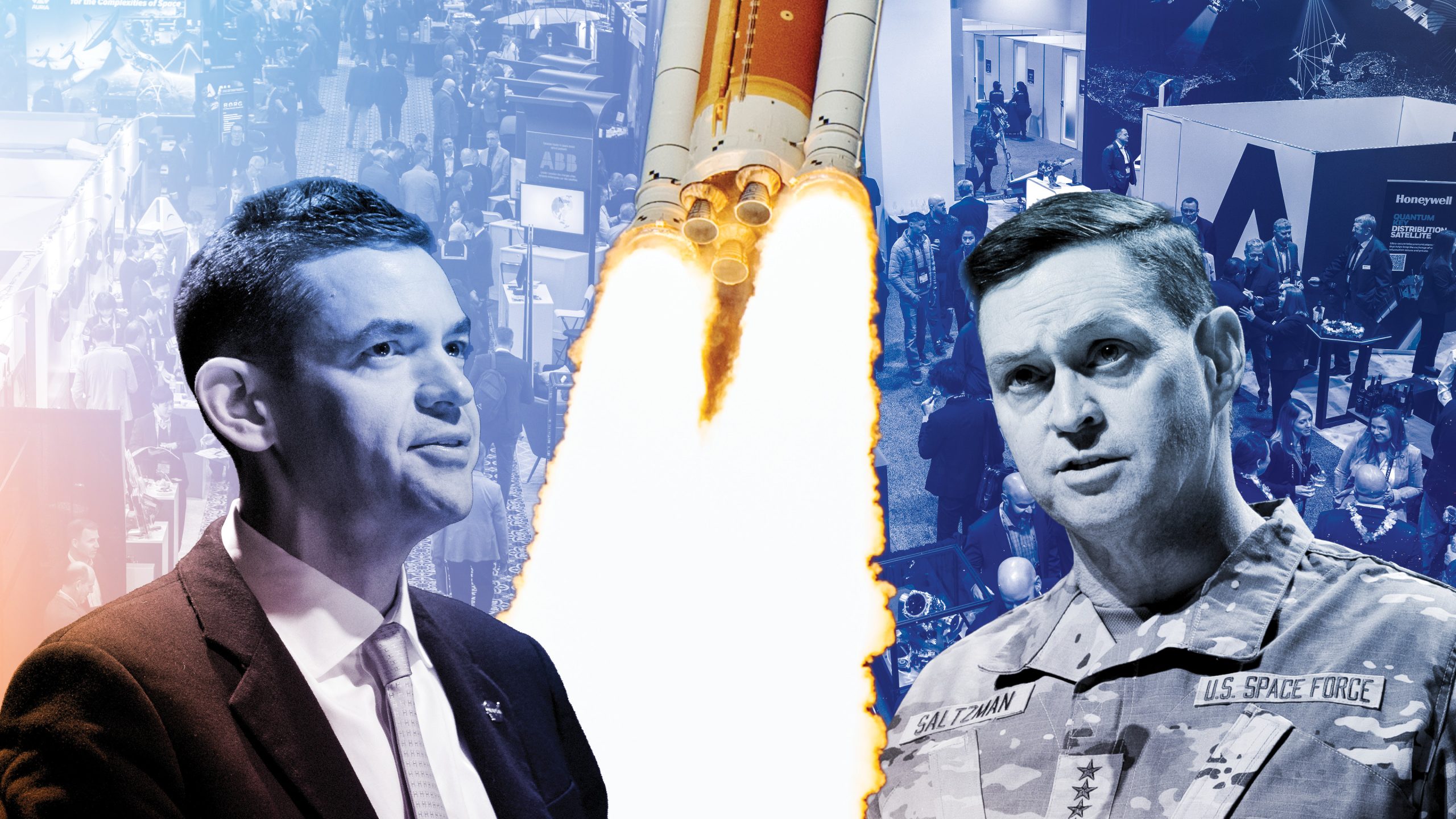

A historic mission to the moon. A record-setting budget for the Space Force. Billions of dollars in new valuations.
As the 41st Space Symposium opens in Colorado Springs, optimism is bountiful for the space industry.
At the same time, leaders are emphasizing speed, near-perfect execution and new ways of working together across government and industry.
With a week of keynotes, policy signals and industry dealmaking ahead, here are three questions to listen for this week:
How do civil and commercial leaders make sense of the proposed NASA budget?
The White House budget proposal included $18.8 billion for NASA, a 23% reduction from what the agency received in a final fiscal year 2026 appropriations bill in January. The new request comes at a time when the agency is on the high from the good feelings from the Artemis 2 mission and crystal clear images of the moon.
Congress didn’t like the last budget. It will be interesting to see if they will like this one better. NASA’s Administrator Jared Isaacman defended the budget last week and said “NASA doesn’t have a topline problem.” The head of the White House’s Office of Science and Technology Policy, Michael Kratsios, is also scheduled to speak. Without a National Space Council in this second Trump administration, people are curious to hear from him given OSTP’s role coordinating space policy.
What kind of operational success has the Space Force had in the last year to lead to such a budget hike at the Pentagon?
The Space Force has a monster budget in the White House proposal, with funding for the service projected to climb to more than $71 billion — up about $40 billion from fiscal 2026 levels. (Reminder, the Space Force budget from FY2021 was about $15 billion.)
The details for the funding require the legislative mechanism known as reconciliation.
But the larger budget request matches one of the year’s trends in which nearly every space company is a defense company. Consider two comments from Gen. Chance Saltzman, the head of the Space Force.
First, he said that “guardians and space capabilities have played an outsized role in enabling the joint force to project power and meet our national strategic objectives.”
Second, he said that Pentagon leadership was convinced of the value of space capabilities. “Our team has done a really good job of explaining why Space Force capabilities are so critical,” Saltzman said April 1. “The leadership … agree with our advocacy that space capabilities need to grow.”
This year, the Pentagon has been involved in Midnight Hammer, Absolute Resolve and Operation Epic Fury. In Colorado Springs, SpaceNews reporters will be listening for the operational details, anecdotes and examples that Space Force leaders share, if any, from those conflicts. In other words, what kind of battlefield successes (or gaps) has the Space Force experienced recently that’s led to this level of budget increase?
What has to happen in the next few years for the infrastructure-in-space movement to become a reality?
There’s plenty of interest in putting more infrastructure in space. And there’s money behind it to make that happen. Think: orbital data centers. What has to go right?
One obvious answer is launch, as all eyes are on whether SpaceX’s Starship can reach the flight rates needed to deploy the kind of multi-ton satellites that ventures like Starcloud are designing — in addition to its own plans for up to 1 million orbital data centers.
Equally important is whether companies can actually produce these systems at scale. While many are pursuing this emerging market plan to leverage the economics and speed of vertical integration, supply chain capacity remains an open question.
Then there are less-visible technical hurdles that industry players are only beginning to address in detail. How to generate and manage large amounts of power in orbit, how to reject heat from energy-intensive computing workloads and, ultimately, deliver vast amounts of data back to Earth via optical links.
Finally, there are also questions about how quickly regulators can or should process an unprecedented surge of constellation proposals. Is the industry underestimating how many things have to go right at once to make orbital data centers a reality in the near-term?










Related Posts



Stay Informed With the Latest & Most Important News
Previous Post
Next Post



Advertisement
-
 01Two Black Holes Observed Circling Each Other for the First Time
 -
 02From Polymerization-Enabled Folding and Assembly to Chemical Evolution: Key Processes for Emergence of Functional Polymers in the Origin of Life
 -
 03Astronomy 101: From the Sun and Moon to Wormholes and Warp Drive, Key Theories, Discoveries, and Facts about the Universe (The Adams 101 Series)
 -
 04True Anomaly hires former York Space executive as chief operating officer
 -
 05Φsat-2 begins science phase for AI Earth images
 -
 06Hurricane forecasters are losing 3 key satellites ahead of peak storm season − a meteorologist explains why it matters
 -
 07Binary star systems are complex astronomical objects − a new AI approach could pin down their properties quickly