
Now Reading: Startup develops software to help military tap commercial imaging satellites
-
01
Startup develops software to help military tap commercial imaging satellites



DENVER — A boom in commercial satellites has flooded the market with imagery, but for military users the challenge has shifted from scarcity to access. Getting the right data at the right time still often depends on one-off arrangements with individual providers.
Divergent Space Technologies, an early-stage company based in Reston, Va., is pitching a software platform designed to bridge that gap. The system anticipates when satellites will pass over areas of interest and automatically places orders across multiple vendors, aiming to replace a largely manual, fragmented process with something closer to real-time coordination.
Founder and chief executive Philip Brooks, who previously worked at the National Reconnaissance Office’s mission integration directorate, said he saw the problem firsthand while supporting military users who rely on satellite imagery and analysis.
“National systems are in extremely high demand, but extremely low density,” Brooks said. Commercial providers, by contrast, are “extremely high density, but no one knows how to get to them,” he told SpaceNews. “If you talk to the combatant commanders they say, ‘we love commercial, but how do we get to it?’”
Hundreds of commercial satellites now provide electro-optical imagery, synthetic aperture radar, infrared sensing and radio-frequency data, generating large volumes of information used for missions such as maritime surveillance, missile tracking and battlefield monitoring. The challenge, Brooks said, is less about access to data than integrating it into usable workflows.
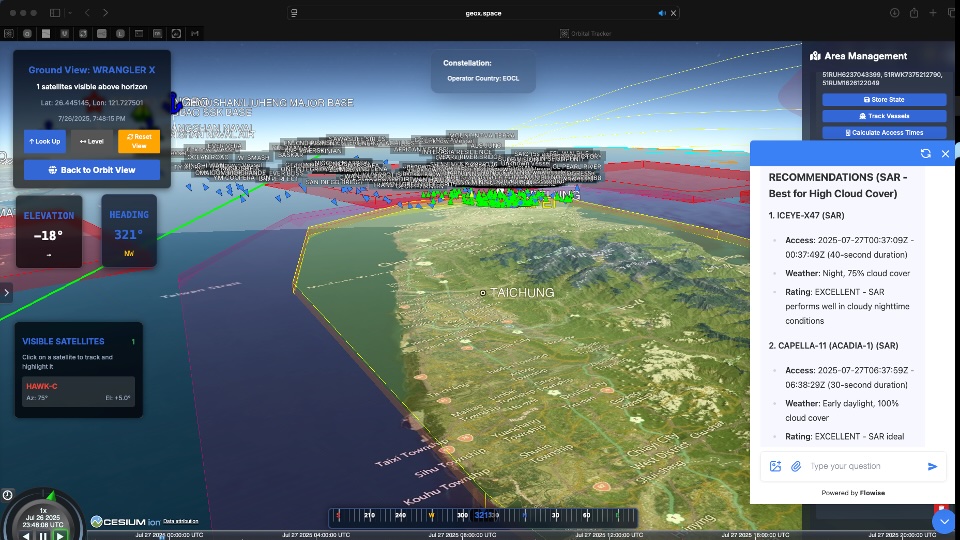
Divergent’s platform, known as GEOx, is intended to serve as that integration layer. “The greatest value of commercial space sensors emerges not from their individual capabilities but from their synchronized operation,” he said.
The system is still in development but is already being used by some U.S. and allied military organizations. It currently cannot directly task satellites, though Brooks said that capability is planned. For now, it provides a visualization of satellite coverage and can map what both friendly and adversary systems can observe at a given time.
One application is improving “tipping and cueing,” a process in which one sensor detects an event and others are directed to follow up before the opportunity passes. The main bottleneck, Brooks said, is not the number of available sensors but the time it takes to retask them, especially when they belong to different companies.
An orchestration layer would treat multiple satellite constellations as a pooled resource. When an initial detection occurs, such as identifying a radio-frequency emitter or inferring a missile launch from infrared data, the system can determine which satellites across providers have line-of-sight and issue tasking requests in parallel, rather than relying on sequential outreach.
The existing process — tasking, collection, processing and dissemination — can be slow and cumbersome. “What we’re trying to do is compress” that timeline, Brooks said. “Ninety-five percent of the time, by the time a tasking solution is created, the window has already passed,” he added, noting how quickly satellites move.
In current workflows, each task order is sent separately to satellite providers, each of which uses its own systems to process data. Divergent built application programming interfaces to connect with providers individually and is working to onboard companies across different sensing modalities, or “phenomenologies.”
The approach raises questions about whether users can reliably secure imagery in high-demand areas. Brooks said competition for collection slots can be intense in certain regions, but that commercial operators generally have excess capacity. “So we’re trying to create a route to profitability for them by introducing this simple way to task,” he said.
A broader issue is that while providers have incentives to sell data, they have less incentive to collaborate in ways that increase its overall value. Brooks said that may change as companies look for new ways to monetize unused capacity.
The NRO has expressed support for the effort, saying in a letter that GEOx “meets a currently unfulfilled U.S. government need and offers a unique value to U.S. national security space missions,” Brooks said.
Demand beyond the U.S.
Frank Rose, a Divergent board member and former State Department official, said allies are increasingly interested in tools that provide access to commercial intelligence. “We’ve had a lot of talks with European allies and partners, as well as beginning to look into the Middle East, to countries like the UAE and others in the region,” he said.
In the current geopolitical climate, Rose added, “there is a general angst amongst allies that the United States at a political level cannot be counted on to back them up and provide critical capabilities that they have come to rely on, so they need a plan B.”
Separately, Divergent is developing a related system focused on communications satellites, aimed at helping U.S. forces avoid transmitting signals when foreign signals-intelligence satellites are overhead. The platform would predict when satellites operated by countries such as China and Russia are in position to collect radio-frequency emissions.
That information could allow U.S. users to delay transmissions or reroute communications to reduce the risk of interception. “This is still very much a prototype,” Brooks said. The goal is to “understand where your adversaries are collecting, and transmit only when you’re not in their direct beam.”
Rose said such capabilities could also appeal to countries like Ukraine and Taiwan, which face similar concerns about foreign collection.










Related Posts


Stay Informed With the Latest & Most Important News
Previous Post
Next Post




Advertisement
-
 01Two Black Holes Observed Circling Each Other for the First Time
 -
 02From Polymerization-Enabled Folding and Assembly to Chemical Evolution: Key Processes for Emergence of Functional Polymers in the Origin of Life
 -
 03Astronomy 101: From the Sun and Moon to Wormholes and Warp Drive, Key Theories, Discoveries, and Facts about the Universe (The Adams 101 Series)
 -
 04True Anomaly hires former York Space executive as chief operating officer
 -
 05Φsat-2 begins science phase for AI Earth images
 -
 06Hurricane forecasters are losing 3 key satellites ahead of peak storm season − a meteorologist explains why it matters
 -
 07Binary star systems are complex astronomical objects − a new AI approach could pin down their properties quickly