
Now Reading: Super-Earth Masses And Stellar Abundances From NIRPS Reveal Tentative Evidence For Water-rich Formation Around M Dwarfs
-
01
Super-Earth Masses And Stellar Abundances From NIRPS Reveal Tentative Evidence For Water-rich Formation Around M Dwarfs

Super-Earth Masses And Stellar Abundances From NIRPS Reveal Tentative Evidence For Water-rich Formation Around M Dwarfs

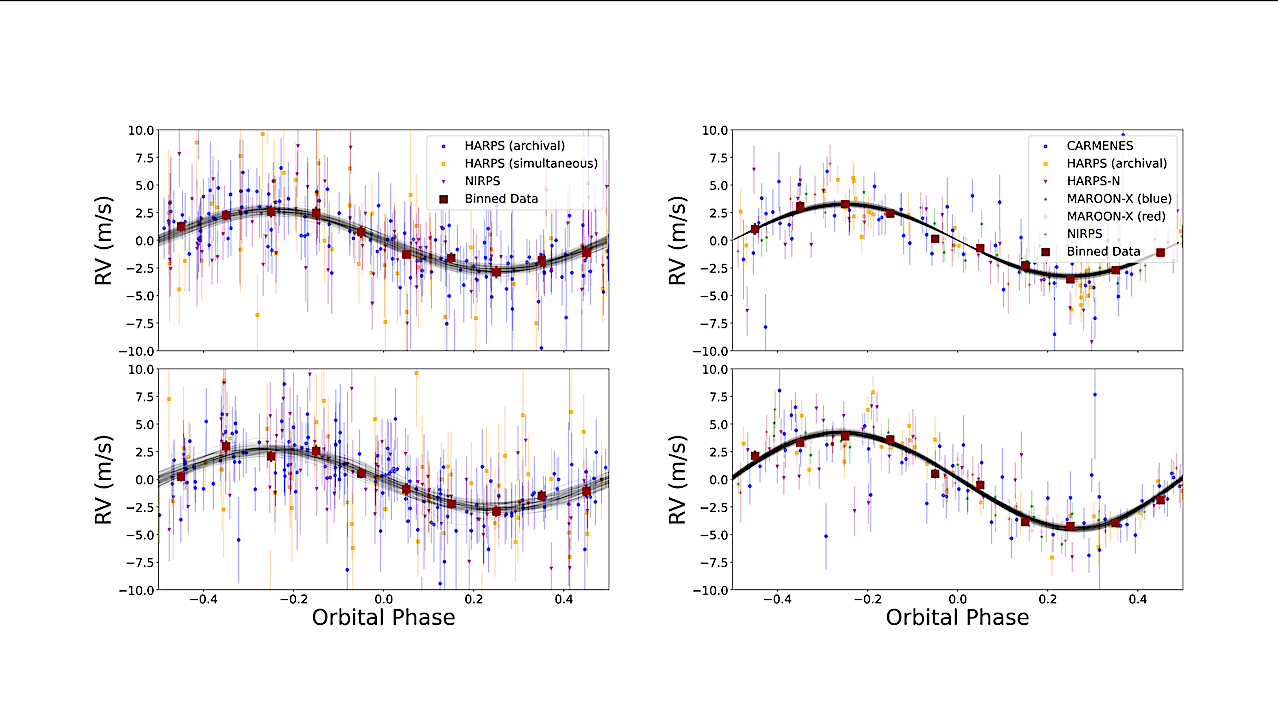
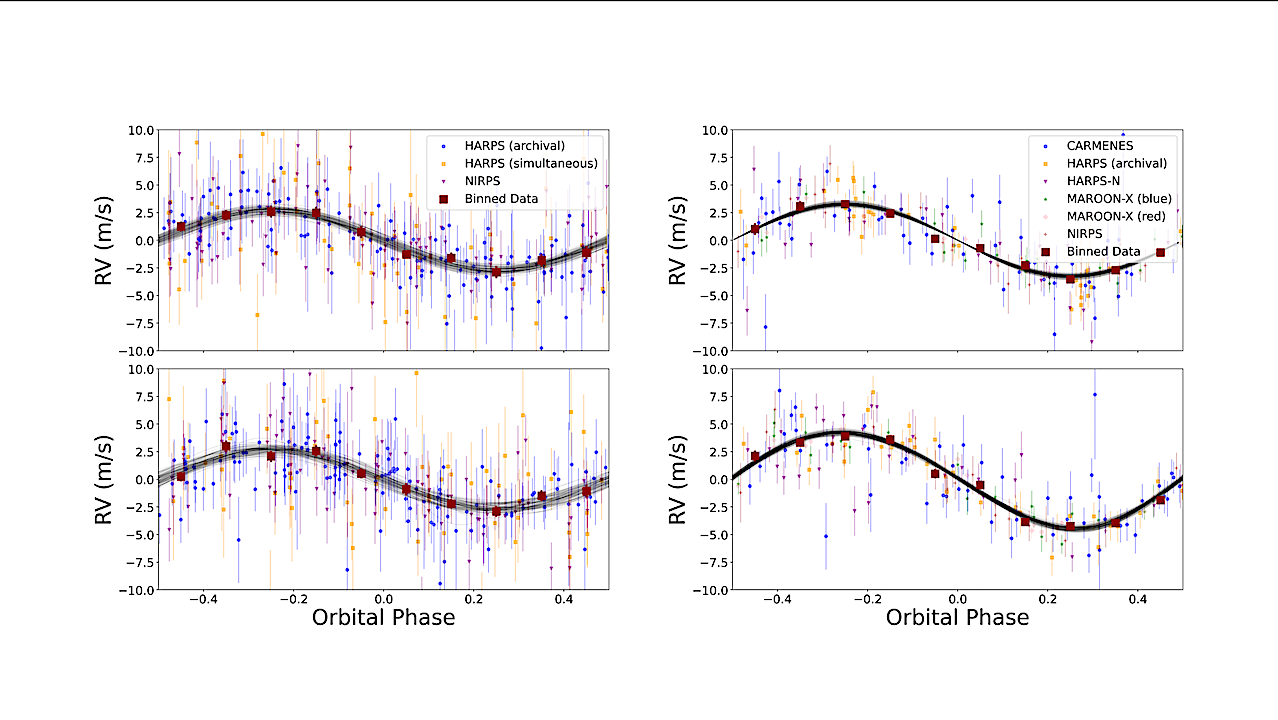
[L] The detrended and phase-folded RV time series of GJ 1132 b (top) and GJ 1132 c (bottom). Different draws of the Keplerian models from our posterior are superimposed in black. The different colored markers correspond to different RV time series. Binned data points are shown as red squares. [R] Phase-folded and detrended RV time series of LTT 3780 b (top) and LTT 3780 c (bottom). The best-fit Keplerian model is superimposed in black. The different colors and markers correspond to different RV time series. Binned data points are shown as red squares. — astro-ph.EP
Tracing the compositional link between terrestrial super-Earths and their host stars provides clues to their dominant formation pathway. By constraining the stellar abundances of refractory elements, we can predict the core mass fractions (CMFs) of their super-Earths.
The level of agreement between this prediction and the planetary CMF derived from their masses and radii can reveal past formation processes, like mantle stripping and water-rich formation plus sequestration in the planet’s core. Here, we present the first results from the Near Infrared Planet Searcher (NIRPS) GTO CMF subprogram: an intensive radial velocity campaign to refine masses and compute host stellar abundances of three hot super- Earths around M dwarfs (GJ 1132 b, GJ 1252 b, and LTT 3780 b), calculating masses of 1.69±0.15M⊕, 1.54±0.18M⊕, and 2.34±0.10M⊕ respectively.
We measure the CMFs of these and six further hot super-Earths with precise masses already available in the literature to 10-15% precision. We compare these to CMF predictions made from measuring the Fe, Mg, and Si abundances of their host stars measured from the NIRPS spectra.
We find that the CMFs of these planets are smaller than expected from their host stellar abundances, to a statistically significant degree. This discrepancy is suggestive of significant reservoirs of water, and while these planets are too hot to harbor surface water, they likely have interior water mass fractions of ∼1%.
Drew Weisserman, Nicole Gromek, Ryan Cloutier, Komal Bali, Charles Cadieux, Mykhaylo Plotnykov, Alexandrine L’Heureux, Avidaan Srivastava, Andres Carmona, Yolanda G. C. Frensch, Étienne Artigau, Frédérique Baron, Susana C. C. Barros, Björn Benneke, Xavier Bonfils, François Bouchy, Marta Bryan, Neil J. Cook, Nicolas B. Cowan, Eduardo Cristo, Xavier Delfosse, René Doyon, Xavier Dumusque, David Ehrenreich, Jonay I. González Hernández, David Lafrenière, Izan de Castro Leão, Christophe Lovis, Lison Malo, Bruno L. Canto Martins, Alejandro Suárez Mascareño, Jose Renan De Medeiros, Claudio Melo, Lucile Mignon, Christoph Mordasini, Francesco Pepe, Rafael Rebolo, Jason Rowe, Nuno C. Santos, Damien Ségransan, Stéphane Udry, Diana Valencia, Gregg Wade, José Luan A. Aguiar, Romain Allart, Luc Bazinet, Jean-Baptiste Delisle, Flavie Bélanger, Joshua Blackman, Vincent Bourrier, Pedro Branco, Vincent Bruniquel, Yann Carteret, Marion Cointepas, Antoine Darveau-Bernier, Laurie Dauplaise, Elisa Delgado-Mena, Caroline Dorn, Dhvani Doshi, João Faria, Dasaev O. Fontinele, Thierry Forveille, Jonathan Gagné, Frédéric Genest, Jennifer Glover, Roseane de Lima Gomes, Nolan Grieves, Melissa J. Hobson, H. Jens Hoeijmakers, Farbod Jahandar, Vigneshwaran Krishnamurthy, Pierrot Lamontagne, Pierre Larue, Henry Leath, Olivia Lim, Justin Lipper, Lina Messamah, Yuri S. Messias, Telmo Monteiro, Leslie Moranta, Khaled Al Moulla, Dany Mounzer, Georgia Mraz, Nicola Nari, Louise D. Nielsen, Ares Osborn, Jon Otegi, Léna Parc, Stefan Pelletier, Olivia Pereira, Caroline Piaulet-Ghorayeb, Riley Rosener, Julia Seidel, João Gomes da Silva, Ana Rita Costa Silva, Atanas K. Stefanov, Márcio A. Teixeira, Thomas Vandal, Valentina Vaulato, Joost P. Wardenier, Vincent Yariv
Comments: 24 pages, 13 figures, 8 tables. Accepted for publication in Astronomy & Astrophysics
Subjects: Earth and Planetary Astrophysics (astro-ph.EP); Solar and Stellar Astrophysics (astro-ph.SR)
Cite as: arXiv:2604.07447 [astro-ph.EP] (or arXiv:2604.07447v1 [astro-ph.EP] for this version)
https://doi.org/10.48550/arXiv.2604.07447
Focus to learn more
Submission history
From: Drew Weisserman
[v1] Wed, 8 Apr 2026 18:00:03 UTC (8,969 KB)
https://arxiv.org/abs/2604.07447
Astrobiology, Astrochemistry, Astrogeology, exoplanet,










Related Posts
Stay Informed With the Latest & Most Important News



Advertisement
-
 01Two Black Holes Observed Circling Each Other for the First Time
 -
 02From Polymerization-Enabled Folding and Assembly to Chemical Evolution: Key Processes for Emergence of Functional Polymers in the Origin of Life
 -
 03Astronomy 101: From the Sun and Moon to Wormholes and Warp Drive, Key Theories, Discoveries, and Facts about the Universe (The Adams 101 Series)
 -
 04True Anomaly hires former York Space executive as chief operating officer
 -
 05Φsat-2 begins science phase for AI Earth images
 -
 06Hurricane forecasters are losing 3 key satellites ahead of peak storm season − a meteorologist explains why it matters
 -
 07Binary star systems are complex astronomical objects − a new AI approach could pin down their properties quickly