
Now Reading: Synthetic Biology As An Empirical Tool For Evolutionary Theory
-
01
Synthetic Biology As An Empirical Tool For Evolutionary Theory


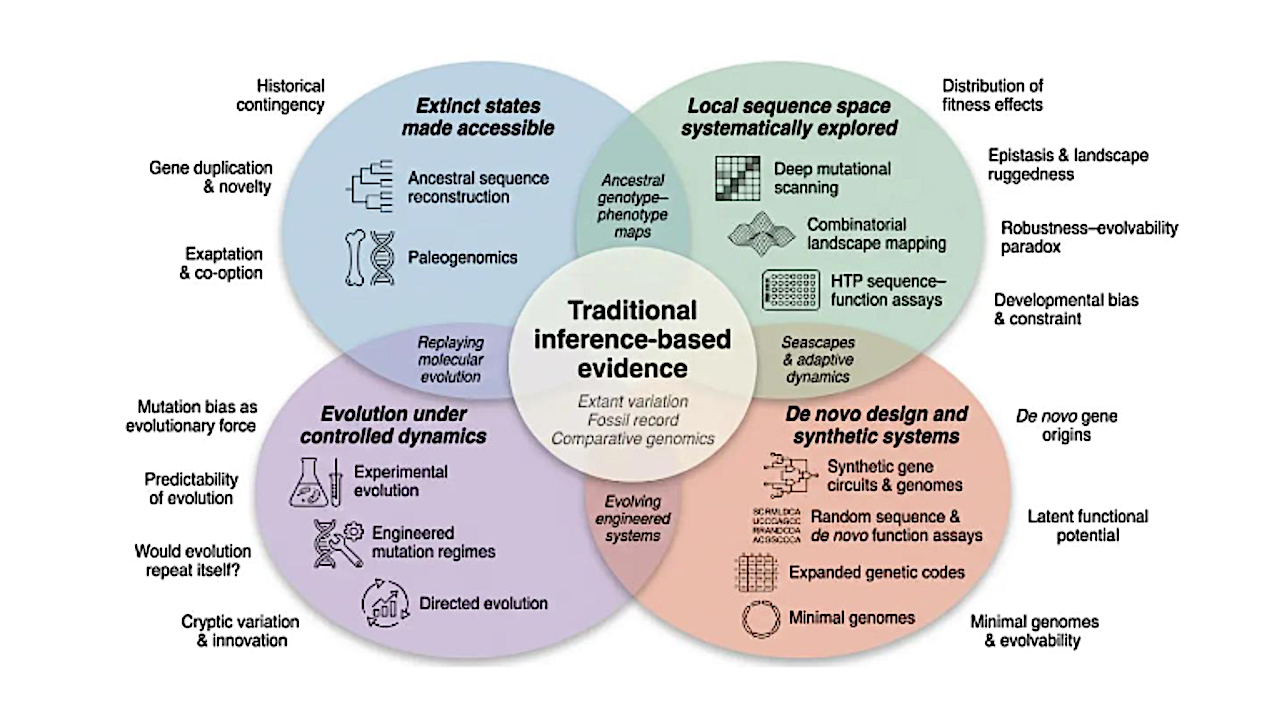
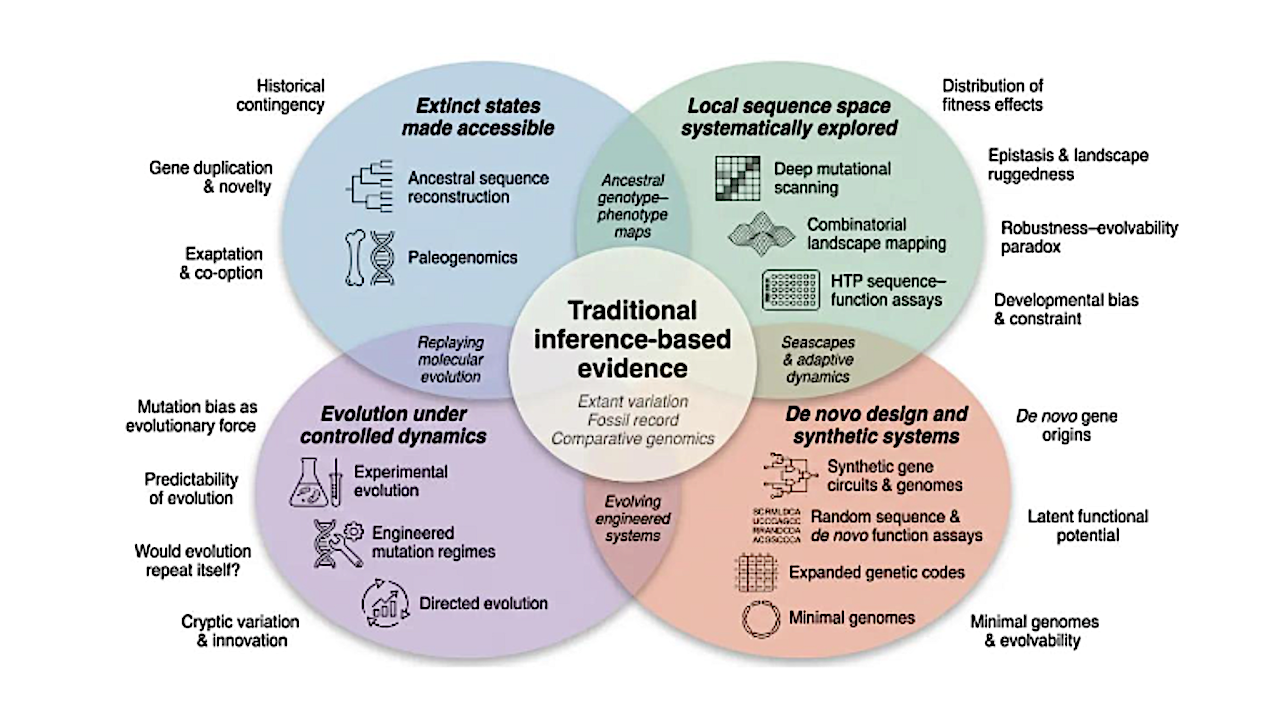
Synthetic and experimental approaches expand evolutionary access beyond natural observation. Evolutionary biology has traditionally relied on inference from extant variation, the fossil record, and comparative genomics (centre). Four complementary classes of approaches now extend this empirical reach. Extinct states made accessible(upper left): ancestral sequence reconstruction and paleogenomics resurrect ancient molecules and genotypes, enabling direct functional tests of evolutionary history. Local sequence space systematically explored (upper right): deep mutational scanning, combinatorial libraries, and high-throughput sequence–function assays map genotype–phenotype and fitness landscapes around natural sequences with unprecedented resolution. Evolution under controlled dynamics (lower left): experimental evolution, engineered mutation regimes, and directed evolution allow populations to be replayed, redirected, or exposed to defined selective pressures, testing how mutation bias, contingency, and repeatability shape adaptive trajectories. De novo design and synthetic systems(lower right): synthetic gene circuits, minimal genomes, expanded genetic codes, and random-sequence assays probe functional regions of sequence space that natural evolution may never have sampled, addressing what evolution could do rather than only what it did. Overlap zones highlight questions that are most effectively addressed by combining approaches: ancestral genotype–phenotype maps emerge from coupling sequence reconstruction with systematic landscape mapping; replaying molecular evolution integrates resurrected ancestors with forward experimental evolution; seascapes and adaptive dynamics link empirical landscape characterisation with controlled evolutionary experiments; de novo regulatory landscapes connect high-throughput assays with synthetic and random sequence libraries; and evolving engineered systems combines experimental evolution with synthetic circuits and minimal genomes. Classical evolutionary questions are shown at the periphery. Together, these approaches shift the field from observing evolutionary outcomes to experimentally testing evolutionary possibilities. — ecoevorxiv.org
Evolutionary biology has traditionally inferred process from patterns in extant organisms and the fossil record, leaving many foundational questions constrained by their historical nature.
Over the past two decades, synthetic and high-throughput approaches — including deep mutational scanning, genome editing, ancestral sequence reconstruction, engineered mutators, and random-sequence assays — have made it possible to test these questions directly by constructing, perturbing, and replaying evolutionary systems.
Here, we review how these approaches reshape several foundational questions: the distribution of mutational effects, the structure and navigability of fitness landscapes, the evolution of evolvability, developmental constraint, historical contingency, and the engineering of evolutionary systems.
Across these domains, synthetic experiments are exposing unexpected mechanistic detail that refines and extends classical theory — revealing, for example, how strongly mutational effects depend on environmental and genetic context, how ruggedness can coexist with broad accessibility on fitness landscapes, how genotype–phenotype maps are intrinsically biased and heterogeneous, and how random sequences carry latent functional potential that may serve as raw material for later innovation.
As these technologies continue to expand the empirical reach of evolutionary biology, theory in turn sharpens the questions they are best suited to address — an iterative dialogue between experiment and theory that brings us closer to understanding how life evolves.
Synthetic biology as an empirical tool for evolutionary theory, ecoevorxiv.org (open access)
Astrobiology, evolution,










Related Posts

Stay Informed With the Latest & Most Important News
Previous Post
Next Post




Advertisement
-
 01Two Black Holes Observed Circling Each Other for the First Time
 -
 02From Polymerization-Enabled Folding and Assembly to Chemical Evolution: Key Processes for Emergence of Functional Polymers in the Origin of Life
 -
 03Astronomy 101: From the Sun and Moon to Wormholes and Warp Drive, Key Theories, Discoveries, and Facts about the Universe (The Adams 101 Series)
 -
 04True Anomaly hires former York Space executive as chief operating officer
 -
 05Φsat-2 begins science phase for AI Earth images
 -
 06Hurricane forecasters are losing 3 key satellites ahead of peak storm season − a meteorologist explains why it matters
 -
 07Binary star systems are complex astronomical objects − a new AI approach could pin down their properties quickly