
Now Reading: Telescope livestream: Watch the moon pass in front of the Pleiades on April 19
-
01
Telescope livestream: Watch the moon pass in front of the Pleiades on April 19


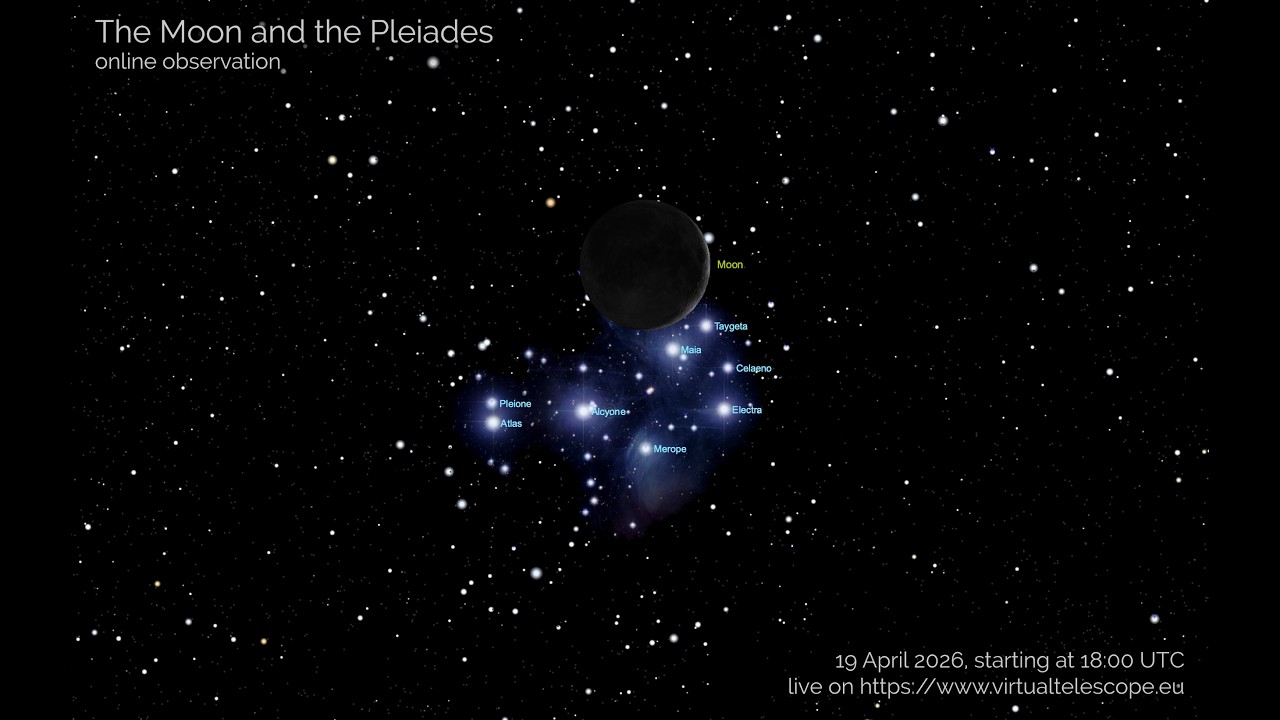
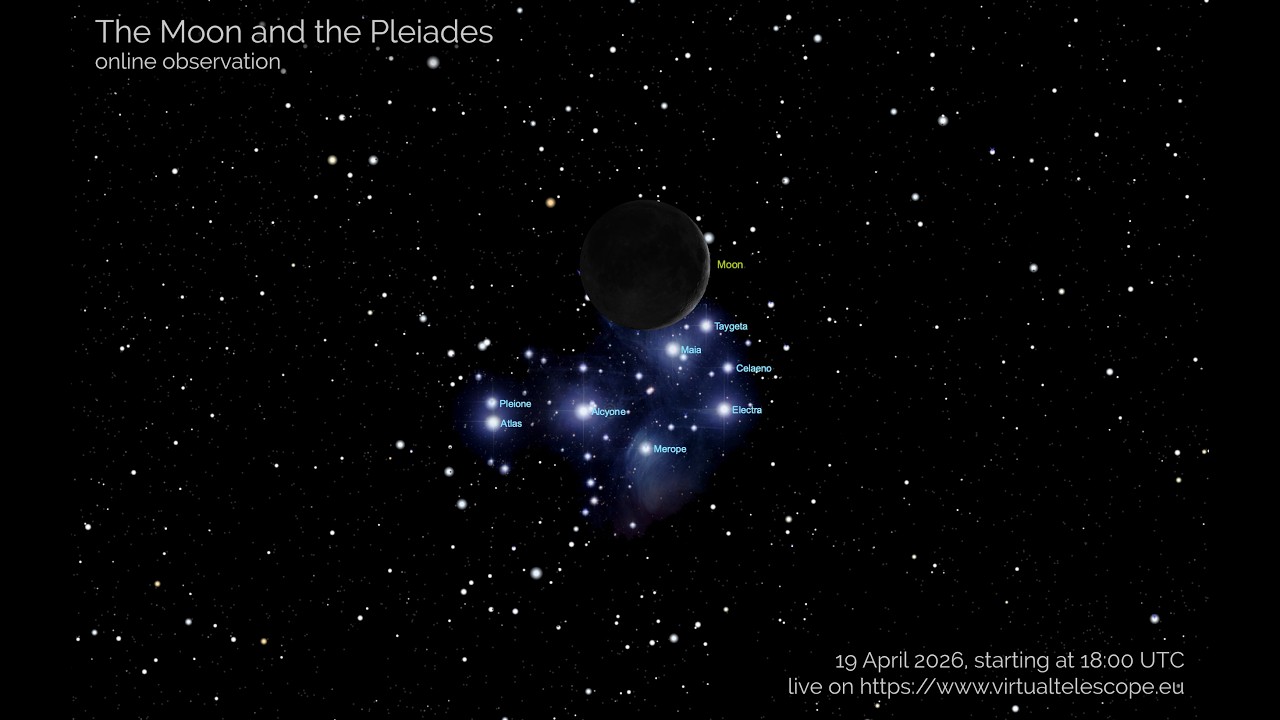
Get ready for an amazing sight, as the waxing crescent moon passes in front of — and briefly occults —the blue-white stars of the Pleiades on April 19. Here’s how to watch the alignment unfold in real time online with this Virtual Telescope Project livestream.
Viewers in Italy, on the other hand, will be perfectly positioned to witness the moon slip from the Pleiades in the hours following sunset, as the lunar disk arcs towards the western horizon, chasing the glow of the retreating sun.
When can I watch?
The Virtual Telescope Project’s YouTube livestream will begin at 2 p.m. EDT (1800 GMT) on April 19, providing real-time telescopic views from its panoramic telescope as the crescent moon slips from the Pleiades in the skies over Italy, weather permitting.
“It will be a memorable sight involving our satellite, showing as a sharp crescent with its elegant ‘earthshine’ and one of the most iconic deep-sky gems, Messier 45,” Virtual Telescope Project founder Gianluca Masi told Space.com in an email.

Gianluca Masi is a professional astronomer and founder of The Virtual Telescope Project, which provides access to several robotic telescopes, along with special events and other scientific outreach initiatives.
Earthshine occurs when sunlight bounces off our planet’s cloudy atmosphere to strike the moon, bathing its unlit side in a subtle glow that can reveal the dark forms of lunar maria, vast plains where ancient lava once cooled and hardened into sweeping basaltic landscapes.
The occultation takes place just two days after the April 17 new moon. Earthshine is particularly easy to spot around this time and the relatively weak glow from the moon’s sunlit crescent won’t be enough to obscure the light of the Pleiades, as its stars — more than 1,000 in total —shine about 445 light-years away in the constellation Taurus.
Editor’s Note: If you would capture a photo of the moon with the Pleiades and want to share it with Space.com’s readers, then please send your photo(s), comments, and your name and location to spacephotos@space.com.










Related Posts
Stay Informed With the Latest & Most Important News
Previous Post
Next Post

Advertisement
-
 01Two Black Holes Observed Circling Each Other for the First Time
 -
 02From Polymerization-Enabled Folding and Assembly to Chemical Evolution: Key Processes for Emergence of Functional Polymers in the Origin of Life
 -
 03Astronomy 101: From the Sun and Moon to Wormholes and Warp Drive, Key Theories, Discoveries, and Facts about the Universe (The Adams 101 Series)
 -
 04True Anomaly hires former York Space executive as chief operating officer
 -
 05Φsat-2 begins science phase for AI Earth images
 -
 06Hurricane forecasters are losing 3 key satellites ahead of peak storm season − a meteorologist explains why it matters
 -
 07Binary star systems are complex astronomical objects − a new AI approach could pin down their properties quickly