
Now Reading: The Goldilocks Problem For Detecting Water In Terrestrial Planets: Constraining Water Abundances In The mid-IR With LIFE
-
01
The Goldilocks Problem For Detecting Water In Terrestrial Planets: Constraining Water Abundances In The mid-IR With LIFE

The Goldilocks Problem For Detecting Water In Terrestrial Planets: Constraining Water Abundances In The mid-IR With LIFE

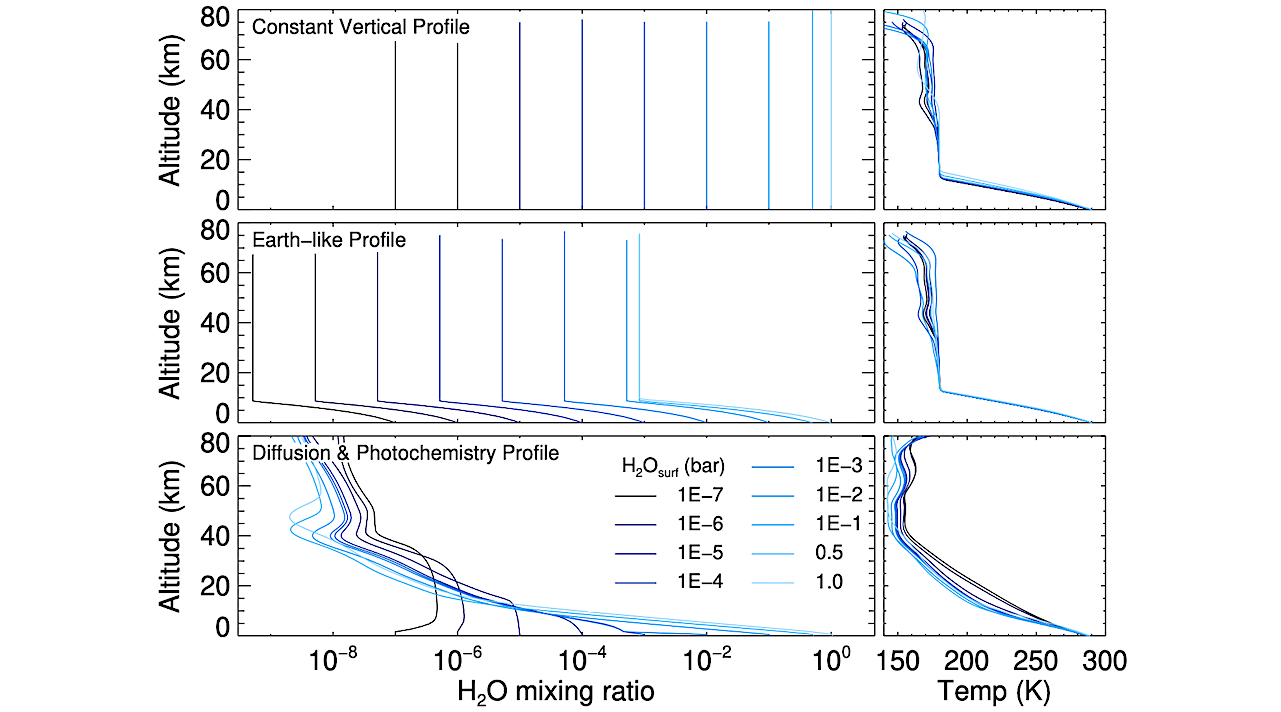
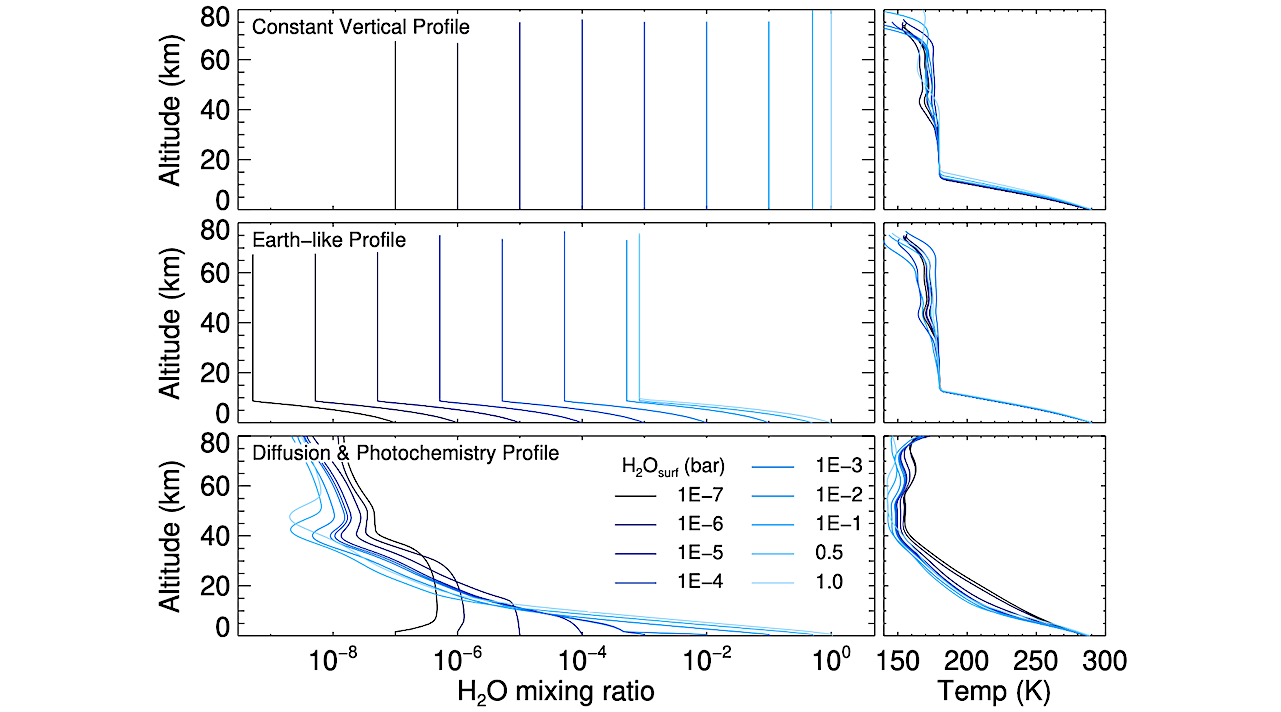
Water mixing ratios vs. altitude for each of our three profile assumptions (left) and the temperature vs altitude profile (right). The surface mixing ratio of water is fixed, spanning concentrations from 10−7 to 1 bar. The water profile above the surface is modeled to be constant with height (top panel), an Earth-like profile (middle panel), or from only diffusion and photochemical production (bottom panel). — astro-ph.EP
We investigate how well the Large Interferometer for Exoplanets (LIFE) mission concept can detect habitable conditions on exoplanets through the presence of atmospheric water vapor as a proxy for surface oceans.
We model the atmosphere of a pre-biotic Earth-like planet across a range of water concentrations, from water-poor to water-rich, with surface partial pressures from 10−7 to 1 bar of H2O.
We simulate LIFE-like noise at spectral resolutions R = 50 and 100 using LIFEsim and perform Bayesian atmospheric retrievals to determine the technical requirements for LIFE to confirm habitability.
We model three vertical water distributions: a vertically constant profile, a Manabe-Wetherald based Earth-like profile, and a diffusion and photochemistry profile to test how the assumed vertical structure influences the retrieved abundances. Clouds are not modeled. We find the ability for LIFE to detect water strongly depends on the vertical profile assumed. LIFE is unable to constrain the highest water cases and provides upper limits on low water planets.
For the highest water abundances, absorption features saturate and reduce sensitivity to characterize precise H2O levels. Water vapor is not detectable in any profile modeled for ≤10−6 bar in surface water, comparable to Mars. For an Earth-like profile, LIFE could constrain H2O concentrations from ∼10−3 to 1 bar, spanning below and above present-day Earth concentrations of 10−2 bar.
Detectable atmospheric water may imply surface oceans, as water is highly reactive and rapidly removed by surface mineral reactions. Thus, LIFE can characterize water abundances indicative of habitable surface conditions.
Sarah Rugheimer, Eleonora Alei, Björn S. Konrad, Benjamin Taysum, John Lee Grenfell, Tim Lichtenberg, Daniel Kitzmann, Floris van der Tak, Sascha P. Quanz, LIFE collaboration
Comments: 19 pages, 8 figures, in press ApJ
Subjects: Earth and Planetary Astrophysics (astro-ph.EP); Instrumentation and Methods for Astrophysics (astro-ph.IM)
Cite as: arXiv:2604.07461 [astro-ph.EP] (or arXiv:2604.07461v1 [astro-ph.EP] for this version)
https://doi.org/10.48550/arXiv.2604.07461
Focus to learn more
Related DOI:
https://doi.org/10.3847/1538-4357/ae5b75
Focus to learn more
Submission history
From: Sarah Rugheimer
[v1] Wed, 8 Apr 2026 18:01:55 UTC (2,630 KB)
https://arxiv.org/abs/2604.07461
Astrobiology, Astrogeology, Astrochemistry,










Related Posts
Stay Informed With the Latest & Most Important News
Advertisement
-
 01Two Black Holes Observed Circling Each Other for the First Time
 -
 02From Polymerization-Enabled Folding and Assembly to Chemical Evolution: Key Processes for Emergence of Functional Polymers in the Origin of Life
 -
 03Astronomy 101: From the Sun and Moon to Wormholes and Warp Drive, Key Theories, Discoveries, and Facts about the Universe (The Adams 101 Series)
 -
 04True Anomaly hires former York Space executive as chief operating officer
 -
 05Φsat-2 begins science phase for AI Earth images
 -
 06Hurricane forecasters are losing 3 key satellites ahead of peak storm season − a meteorologist explains why it matters
 -
 07Binary star systems are complex astronomical objects − a new AI approach could pin down their properties quickly