
Now Reading: The Multi-planet System TOI-5624: Four Transiting Sub-Neptunes With An Outer Companion Revealed By Transit-timing Variations
-
01
The Multi-planet System TOI-5624: Four Transiting Sub-Neptunes With An Outer Companion Revealed By Transit-timing Variations

The Multi-planet System TOI-5624: Four Transiting Sub-Neptunes With An Outer Companion Revealed By Transit-timing Variations

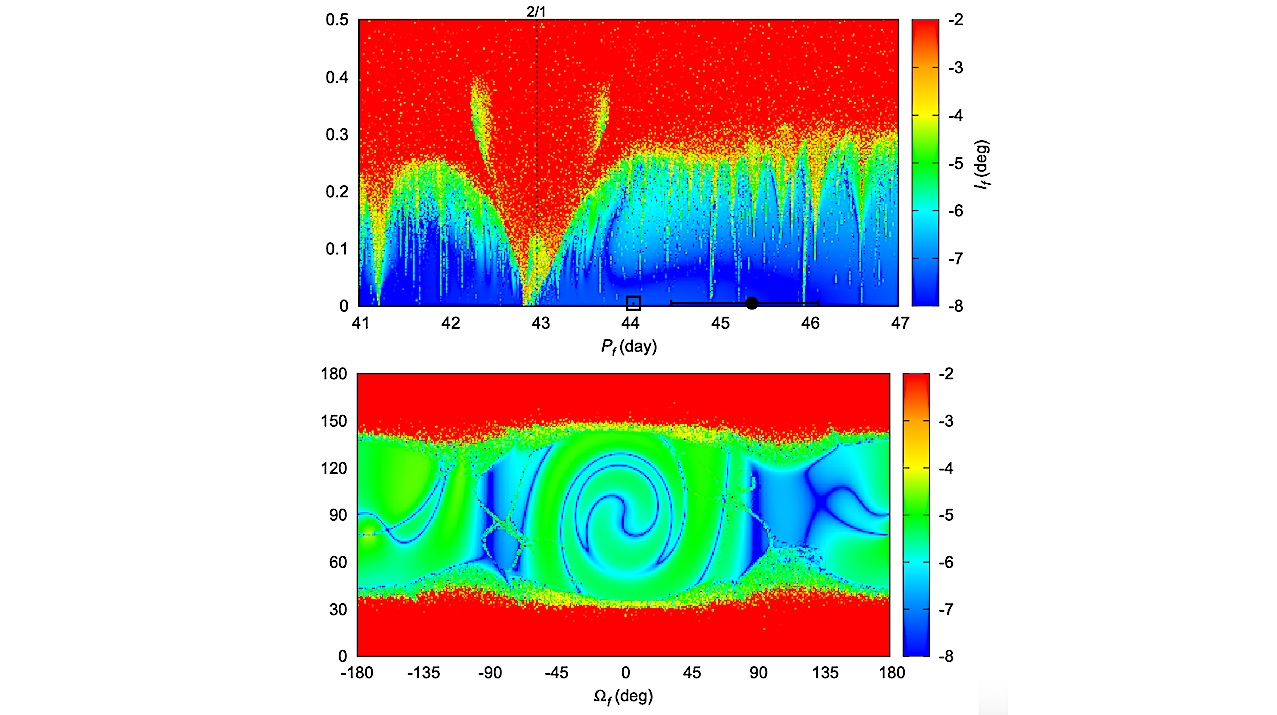
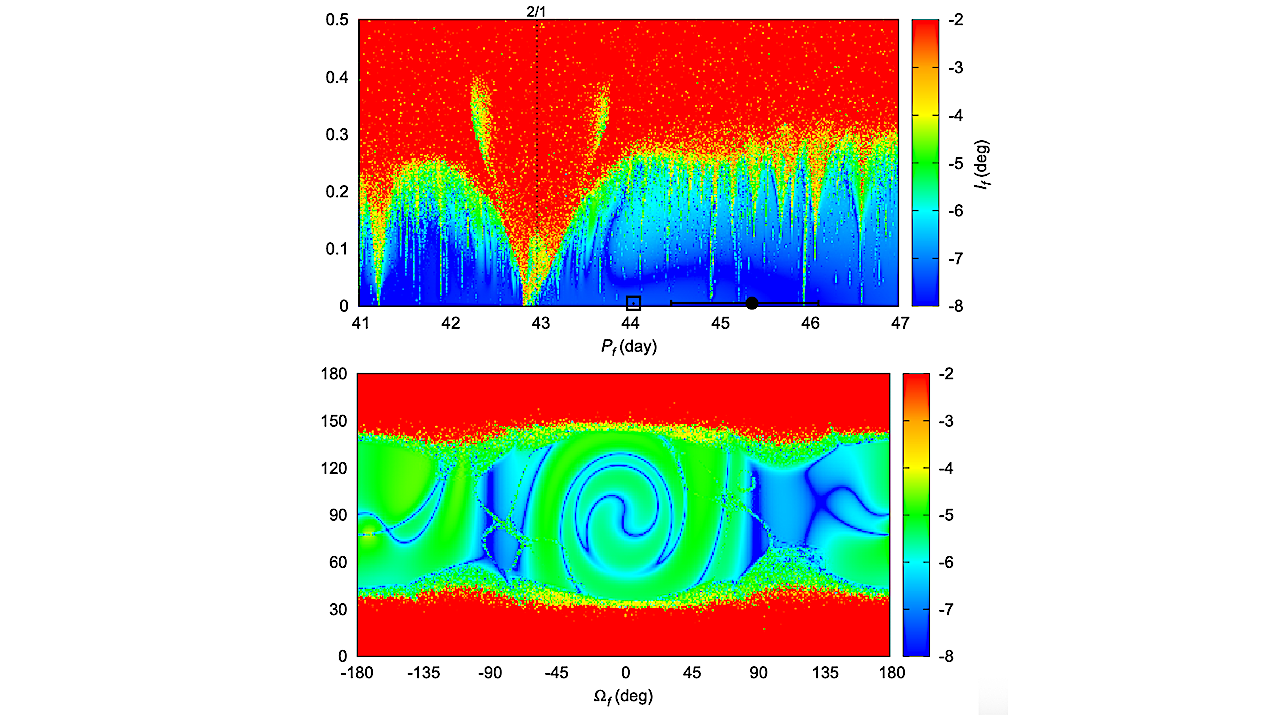
Stability analysis of the TOI-5624 planetary system focusing on planet f. We vary the orbital period Pf and the eccentricity ef (left panel) and the longitude of the node Ωf and the inclination If (right panel), while keeping all the remaining orbital parameters fixed at their best-fit values (Tab. 2). The step size is 0.015 day in the orbital period, 0.0025 in the eccentricity, and 1 ◦ in the longitude of the node and inclination. Plots are colour-coded according to the stability indicator calculated from the frequency analysis of the mean longitude of TOI-5624 f. Red points correspond to highly unstable orbits, while blue points correspond to orbits that are likely to be stable on Gyr timescales. The vertical dashed line (left panel) corresponds to the 2:1 MMR between planets e and f. The black dot along with its error bars highlights the RV-based best-fit solution Pf,RV = 45.37+0.74 −0.90 d from Tab. 2, while the black empty square indicates the more precise orbital period of planet f as inferred from the TTV+RV dynamical analysis (Pf,dyn = 44.092+0.015 −0.057 d, Table C.5). Both solutions (consistent at the 1.4σ level) are compatible with a stable configuration of the system. — astro-ph.EP
Following the 2022 alert of a TESS object of interest transiting TOI-5624 (a G7 V star ∼100 pc away), a CHEOPS campaign in 2023 detected four planetary signals at Pb≈3.4, Pc≈7.9, Pd≈13.7, and Pe≈21.5 days, later confirmed by additional TESS and CHEOPS photometry in 2024-2025.
After analysing the TESS & CHEOPS photometric data, we extracted and modelled the HARPS-N & SOPHIE RV time series using two independent methodologies both within an MCMC framework. We further integrated the N-body equations of motion, while simultaneously fitting the transit times and the detrended RVs, to dynamically characterise the system.
We present the discovery of four transiting sub-Neptunes with radii of Rb=2.314±0.035R⊕, Rc=2.474±0.042R⊕, Rd=3.584+0.051−0.050R⊕, and Re=3.247+0.042−0.043R⊕ and masses of Mb=9.4±1.4M⊕, Mc=4.8±1.9M⊕, Md=4.9±2.2M⊕, and Me=8.9+2.9−3.0M⊕.
Our photometric analysis reveals that the outermost transiting planet TOI-5624 e shows significant TTVs. We find a robust Keplerian signal in the RV time series close to the 2:1 period commensurability with TOI-5624 e, which explains the TTV pattern exhibited by TOI-5624 e according to our dynamical analysis. We label this non-transiting planet as TOI-5624 f and find its minimum mass to be Mfsinif=13.0±3.7M⊕.
Among the known systems hosting more than four planets, the remarkable precision with which the radii have been measured (<1.7%) and the firm assessment (>3σ) of the mass for at least three planets has been previously reached only for TRAPPIST-1. Additional photometric observations will enable a better sample of the TTV modulation and a more robust dynamical determination of the masses.
A. Bonfanti, D. Gandolfi, P. Leonardi, H. P. Osborn, L. M. Serrano, G. Hébrard, N. Billot, A. Bekkelien, G. Olofsson, C. Broeg, D. Nardiello, S. G. Sousa, T. G. Wilson, A. C. M. Correia, C. Pezzotti, A. Brandeker, L. Fossati, M. Gillon, M. Stalport, B. Akinsanmi, Y. Alibert, R. Alonso, J. Asquier, T. Bárczy, D. Barrado, S. C. C. Barros, W. Baumjohann, W. Benz, L. Borsato, A. Castro González, A. Collier Cameron, Sz. Csizmadia, P. E. Cubillos, M. B. Davies, M. Deleuil, X. Delfosse, A. Deline, O. D. S. Demangeon, B.-O. Demory, A. Derekas, F. Destriez, B. Edwards, D. Ehrenreich, A. Erikson, A. Fortier, M. Fridlund, K. Gazeas, M. Güdel, M. N. Günther, N. Hara, N. Heidari, A. Heitzmann, Ch. Helling, K. G. Isaak, T. Keller, L. L. Kiss, D. Kitzmann, J. Korth, G. Lacedelli, K. W. F. Lam, J. Laskar, A. Lecavelier des Etangs, A. Leleu, M. Lendl, D. Magrin, P. F. L. Maxted, M. Mecina, B. Merín, C. Mordasini, V. Nascimbeni, R. Ottensamer, I. Pagano, E. Pallé, G. Peter, D. Piazza, G. Piotto, D. Pollacco, D. Queloz, R. Ragazzoni, N. Rando, H. Rauer, I. Ribas, N. C. Santos, G. Scandariato, D. Ségransan, A. E. Simon, A. M. S. Smith, S. Sulis, Gy. M. Szabó, S. Udry, S. Ulmer-Moll, V. Van Grootel, J. Venturini, F. Verrecchia, E. Villaver, N. A. Walton, S. Wolf, D. Wolter, T. Zingales
Comments: Accepted for publication in A&A. 22 pages (13 in the main text), 4 figures (+9 in the Appendix), 2 tables (+7 in the Appendix). Abstract abridged to satisfy the arXiv submission requirements
Subjects: Earth and Planetary Astrophysics (astro-ph.EP)
Cite as: arXiv:2604.15035 [astro-ph.EP] (or arXiv:2604.15035v1 [astro-ph.EP] for this version)
https://doi.org/10.48550/arXiv.2604.15035
Focus to learn more
Submission history
From: Andrea Bonfanti
[v1] Thu, 16 Apr 2026 14:04:19 UTC (6,147 KB)
https://arxiv.org/abs/2604.15035
Astrobiology, Exoplanet,










Related Posts

Stay Informed With the Latest & Most Important News
Previous Post
Next Post


Advertisement
-
 01Two Black Holes Observed Circling Each Other for the First Time
 -
 02From Polymerization-Enabled Folding and Assembly to Chemical Evolution: Key Processes for Emergence of Functional Polymers in the Origin of Life
 -
 03Astronomy 101: From the Sun and Moon to Wormholes and Warp Drive, Key Theories, Discoveries, and Facts about the Universe (The Adams 101 Series)
 -
 04True Anomaly hires former York Space executive as chief operating officer
 -
 05Φsat-2 begins science phase for AI Earth images
 -
 06Hurricane forecasters are losing 3 key satellites ahead of peak storm season − a meteorologist explains why it matters
 -
 07Binary star systems are complex astronomical objects − a new AI approach could pin down their properties quickly