
Now Reading: The Physical Nature of Regolith on Icy Moons
-
01
The Physical Nature of Regolith on Icy Moons


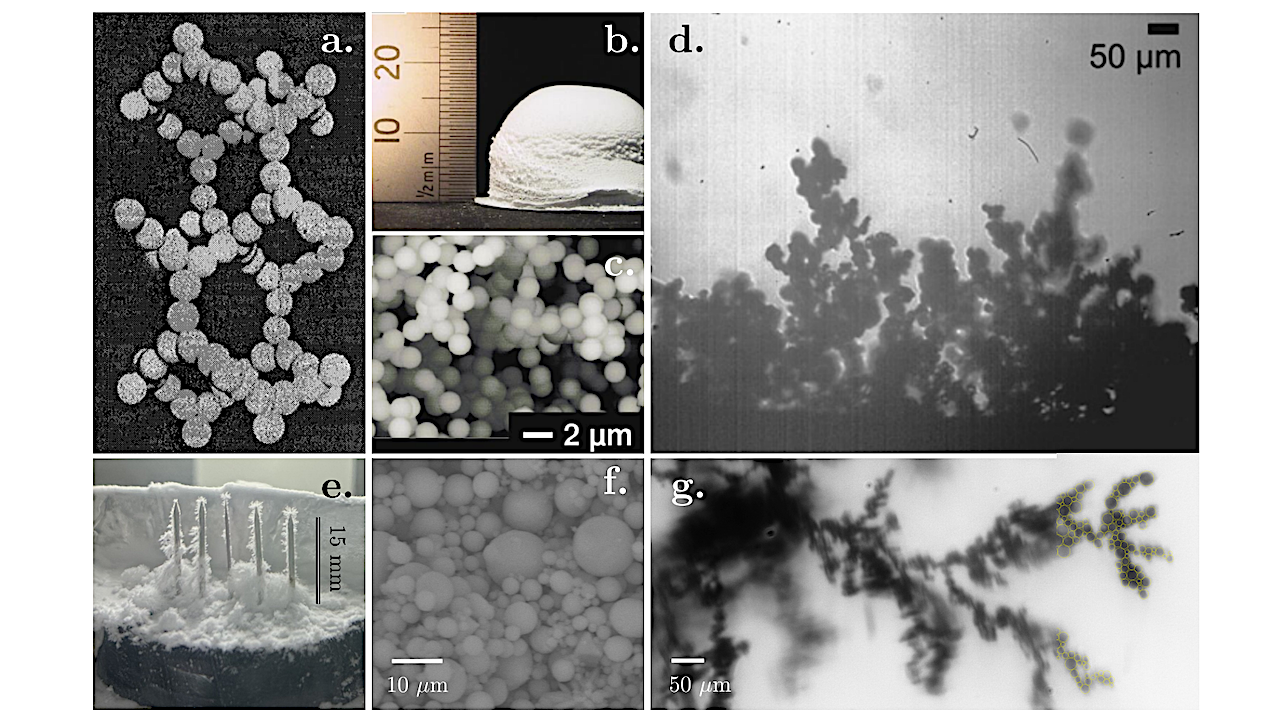
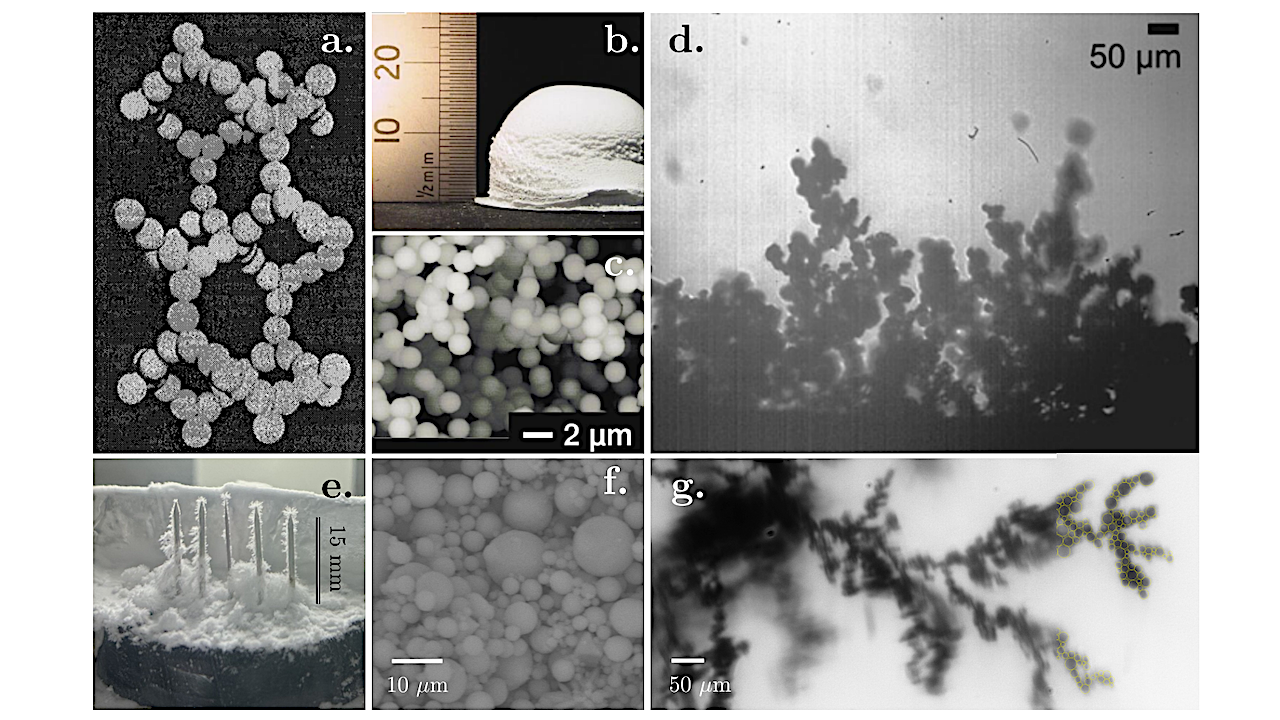
Examples of materials with extremely high porosities (ϕ > 80%). a) Heesch & Laves (1933) 94.45% rigid packing structure. b) and c) pictures from Blum & Schr¨apler (2004) experiments of SiO2 agglomerates with 85% porosity. d) Water ice aggregates with 89% porosity observed with a long-distance microscope (Gundlach et al. 2011). Bottom Row: experimental pictures from the Core-Mantle Particle Sedimentation System e) Cryogenically cooled chamber with 15 mm high needles that serve as sample mounts for ice aggregates. f) Micrometer-sized water ice spheres as seen from the scanning electron microscope. g) Fractal ice aggregates as seen from the long distance microscope. Each individual grain has been highlighted in yellow on the right side of the picture. — astro-ph.EP
Estimating surface properties such as porosity and grain sizes is key for planning lander missions and landing site selection on icy moons.
However, spaceborne instruments do not measure the regolith properties directly: instead, they record proxy measurements such as thermal flux, which are then interpreted through modeling to estimate thermal inertia, porosity, grain size, etc.
A striking conclusion from all thermal measurements that probed the uppermost surface (first millimeters) of icy moons is they all show an exceptionally low thermal inertia, ranging from 9 to 20 J.m-2.K-1.s-0.5. This value is orders of magnitude lower than that of bulk hexagonal water ice (2000 J.m-2.K-1.s-0.5) at these temperatures.
We demonstrate that a regolith thermally dominated by hexagonal water ice may only achieve such thermal inertia through a combination of extremely high porosity (>80%), small grain radii (<1 mm), and an unconsolidated regolith (minimal contact area between grains), consistent with previous photometry and spectroscopy studies. For the Galilean moons, deeper thermal observations (>1 cm) have revealed higher thermal inertia (>~50 J.m-2.K-1.s-0.5), indicating that the regolith compacts over centimeter scales.
Since gravity has no effect on compaction on such scale, we propose three formation scenarios to account for vertical layering: deposition cover, degradation by impactors, and temperature gradient metamorphism.
We discuss how monodisperse grains can reach such extreme porosities and provide examples of experimental analogs that could best represent the regolith. We propose that high porosity regolith are favored on icy moons due to the adhesive nature of water ice and their low-gravity environment.
Cyril Mergny, Thomas Cornet, Alice Le Gall, Guillaume Cruz-Mermy, Lucas Lange, Tina Rückriemen-Bez, Bastian Gundlach, Paula Heitmann, Moritz Goldmann, Paul O. Hayne, Apurva Oza
Comments: Submitted to JGR:Planets on May 11, 2026. Please refer to the published version when available
Subjects: Earth and Planetary Astrophysics (astro-ph.EP)
Cite as: arXiv:2605.27048 [astro-ph.EP] (or arXiv:2605.27048v1 [astro-ph.EP] for this version)
https://doi.org/10.48550/arXiv.2605.27048
Focus to learn more
Submission history
From: Cyril Mergny
[v1] Tue, 26 May 2026 14:02:01 UTC (17,493 KB)
https://arxiv.org/abs/2605.27048
Astrobiology, Astrogeology,










Related Posts
Stay Informed With the Latest & Most Important News
Previous Post
Next Post



Advertisement
-
 01Two Black Holes Observed Circling Each Other for the First Time
 -
 02From Polymerization-Enabled Folding and Assembly to Chemical Evolution: Key Processes for Emergence of Functional Polymers in the Origin of Life
 -
 03Astronomy 101: From the Sun and Moon to Wormholes and Warp Drive, Key Theories, Discoveries, and Facts about the Universe (The Adams 101 Series)
 -
 04True Anomaly hires former York Space executive as chief operating officer
 -
 05Φsat-2 begins science phase for AI Earth images
 -
 06Hurricane forecasters are losing 3 key satellites ahead of peak storm season − a meteorologist explains why it matters
 -
 07Binary star systems are complex astronomical objects − a new AI approach could pin down their properties quickly