
Now Reading: The Search For Technosignatures: A Review Of Possibilities
-
01
The Search For Technosignatures: A Review Of Possibilities


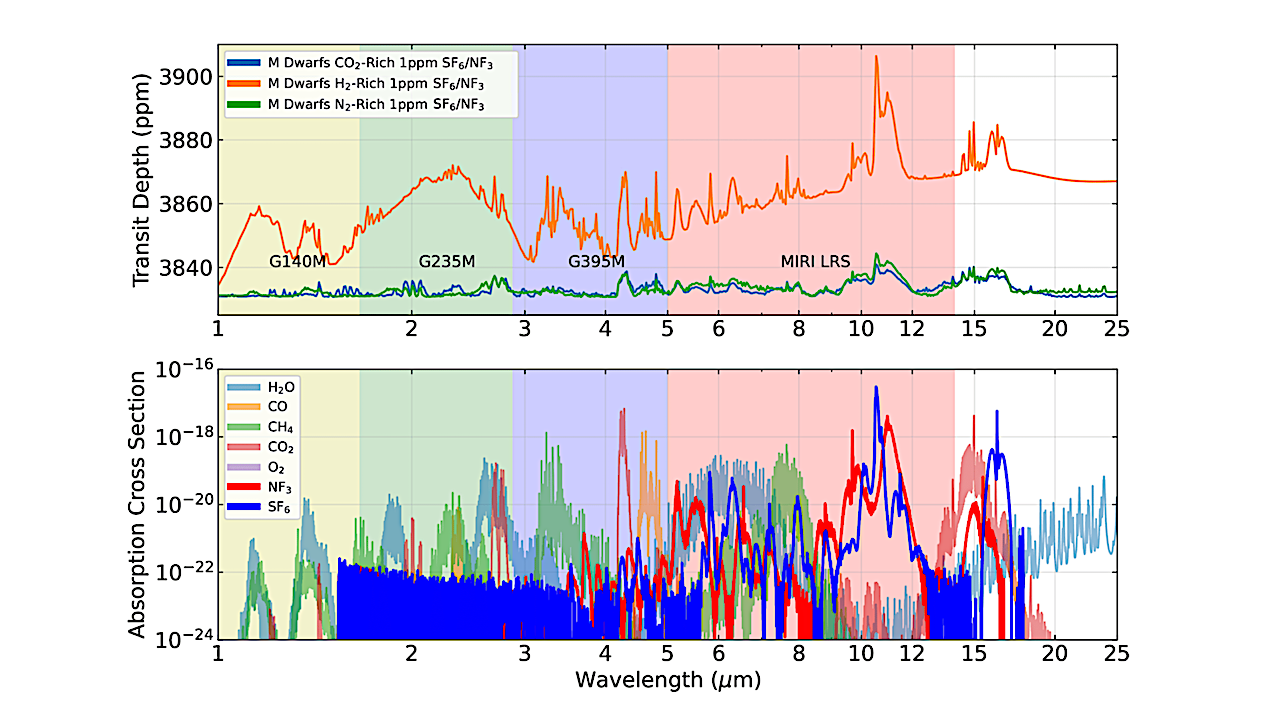
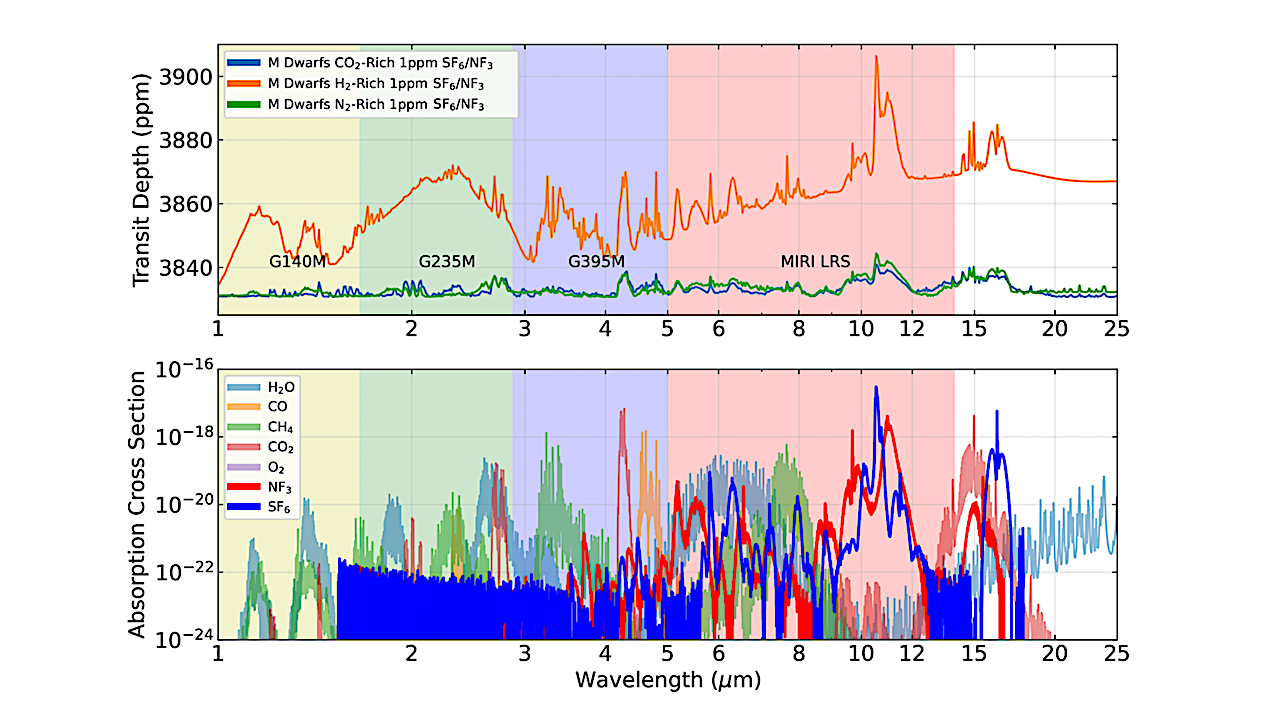
(Top) A simulated transit depth spectrum showing SF6 and NF3 in the atmosphere of terrestrial exoplanets of different atmospheric compositions orbiting an M Dwarf star. The concentrations of SF6 and NF3 are at 1 ppm. (Bottom) Absorption cross sections for various atmospheric molecules, including the industrial produced SF6 and NF3. It is noted that concentrations of 1 ppm for both SF6 and NF3 are orders of magnitude above that of present-day Earth’s abundances of these two industrial gases. The high concentrations of SF6 and NF3 could exist in so-called “service worlds”. Figure from (Seager et al. 2023). — astro-ph.EP
This paper aims to review the diverse range of technosignatures that have been proposed in the literature.
We organize the review by scales, starting carefully from Earth, then zooming out to Earth’s orbit, the solar system, including the Moon, the Earth-Moon Lagrange points, the inner solar system, the asteroid belt, interstellar objects, the outer solar system, the Kuiper belt, the solar gravitational lens region, and the Oort cloud. We then introduce the Kardashev and Barrow scale before exploring exoplanetary technosignatures, from surface, atmospheric to orbital sources.
We next consider stellar technosignatures that may involve massive energy utilization, stellar modification or stellar pollution, and end with a section about compact objects. We then review attempts to detect interstellar communication, and discuss many dimensions of the search space from first principles.
Then we consider interstellar travel technosignatures, and end with galactic, extragalactic and universal signatures. We end with a discussion about synergies between biosignatures and technosignatures searches, anomaly detection, multimodal strategies, instruments for detecting technosignatures, how to evaluate and prioritize the search, as well as epistemological issues.
Clément Vidal, Benji L. Fields, Damian R. Sowinski, Mark Elowitz, Stuart Bartlett, Richard J. Terrile, Alex Ellery, Daliah Bibas, Armando M. Mastrogiovanni, Niklas Döbler, Manika Singla, Julia DeMarines, Theresa Fisher, Yuri Uno, Jake D. Turner, Evan L. Sneed, Advait Huggahalli, Megan Grace Li, Zhuofu (Chester)Li, Macy Huston, Ramiro Saide
Comments: 118 pages, paper started as a collective workshop at the Penn State SETI Symposium (PSETI 2023)
Subjects: Earth and Planetary Astrophysics (astro-ph.EP); Instrumentation and Methods for Astrophysics (astro-ph.IM); Solar and Stellar Astrophysics (astro-ph.SR)
Cite as: arXiv:2605.21093 [astro-ph.EP] (or arXiv:2605.21093v1 [astro-ph.EP] for this version)
https://doi.org/10.48550/arXiv.2605.21093
Focus to learn more
Submission history
From: Clément Vidal
https://arxiv.org/abs/2605.21093
Astrobiology,










Related Posts
Stay Informed With the Latest & Most Important News
Previous Post
Next Post

Advertisement
-
 01Two Black Holes Observed Circling Each Other for the First Time
 -
 02From Polymerization-Enabled Folding and Assembly to Chemical Evolution: Key Processes for Emergence of Functional Polymers in the Origin of Life
 -
 03Astronomy 101: From the Sun and Moon to Wormholes and Warp Drive, Key Theories, Discoveries, and Facts about the Universe (The Adams 101 Series)
 -
 04True Anomaly hires former York Space executive as chief operating officer
 -
 05Φsat-2 begins science phase for AI Earth images
 -
 06Hurricane forecasters are losing 3 key satellites ahead of peak storm season − a meteorologist explains why it matters
 -
 07Binary star systems are complex astronomical objects − a new AI approach could pin down their properties quickly