
Now Reading: Titan’s Plains Revealed: Evidence For A Layered Surface
-
01
Titan’s Plains Revealed: Evidence For A Layered Surface


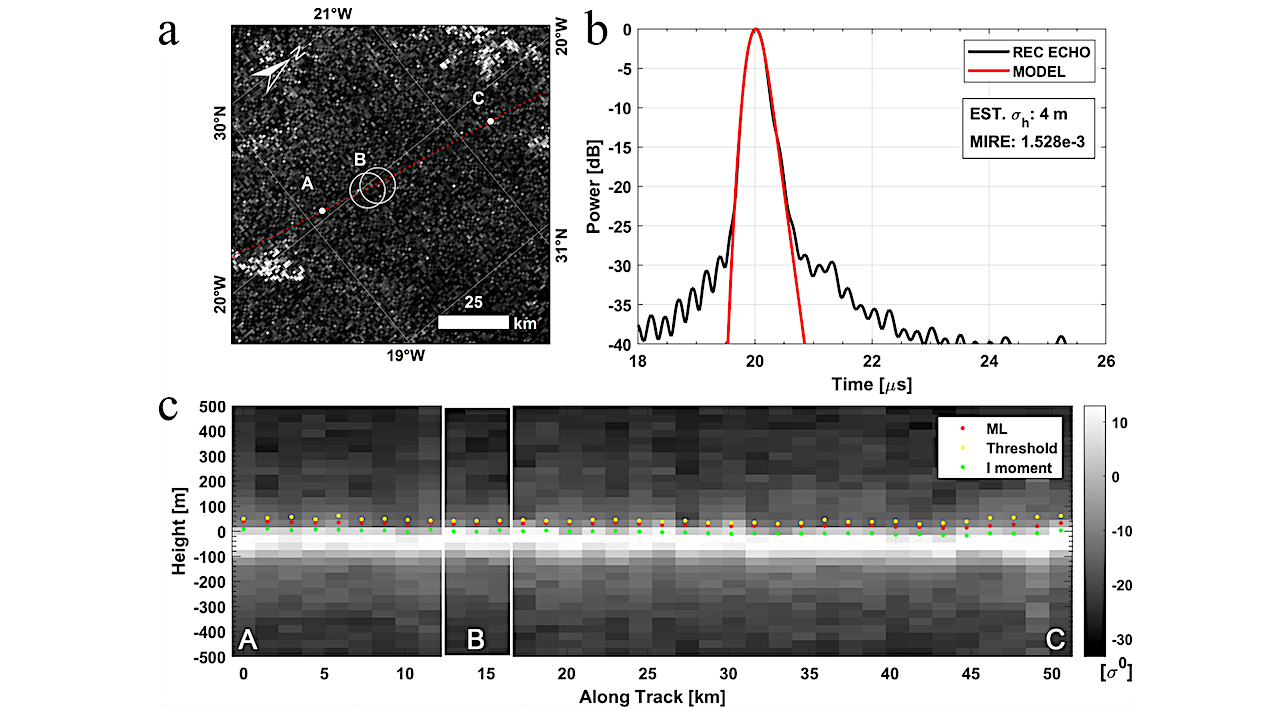
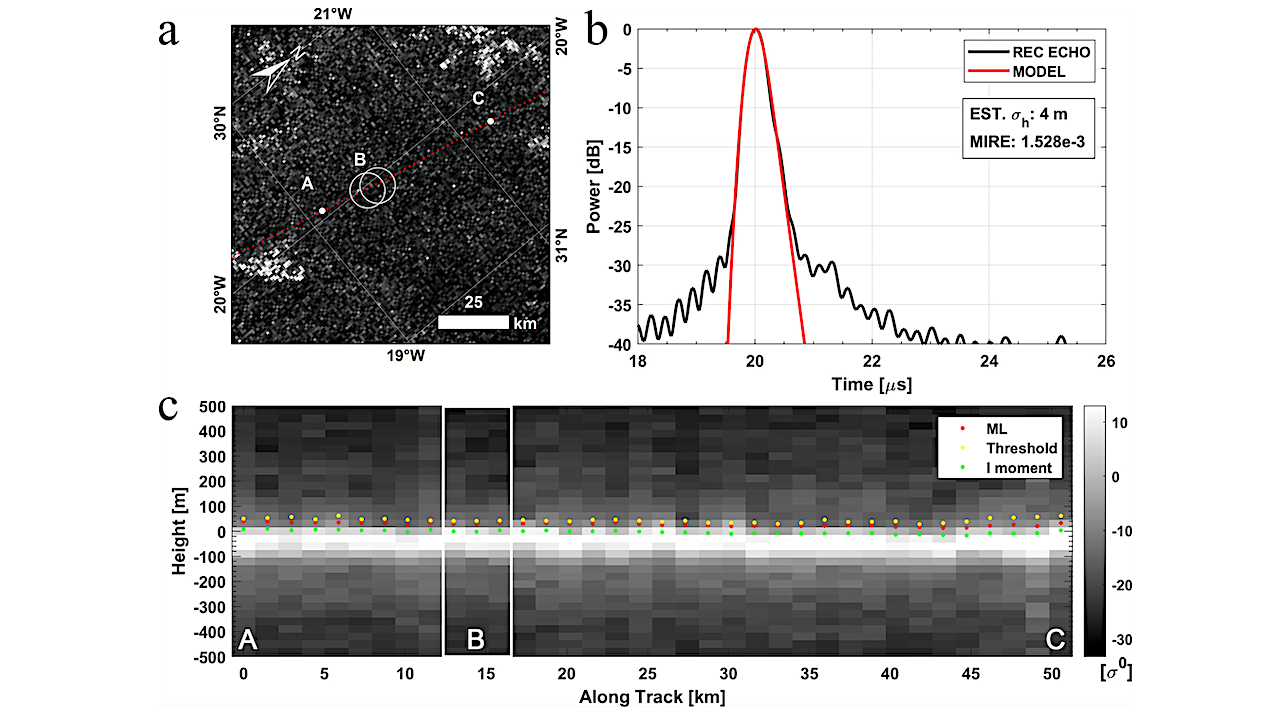
Example of altimeter echo received from plains. This waveform was recorded during flyby T30 from an altitude of 1964.9 km at an incidence angle 0.0137°. Panel (a) shows a context map. Section of the T30 altimeter track observing the plains from point A to C. The waveform resulting from the integration of three echoes (Burst ID 131027162/4) located at point B is shown in panel (b) the altimetric model is used to fit the echo, resulting in an estimated RMS height of 4 m over the 115 square km footprints. The fitting error is indicated as a percentage by the mean integral relative error (MIRE). Panel (c) shows the large-scale topography of the plains using three elevation trackers, Maximum Likelihood, Threshold, and First Moment. All three trackers agree that the overall surface height changes less than 50 m over 50 km. — JGR Planets
Undifferentiated plains are the most common terrain type on Titan, yet their composition and geologic history remain poorly understood.
To better characterize their physical properties, we combined Cassini RADAR measurements from nadir altimetry and side-looking SAR modes. We analyzed these data using radar backscatter models, finding that the multi-angle radar response from undifferentiated plains across Titan is remarkably consistent.
This uniformity suggests globally similar properties and formation processes, permitting aggregate modeling. Our analysis reveals that canonical single-layer scattering models fail to reproduce the observed backscatter, particularly the bright near-nadir returns captured by altimetry, which proved critical for model discrimination and accurate parameter estimation.
Instead, a two-layer model is required to fit the data across all incidence angles. Best-fit parameters indicate undifferentiated plains likely consist of a highly porous, low-density surface layer (effective permittivity 1.33) that is exceptionally smooth at radar wavelengths (RMS slope 2°), overlying a higher-density (effective permittivity >2.7) and rougher buried substrate. This surface layer is likely less than 1 m thick.
The layered structure, along with the observed global uniformity and extreme flatness at multiple scales, is most consistent with long-term atmospheric deposition of organic particles (“tholin snow”), which are subsequently densified or buried, potentially during periods of different environmental conditions.
The structure of the undifferentiated plains provides insights into organic processing and transport on Titan and potentially preserves a record of past environmental conditions. Measurements made by the upcoming Dragonfly mission may provide answers to questions raised by our analysis.
Titan’s Plains Revealed: Evidence for a Layered Surface, JGR Planets (open access)
Astrobiology, Astrogeology,











Related Posts
Stay Informed With the Latest & Most Important News


Advertisement
-
 01Two Black Holes Observed Circling Each Other for the First Time
 -
 02From Polymerization-Enabled Folding and Assembly to Chemical Evolution: Key Processes for Emergence of Functional Polymers in the Origin of Life
 -
 03Astronomy 101: From the Sun and Moon to Wormholes and Warp Drive, Key Theories, Discoveries, and Facts about the Universe (The Adams 101 Series)
 -
 04True Anomaly hires former York Space executive as chief operating officer
 -
 05Φsat-2 begins science phase for AI Earth images
 -
 06Hurricane forecasters are losing 3 key satellites ahead of peak storm season − a meteorologist explains why it matters
 -
 07Binary star systems are complex astronomical objects − a new AI approach could pin down their properties quickly