
Now Reading: Weird, ultra-hot, double-tailed planet surprises scientists
-
01
Weird, ultra-hot, double-tailed planet surprises scientists


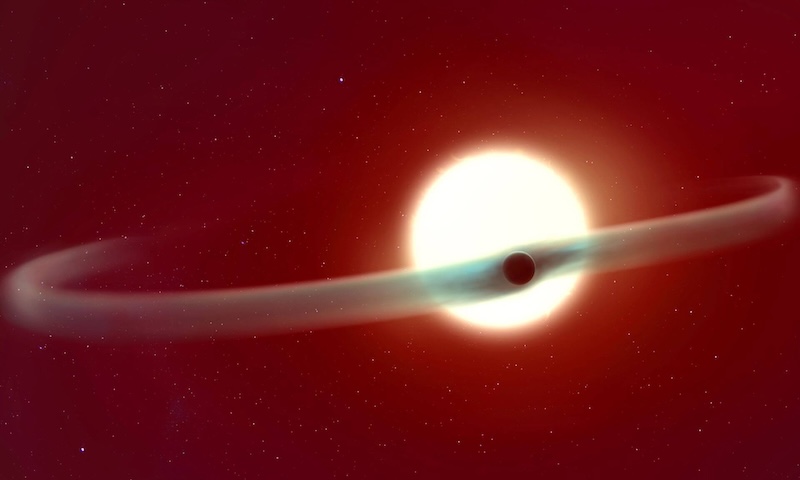
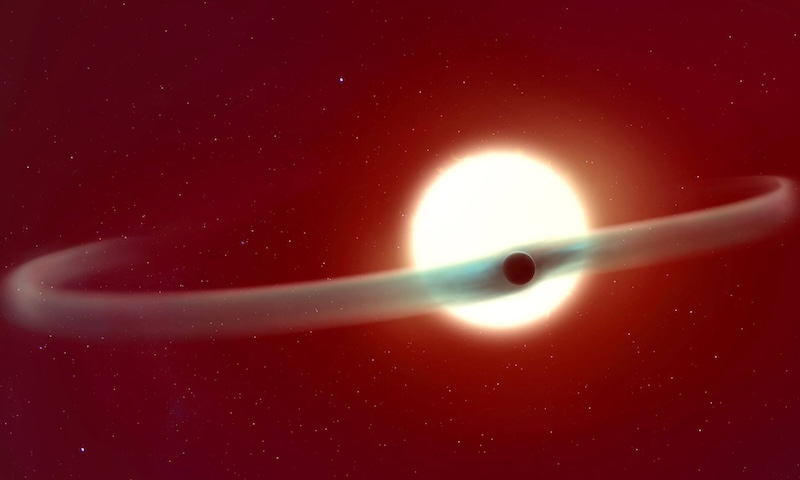
- WASP-121 b is an ‘ultra-hot Jupiter’ exoplanet about 880 light-years away. Radiation from its star is gradually stripping away the planet’s atmosphere.
- This scorching world has two huge tails of helium gas that extend more than halfway along the planet’s orbit.
- Scientists aren’t sure why there are two tails instead of the usual one for such planets. But they suspect that both stellar winds and gravitational forces from the star are involved.
EarthSky’s 2026 lunar calendar is available now. Get yours today! Makes a great gift.
The double-tailed planet
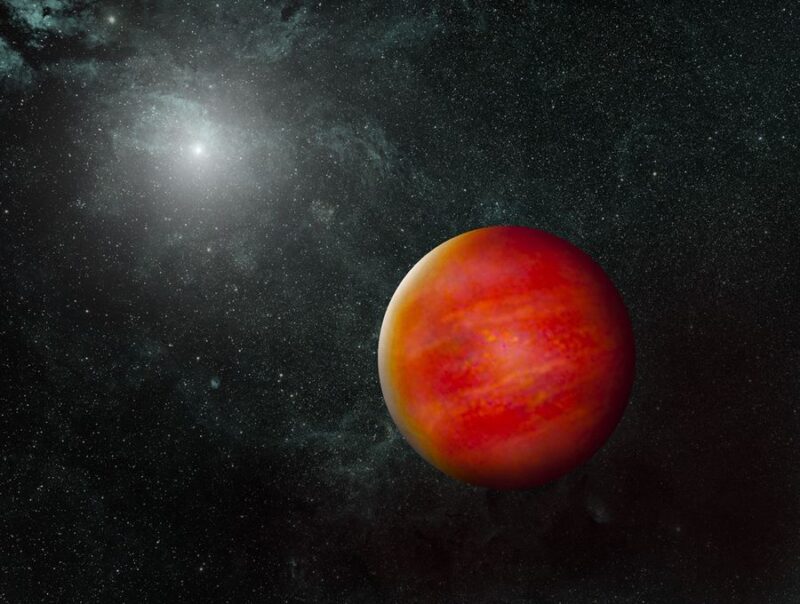
WASP-121 b, a gas giant exoplanet some 880 light-years away, orbits very close to its star. That means the intense radiation from the star blasts the planet’s atmosphere. And as a result, some of the lighter gases in the atmosphere escape into space, forming a comet-like tail.
Researchers in Canada and Switzerland recently monitored the leaking atmosphere using the James Webb Space Telescope and found something surprising. They said on December 8, 2025, that the planet has not just one, but two tails of helium gas that extend around most of the planet’s orbit about its star. Astronomers have seen single planetary tails before, but never pairs. Plus, this is the first time they’ve observed a tail throughout a complete orbit of a planet.
WASP-121 b is a type of world known as an ultra-hot Jupiter. It’s a gas giant, like Jupiter, and it’s superheated by being so close to its star. Because it orbits so close, its year is only 30 days long. Astronomers have dubbed it the “heavy metal exoplanet” because it also has magnesium and iron in its hot atmosphere.
The researchers published the peer-reviewed details of their discovery in Nature Communications on December 8, 2025.
The James Webb Space Telescope has captured two massive helium tails escaping from the atmosphere of WASP-121 b, offering new insight into how intense stellar radiation shapes exoplanet evolution.
— Science X / Phys.org (@sciencex.bsky.social) 2025-12-08T11:14:09-05:00
Huge helium tails
On WASP-121 b, the radiation from the star is gradually stripping away lighter gases, such as helium and hydrogen, from its atmosphere. This forms the planetary tail. But WASP-121 b has two tails, not just one. They stream out from opposite sides of the planet and follow the orbital path of the planet around its star. The tails are huge, wrapping around about 60% of the planet’s orbit like a giant partial ring.
The leading tail curves ahead of the planet and the trailing tail curves away from the planet in the opposite direction. Both tails are composed of helium particles. The total length of the tails is over 100 times the diameter of WASP-121 b.
Romain Allart is a postdoctoral researcher and lead author at the University of Montreal and Trottier Institute for Research on Exoplanets. He said:
We were incredibly surprised to see how long the helium outflow lasted. This discovery reveals the complex physical processes sculpting exoplanet atmospheres and how they interact with their stellar environment. We are only starting to uncover the true complexity of these worlds.

What explains this double-tailed planet?
Astronomers have seen single planetary tails before, but never have they seen a double-tailed planet. So how did these tails form? The researchers say that both stellar wind from the star and gravitational forces are likely involved. But new kinds of 3D simulations will be required to understand the processes involved. Allart explained:
This is truly a turning point. We now have to rethink how we simulate atmospheric mass loss, not just as a simple flow, but with a 3D geometry interacting with its star. This is critical to understand how planets evolve and if gas giant planets can turn into bare rocks.
New clues about planetary evolution
Being able to observe double-tailed planet WASP-121 b provides astronomers with new clues about how planets form and evolve. Whether a new planet keeps its atmosphere or loses it over time has huge implications for what kind of planet it ultimately becomes. It could remain a gas giant, shrink down to a Neptune or sub-Neptune, or lose all of its primordial hydrogen atmosphere and become a rocky world.
Helium, as seen on WASP-121 b, is one of the most effective tracers of atmospheric escape. So this makes WASP-121 b an ideal test planet to study this process in real time. Astronomers will also use the Webb telescope to see just how rare these double tails are.
Bottom line: WASP-121 b is a scorching double-tailed planet. Helium gas is escaping from its atmosphere and forming two huge tails along its orbit.
Read more: Meet WASP-121b, a hot ‘heavy metal’ exoplanet
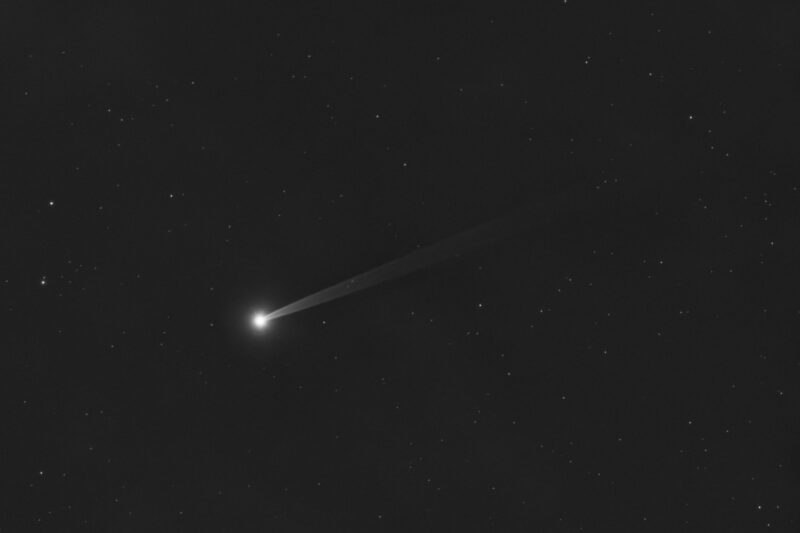
Read more: Mercury’s sodium tail is now appearing in special filters
The post Weird, ultra-hot, double-tailed planet surprises scientists first appeared on EarthSky.










Related Posts
Stay Informed With the Latest & Most Important News
Previous Post
Next Post


Advertisement
-
 01Two Black Holes Observed Circling Each Other for the First Time
 -
 02From Polymerization-Enabled Folding and Assembly to Chemical Evolution: Key Processes for Emergence of Functional Polymers in the Origin of Life
 -
 03Astronomy 101: From the Sun and Moon to Wormholes and Warp Drive, Key Theories, Discoveries, and Facts about the Universe (The Adams 101 Series)
 -
 04True Anomaly hires former York Space executive as chief operating officer
 -
 05Φsat-2 begins science phase for AI Earth images
 -
 06Hurricane forecasters are losing 3 key satellites ahead of peak storm season − a meteorologist explains why it matters
 -
 07Binary star systems are complex astronomical objects − a new AI approach could pin down their properties quickly