
Now Reading: The Evolution Of C4H And c-C3H2 In Molecular Cores
-
01
The Evolution Of C4H And c-C3H2 In Molecular Cores


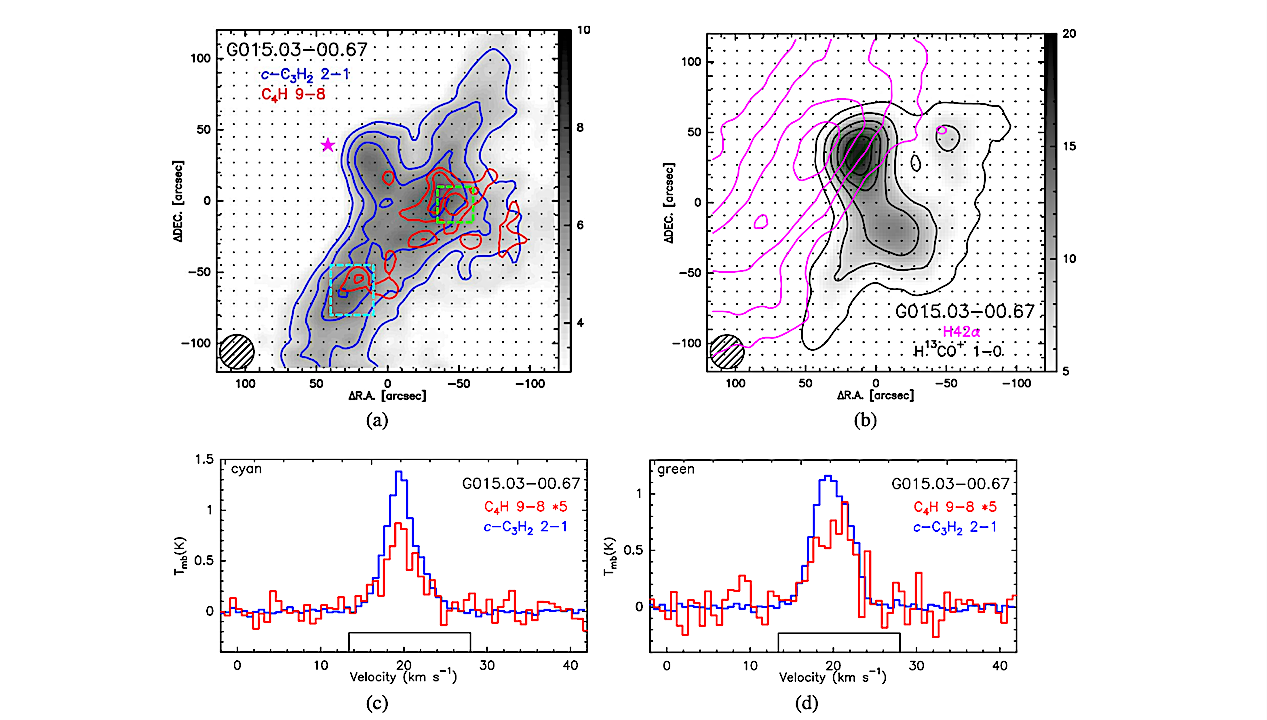
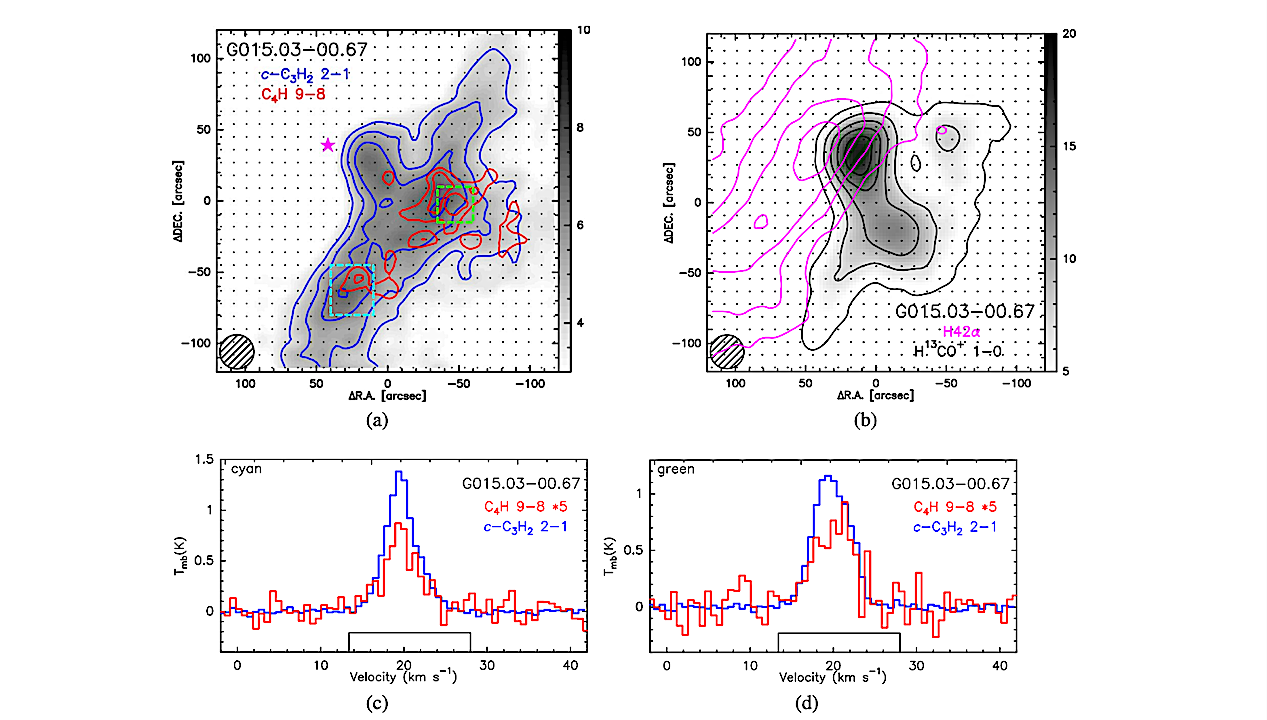
Velocity-integrated intensity maps and spatial averaged spectra of C4H 9–8, c-C3H2 2–1, H13CO+ 1–0, and H42α. The source names are presented in the maps and spectra. The grey scale colour at the right is in units of K km s−1 . (a) and (b) Velocity-integrated intensity maps of G015.03−00.67, where panel (a) shows C4H 9–8 (red contours) overlaid on c-C3H2 2–1 (blue contours and grey scale) and panel (b) shows H42α (magenta contours) overlaid on H13CO+ 1–0 (black contours and grey scale). The excitation peak of H42α is marked with a magenta five-pointed star in panel (a), (c), and (d) Spectra of C4H at 85672.5793 MHz and c-C3H2 at 85338.8940 MHz in the green and cyan box of G015.03-00.67. The detailed mapping information of all sources for C44H 9–8, c-C3H2 2–1 and H13CO+ 1–0 are listed in Table B.3. — astro-ph.GA
Linear C4H and cyclic c-C3H2, as small unsaturated hydrocarbons, are the key precursors to complex organic molecules and are critical components of the interstellar medium. We present on-the-fly mapping observations of C4H 9-8 lines, c-C3H2 2-1, H13CO+ 1-0, and H42 toward a sample of 22 massive star-forming regions using the IRAM 30m telescope.
Our aim is to further explore the evolution of these carbon-chain molecules by combining observational results obtained in cold cores. We employed H13CO+ 1-0 and H42a as tracers to probe the positions of molecular cloud cores and ionised hydrogen regions (HII regions), respectively.
One chemical model in particular, which includes gas, dust grain surface, and icy mantle phases for C4H and c-C3H2 molecules, was used to make comparisons with observed abundances. From mapping observations targeting 31 regions across 22 sources, C4H 9-8 (J = 19/2-17/2) and C4H 9-8 (J = 17/2-15/2) were detected in only 17 regions, while H13CO+ 1-0 and c-C3H2 2-1 were successfully detected in all 31 regions.
We find that the emission of C4H 9-8 and c-C3H2 2-1 is concentrated at the edges of H42a emission regions. The C4H/H13CO+ and c-C3H2/H13CO+ relative abundance ratios range from 0.17 to 1.77 and 1.42 to 6.69, respectively, with a median C4H/c-C3H2 ratio of 0.13. By combining the observational results of cold cores, we find that C4H/H13CO+ and c-C3H2/H13CO++ ratios show a strong decreasing trend as molecular cores evolve.
The decreasing trends in C4H/H13CO+ and c-C33H2/H13CO+ ratios imply that small unsaturated hydrocarbons can be consumed and converted into other organic molecules during the evolution of molecular cores. The spatial concentration of C4H and c-C3H2 emission at the edges of H42a regions further supports their role as precursors in the chemical pathways that lead to complex organic molecules in the interstellar medium.
Yijia Liu, Junzhi Wang, Ningyu Tang, Yajiang Lu, Donghui Quan, Juan Li, Kai Yang, Shu Liu, Yuqiang Li, Siqi Zheng, Chao Ou
Subjects: Astrophysics of Galaxies (astro-ph.GA)
Cite as: arXiv:2605.08790 [astro-ph.GA] (or arXiv:2605.08790v1 [astro-ph.GA] for this version)
https://doi.org/10.48550/arXiv.2605.08790
Focus to learn more
Journal reference: A&A, 708, A254 (2026)
Related DOI:
https://doi.org/10.1051/0004-6361/202659367
Focus to learn more
Submission history
From: Yijia Liu
[v1] Sat, 9 May 2026 08:21:00 UTC (2,292 KB)
https://arxiv.org/abs/2605.08790
Astrobiology, astrochemistry, astrophysics,










Related Posts
Stay Informed With the Latest & Most Important News
Previous Post
Next Post

Advertisement
-
 01Two Black Holes Observed Circling Each Other for the First Time
 -
 02From Polymerization-Enabled Folding and Assembly to Chemical Evolution: Key Processes for Emergence of Functional Polymers in the Origin of Life
 -
 03Astronomy 101: From the Sun and Moon to Wormholes and Warp Drive, Key Theories, Discoveries, and Facts about the Universe (The Adams 101 Series)
 -
 04True Anomaly hires former York Space executive as chief operating officer
 -
 05Φsat-2 begins science phase for AI Earth images
 -
 06Hurricane forecasters are losing 3 key satellites ahead of peak storm season − a meteorologist explains why it matters
 -
 07Binary star systems are complex astronomical objects − a new AI approach could pin down their properties quickly