
Now Reading: Accretion Of Volatile Elements On Earth Without The Need Of A Late Veneer
-
01
Accretion Of Volatile Elements On Earth Without The Need Of A Late Veneer


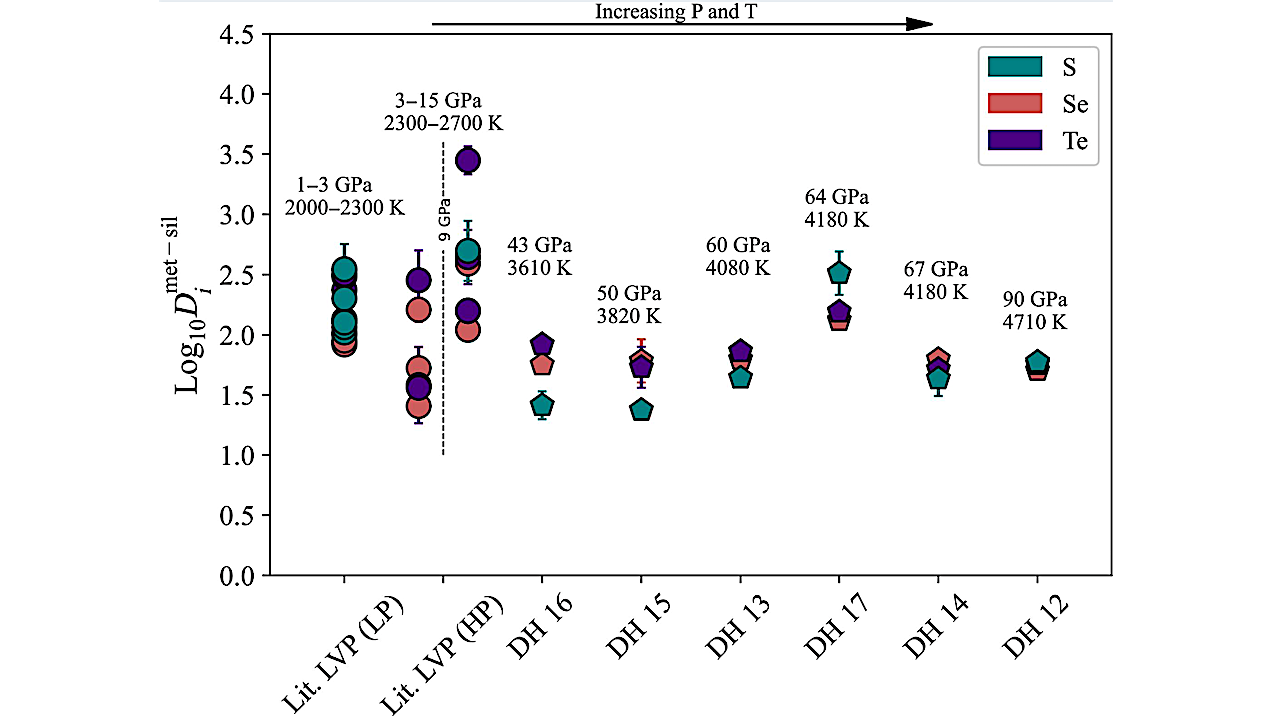

Values from an experimental series in large-volume press experiments (LVP), separated arbitrarily at 9 GPa into lower (LP) and higher pressures (HP) [in circles; (9)], and our experiments (in pentagons, DH16 to DH12) show different metal-silicate partitioning behaviors. As equilibration temperature and pressure increase S, Se, and Te, partition coefficients converge to similar, less siderophile values. — Science Advances via PubMed
Volatile elements are essential for life development and planetary evolution. However, the timing of their delivery to terrestrial planets remains unclear. Sulfur, selenium, and tellurium are volatiles, but also siderophile elements.
Their abundances in Earth’s mantle can be used to determine whether volatile elements were delivered to Earth during or after the segregation of the core. Here, we experimentally measured their partition coefficients between core-forming metal and mantle silicate under pressure, temperature, and oxygen fugacity conditions relevant to a deep magma ocean. Our results show that these elements exhibit similar partitioning behaviors, indicating that core-mantle equilibrium preserves their chondritic relative abundances.
If a volatile-rich late veneer has been delivered to Earth after core segregation, it must have been limited in mass, making up a maximum of 0.1% Earth’s mass. This suggests that volatile elements, including water, were accreted continuously during Earth’s growth rather than being delivered predominantly by a late veneer of volatile-rich material such as carbonaceous chondrites.
Astrobiology, Astrogeology,











Related Posts

Stay Informed With the Latest & Most Important News
Previous Post
Next Post
Previous Post
Next Post

Advertisement
-
 01Two Black Holes Observed Circling Each Other for the First Time
 -
 02From Polymerization-Enabled Folding and Assembly to Chemical Evolution: Key Processes for Emergence of Functional Polymers in the Origin of Life
 -
 03Astronomy 101: From the Sun and Moon to Wormholes and Warp Drive, Key Theories, Discoveries, and Facts about the Universe (The Adams 101 Series)
 -
 04True Anomaly hires former York Space executive as chief operating officer
 -
 05Φsat-2 begins science phase for AI Earth images
 -
 06Hurricane forecasters are losing 3 key satellites ahead of peak storm season − a meteorologist explains why it matters
 -
 07Binary star systems are complex astronomical objects − a new AI approach could pin down their properties quickly