
Now Reading: Why are the Voyager spacecraft getting closer to Earth now?
-
01
Why are the Voyager spacecraft getting closer to Earth now?


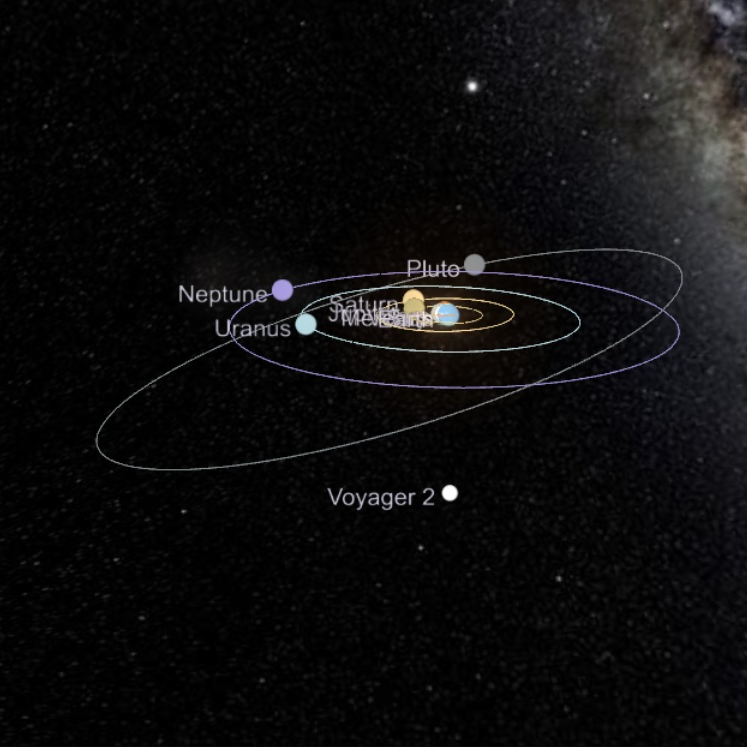
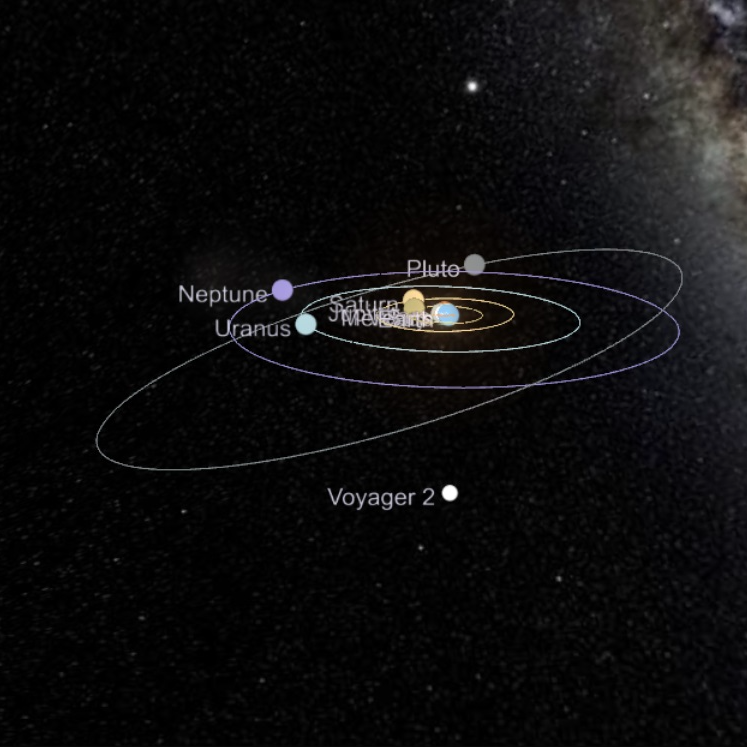
Why are the Voyager spacecraft getting closer to Earth?
For a few months each year, the distances between the Voyager spacecraft and Earth actually decrease. You might know that both Voyager spacecraft were launched into space in the 1970s and visited the outer planets through the 1980s. They’ve been heading out of our solar system ever since. In 2012, Voyager 1 entered interstellar space. Then, in 2018, NASA announced that Voyager 2 had entered interstellar space, too. They are both headed outward, never to return to Earth. So, can they get closer?
The answer is that for a few months each year, Earth in its orbit moves toward the spacecraft faster than they’re moving away. Earth’s motion around the sun is faster than the motion of the Voyager spacecraft. Earth moves through space at a speed of 67,000 miles per hour (30 km/s). Voyager 1 moves at a speed of 38,000 miles per hour (17 km/s). Voyager 2 moves at a speed of 35,000 miles per hour (16 km/s).
So, for a portion of the year, Earth comes around the side of the sun and is speeding toward the spacecraft faster than they’re moving away. Therefore their distances to Earth are getting closer, if only temporarily. They never change their outward motion. It is we who change.
From this video, you can see the trajectory of the Voyager spacecraft as they leave Earth, encounter the outer planets (changing their trajectories), and then head in a straight line outward, out of the solar system.
Where are Voyager 1 and Voyager 2 now?
A closer look at Voyager 2 in relation to Earth
Let’s look specifically at Voyager 2 as an example. Every year from late February to the beginning of June, Voyager 2 actually gets closer to Earth. We measure the distance between objects in space in astronomical units, or AU. This measurement is based on the distance between Earth and the sun, which is one AU.
On February 9, 2026, Voyager 2 was 143.09 AU from Earth. Then, Earth’s orbit began bringing us closer to Voyager 2 once again. The distance between us and Voyager 2 will continue to shrinking until early June when it’ll be 143.4 AU from Earth.
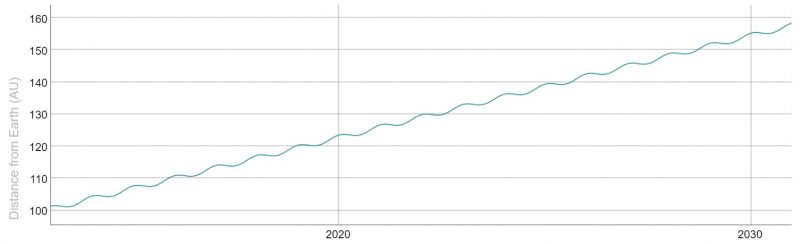
Bottom line: The Voyager spacecraft are on a never-ending journey away from Earth. So, why do the distances between the spacecraft and Earth decrease for a few months every year? It’s because for a few months, Earth moves toward the spacecraft faster in its orbit around the sun than the spacecraft moves away from us.
The post Why are the Voyager spacecraft getting closer to Earth now? first appeared on EarthSky.










Related Posts
Stay Informed With the Latest & Most Important News
Previous Post
Next Post


Advertisement
-
 01Two Black Holes Observed Circling Each Other for the First Time
 -
 02From Polymerization-Enabled Folding and Assembly to Chemical Evolution: Key Processes for Emergence of Functional Polymers in the Origin of Life
 -
 03Astronomy 101: From the Sun and Moon to Wormholes and Warp Drive, Key Theories, Discoveries, and Facts about the Universe (The Adams 101 Series)
 -
 04True Anomaly hires former York Space executive as chief operating officer
 -
 05Φsat-2 begins science phase for AI Earth images
 -
 06Hurricane forecasters are losing 3 key satellites ahead of peak storm season − a meteorologist explains why it matters
 -
 07Binary star systems are complex astronomical objects − a new AI approach could pin down their properties quickly