
Now Reading: Landspace launches improved Zhuque-2E, Long March 6A lofts new Qianfan satellite group
-
01
Landspace launches improved Zhuque-2E, Long March 6A lofts new Qianfan satellite group

Landspace launches improved Zhuque-2E, Long March 6A lofts new Qianfan satellite group

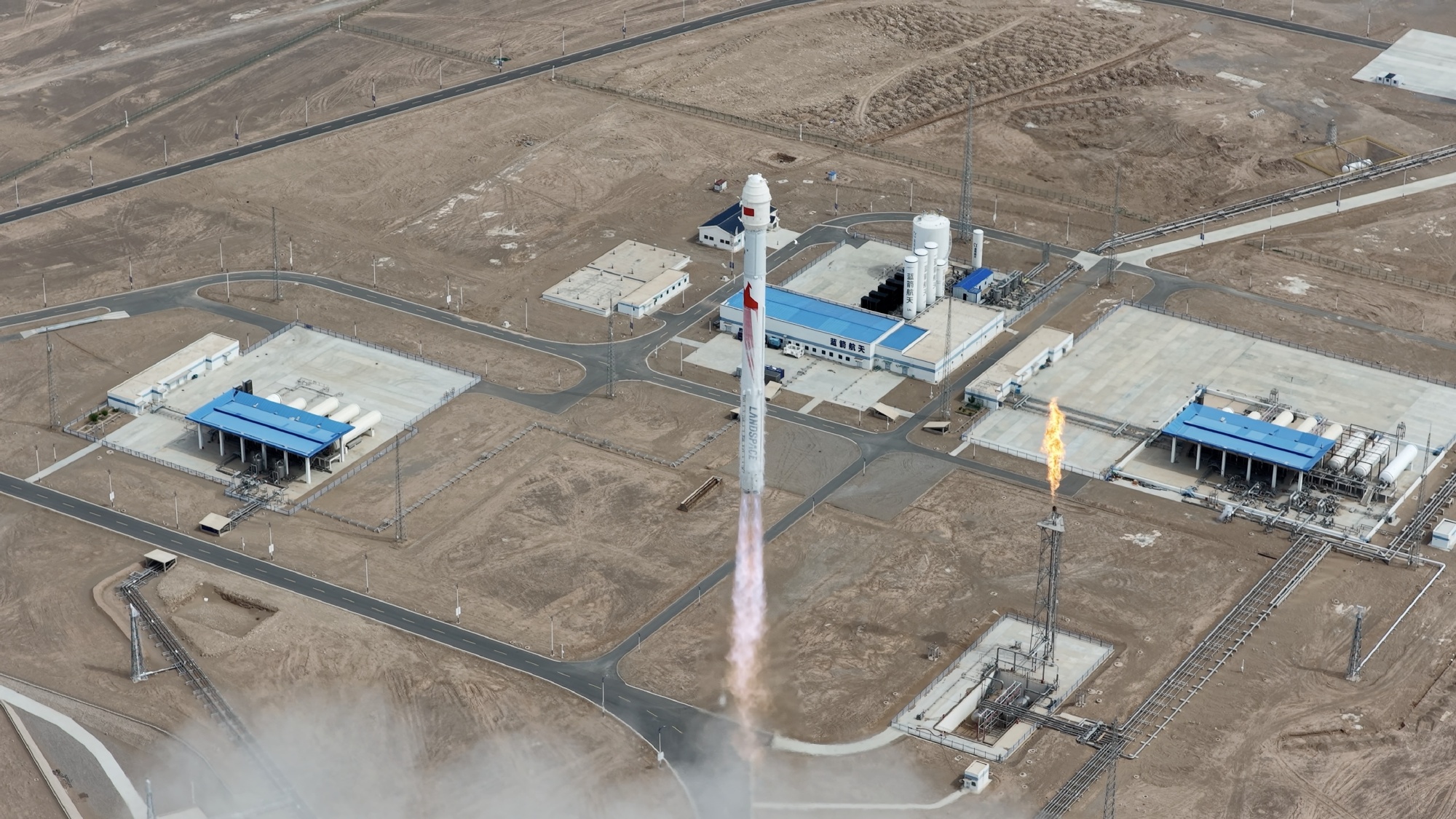

HELSINKI — China has added a new batch of satellites to the Qianfan megaconstellation, while the commercial Zhuque-2E made a return-to-flight featuring numerous improvements.
The Zhuque-2E methane-liquid oxygen rocket lifted off at 11:00 p.m. Eastern, May 13 (0300 UTC, May 14) from a dedicated Landspace pad at the Dongfeng Commercial Space Innovation Test Area at Jiuquan Satellite Launch Center, northwest China.
The launch successfully inserted a 2,800-kilogram customized payload described as a “large-scale constellation deployment experiment” into a 900-kilometer polar orbit, according to Landspace. The mission demonstrated high-mass payload launch capability and readiness for multi-satellite launch services, the company said in a post-launch statement, as it looks to secure launch contracts from China’s megaconstellation projects.
It was the fourth launch of the Zhuque-2E, a “block 2” variant of the original Zhuque-2 which debuted in 2022, and reached orbit on its second flight in July 2023. The previous Zhuque-2E flight, in August 2025, ended in failure and the loss of four satellites. The failure of the Zhuque-2E (Y3) was caused by a voltage issue affecting the second stage, triggering a self-destruct, according to Landspace.
The 3.35-meter-diameter, 55.9-meter-long Zhuque-2E (Y5) includes a number of improvements over the previous version, indicating a successful iterative design process. Improvements include lengthened first-stage tanks, combined with full subcooled propellant loading, a three-ignition second stage allowing orbital disposal, and an accelerated launch campaign and launch cycle. In terms of Landspace’s numbering of flights and rockets, it is unclear if or when the Zhuque-2E (Y4) will fly.
The Zhuque-2E can now deliver 4,000 kg to a 500-km Sun-synchronous orbit (SSO) or 6,000 kg low Earth orbit (LEO). Landspace is also preparing for a second launch and recovery attempt of the methalox, stainless steel Zhuque-3, which reached orbit in December but first stage recovery failed. The second Zhuque-3 appears to have been transported to Jiuquan in late April.
Landspace is currently working on an initial public offering, with its application accepted by the Shanghai Stock Exchange’s STAR Market in late December and currently under regulatory review. The company is targeting $1 billion for its reusable rockets, with the prospectus implying post-IPO valuation of $11 billion (75 billion yuan).
Qianfan constellation grows
The Zhuque-2E launch followed two days after a launch from Taiyuan Satellite Launch Center, north China.
A Long March 6A rocket lifted off at 7:59 a.m. Eastern (1159 UTC) May 12 from Taiyuan, successfully inserting 18 satellites into polar orbits for the Qianfan (Thousand Sails) broadband megaconstellation.
The satellites were manufactured by the Shanghai Engineering Center for Microsatellites. The project is led by Shanghai Spacecom Satellite Technology (SSST), also known as Spacesail.
The launch was the eighth for the Qianfan constellation, which now has launched 144 satellites into orbit. The previous launch took place in April, the next is scheduled for May 17 from the Hainan commercial satellite launch center. Before that, a Lijian-1 (Kinetica-1) solid rocket is scheduled to launch from Jiuquan early Friday (May 15).
The Zhuque-2E and Long March 6A launches were China’s 28th and 29th launches of 2026, with the country understood to be targeting more than 100 orbital launch attempts in a year for the first time.










Related Posts
Stay Informed With the Latest & Most Important News
Previous Post
Next Post


Advertisement
-
 01Two Black Holes Observed Circling Each Other for the First Time
 -
 02From Polymerization-Enabled Folding and Assembly to Chemical Evolution: Key Processes for Emergence of Functional Polymers in the Origin of Life
 -
 03Astronomy 101: From the Sun and Moon to Wormholes and Warp Drive, Key Theories, Discoveries, and Facts about the Universe (The Adams 101 Series)
 -
 04True Anomaly hires former York Space executive as chief operating officer
 -
 05Φsat-2 begins science phase for AI Earth images
 -
 06Hurricane forecasters are losing 3 key satellites ahead of peak storm season − a meteorologist explains why it matters
 -
 07Binary star systems are complex astronomical objects − a new AI approach could pin down their properties quickly