
Now Reading: Solar Twins In Gaia DR3 GSP-Spec II. Age Distribution And Its Implications For The Sun’s Migration
-
01
Solar Twins In Gaia DR3 GSP-Spec II. Age Distribution And Its Implications For The Sun’s Migration

Solar Twins In Gaia DR3 GSP-Spec II. Age Distribution And Its Implications For The Sun’s Migration

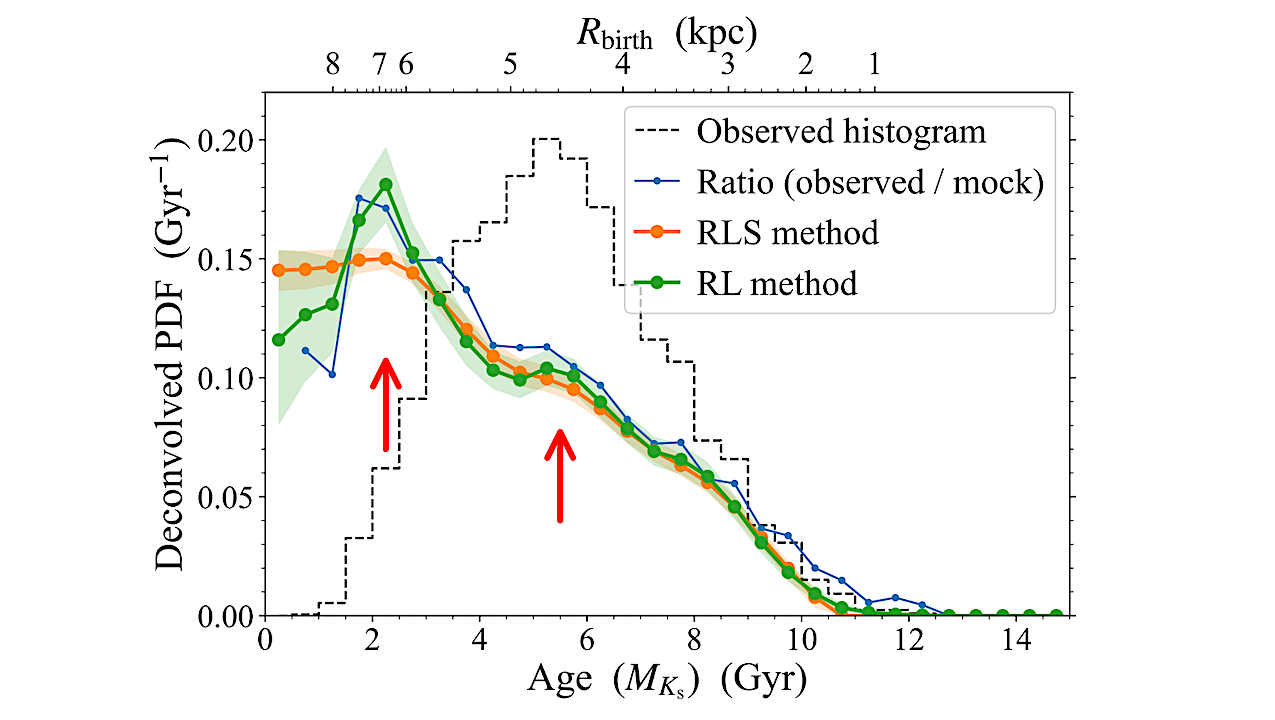
(Deconvolved) probability density function (PDF) of the ages of solar twins determined with MKs . The dotted black line shows the normalized age histogram of our solar twin catalog (same as the blue histogram in Fig. B.1). The blue line shows the normalized ratio between the observed and mock age histograms, as a rough estimate of the intrinsic age distribution. Orange and green lines represent the deconvolved, intrinsic age distributions obtained using the two different (RLS and RL) methods. Shaded regions indicate the statistical uncertainty in the deconvolved PDFs, estimated from 104 Monte Carlo realizations assuming Poisson statistics for the original age histogram (see Appendix C for a validation of this uncertainty estimate). The upper axis provides reference Rbirth values, based on the [Fe/H] = 0 dex slice of the age–Rbirth–[Fe/H] relation in Ratcliffe et al. (2023). See Fig. D.1 for results using log g and those using MG. — astro-ph.GA
Solar twins are among the most powerful tracers of Galactic disk evolution owing to their unique property of sharing nearly solar metallicities ([Fe/H] ~ 0) while spanning a wide range of ages.
To grasp solar twins as relics of Galaxy evolution, individual twins must be tagged with ages. A sufficiently large and well-characterized stellar sample then allows us to construct an age distribution that encodes the star formation history beyond our local region, modulated by the efficiency of radial migration of stars.
Based on our catalog of 6,594 high-quality local (<~ 300 pc) solar twins from the Gaia Data Release 3 spectroscopic (GSP-Spec) catalog, we derived their age distribution after carefully deconvolving the selection function.
We find two distinct features: a narrow peak around ~ 2 Gyr and a broad bump extending over ~ 4–6 Gyr. First, we argue that the former corresponds to a relatively recent burst of star formation that occurred in the disk, including at least a local region within a few kiloparsecs of the Sun, which is in good agreement with previous results deduced from independent works.
On the other hand, the older bump, closely associated with the Sun’s birth epoch, is intriguing since this finding challenges the predicted presence of a corotation barrier built by the Galactic bar, which is thought to prevent stars born inside R_GC ~ 6 kpc from reaching the solar neighborhood.
We propose that the large number of local twins with ages between 4 and 6 Gyr provides compelling evidence that the Sun’s long-distance (>= 3 kpc) migration is shared by many inner disk stars. This, in turn, suggests a possible link with the epoch of bar formation, which may have triggered enhanced star formation in the inner disk and induced efficient radial migration.
Takuji Tsujimoto, Daisuke Taniguchi, Alejandra Recio-Blanco, Pedro A. Palicio, Patrick de Laverny
Comments: 8 pages (main text 4 pages), 2+9 figures. Published in A&A
Subjects: Astrophysics of Galaxies (astro-ph.GA); Solar and Stellar Astrophysics (astro-ph.SR)
Cite as: arXiv:2603.11155 [astro-ph.GA] (or arXiv:2603.11155v1 [astro-ph.GA] for this version)
https://doi.org/10.48550/arXiv.2603.11155
Focus to learn more
Related DOI:
https://doi.org/10.1051/0004-6361/202658914
Focus to learn more
Submission history
From: Daisuke Taniguchi
[v1] Wed, 11 Mar 2026 18:00:00 UTC (347 KB)
https://arxiv.org/abs/2603.11155
Astrobiology, Stellar Cartography,










Related Posts
Stay Informed With the Latest & Most Important News



Advertisement
-
 01Two Black Holes Observed Circling Each Other for the First Time
 -
 02From Polymerization-Enabled Folding and Assembly to Chemical Evolution: Key Processes for Emergence of Functional Polymers in the Origin of Life
 -
 03Astronomy 101: From the Sun and Moon to Wormholes and Warp Drive, Key Theories, Discoveries, and Facts about the Universe (The Adams 101 Series)
 -
 04True Anomaly hires former York Space executive as chief operating officer
 -
 05Φsat-2 begins science phase for AI Earth images
 -
 06Hurricane forecasters are losing 3 key satellites ahead of peak storm season − a meteorologist explains why it matters
 -
 07Binary star systems are complex astronomical objects − a new AI approach could pin down their properties quickly