
Now Reading: Observation Of Spontaneous N-bearing PAH Formation Using Ion Trap: A New Formation Pathway In The Interstellar Medium
-
01
Observation Of Spontaneous N-bearing PAH Formation Using Ion Trap: A New Formation Pathway In The Interstellar Medium

Observation Of Spontaneous N-bearing PAH Formation Using Ion Trap: A New Formation Pathway In The Interstellar Medium

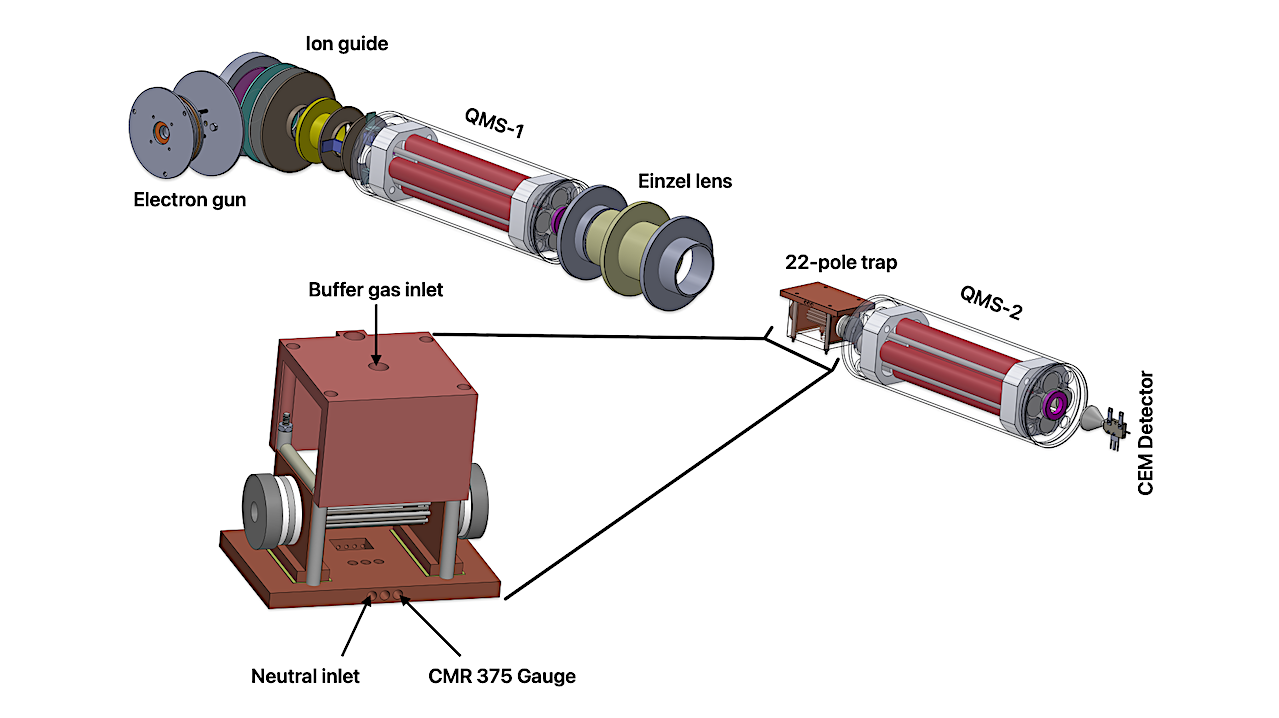
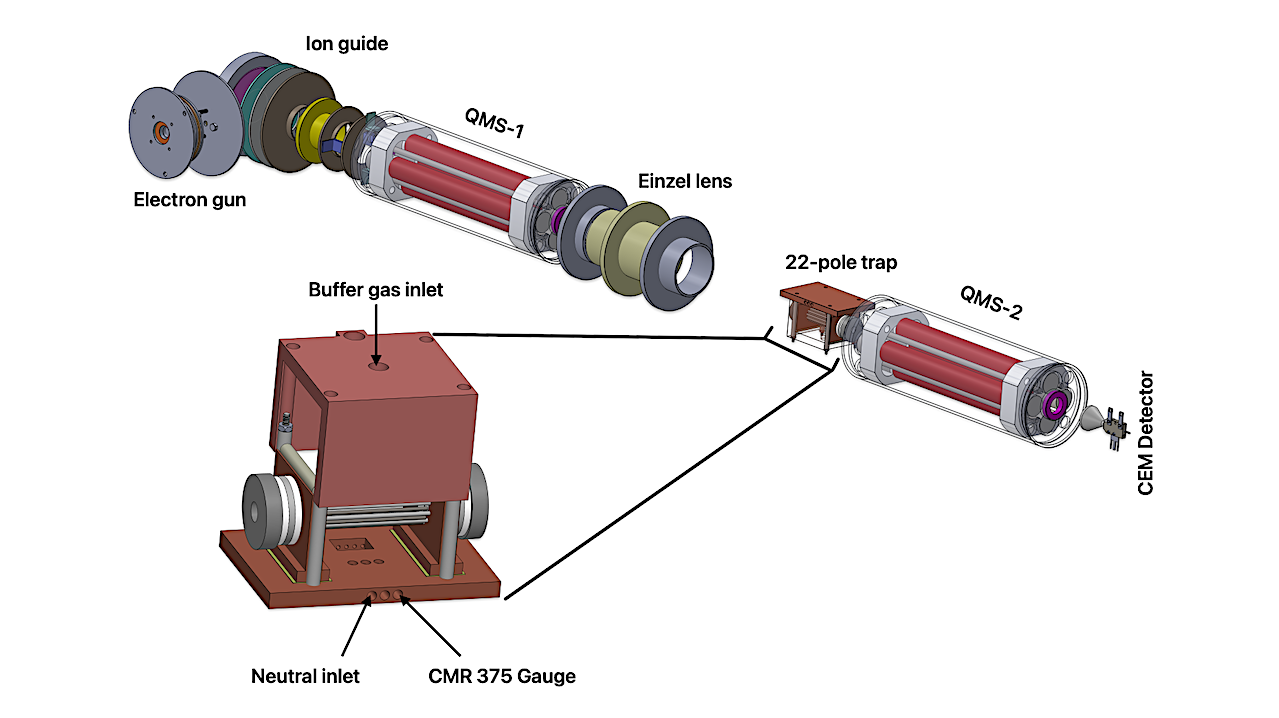
Schematic drawing of the modified 22-pole radio frequency ion trap setup. The ions are produced between the first two plates of the ion guide by electron impact ionization and repelled towards the QMS-1. Mass-selected ions are injected into the 22-pole trap. The trap is equipped with neutral and pulsed buffer gas input ports. A neutral density measurement gauge (Pfeiffer CMR 375) is also connected to the trap volume. After a specified trapping time, the ions are mass-analyzed by QMS-2 and counted in the CEM detector. — astro-ph.GA
Nitrogen-bearing polycyclic aromatic hydrocarbons (N-PAHs) are key precursors to complex organic molecules in both the interstellar medium and the nitrogen-rich planetary atmospheres.
Despite the recent detections of nitrogen-functionalized astromolecules, their formation pathways remain an open question. The discrepancies between their predicted and observed abundances point to unknown mechanism that govern their evolution in the astrophysical environments.
Employing an ion trap technique and electronic structure calculations, we unravel multiple barrier-less reactions between gas-phase pyrimidine cations (C4H4N+2) and acetylene (C2H2) which form an hitherto unreported endocyclic- N-PAHs (C8H7N+2).
The present measurements on reactions involving a double-nitrogen subsituted aromatic heterocycle have implications to the astrochemistry of both the Titan’s atmosphere and interstellar medium.
Siddhartha S. Payra, Pratikkumar Thakkar, Shiv Gupta, Ruth Ann Mathews, Yash Lenka, Saurav Dutta, Nihar Ranjan Behera, Krishna R. Nandipati, G. Aravind
Subjects: Astrophysics of Galaxies (astro-ph.GA); Chemical Physics (physics.chem-ph)
Cite as: arXiv:2605.14424 [astro-ph.GA](or arXiv:2605.14424v1 [astro-ph.GA] for this version)
https://doi.org/10.48550/arXiv.2605.14424
Focus to learn more
Submission history
From: Siddhartha S. Payra
[v1] Thu, 14 May 2026 06:14:07 UTC (13,108 KB)
https://arxiv.org/abs/2605.14424
Astrobiology, Astrochemistry,










Related Posts
Stay Informed With the Latest & Most Important News


Advertisement
-
 01Two Black Holes Observed Circling Each Other for the First Time
 -
 02From Polymerization-Enabled Folding and Assembly to Chemical Evolution: Key Processes for Emergence of Functional Polymers in the Origin of Life
 -
 03Astronomy 101: From the Sun and Moon to Wormholes and Warp Drive, Key Theories, Discoveries, and Facts about the Universe (The Adams 101 Series)
 -
 04True Anomaly hires former York Space executive as chief operating officer
 -
 05Φsat-2 begins science phase for AI Earth images
 -
 06Hurricane forecasters are losing 3 key satellites ahead of peak storm season − a meteorologist explains why it matters
 -
 07Binary star systems are complex astronomical objects − a new AI approach could pin down their properties quickly