
Now Reading: Coupled Photochemical-Climate Modeling of Plausible Tenuous Outgassed Atmospheres on the TRAPPIST-1 Planets
-
01
Coupled Photochemical-Climate Modeling of Plausible Tenuous Outgassed Atmospheres on the TRAPPIST-1 Planets

Coupled Photochemical-Climate Modeling of Plausible Tenuous Outgassed Atmospheres on the TRAPPIST-1 Planets

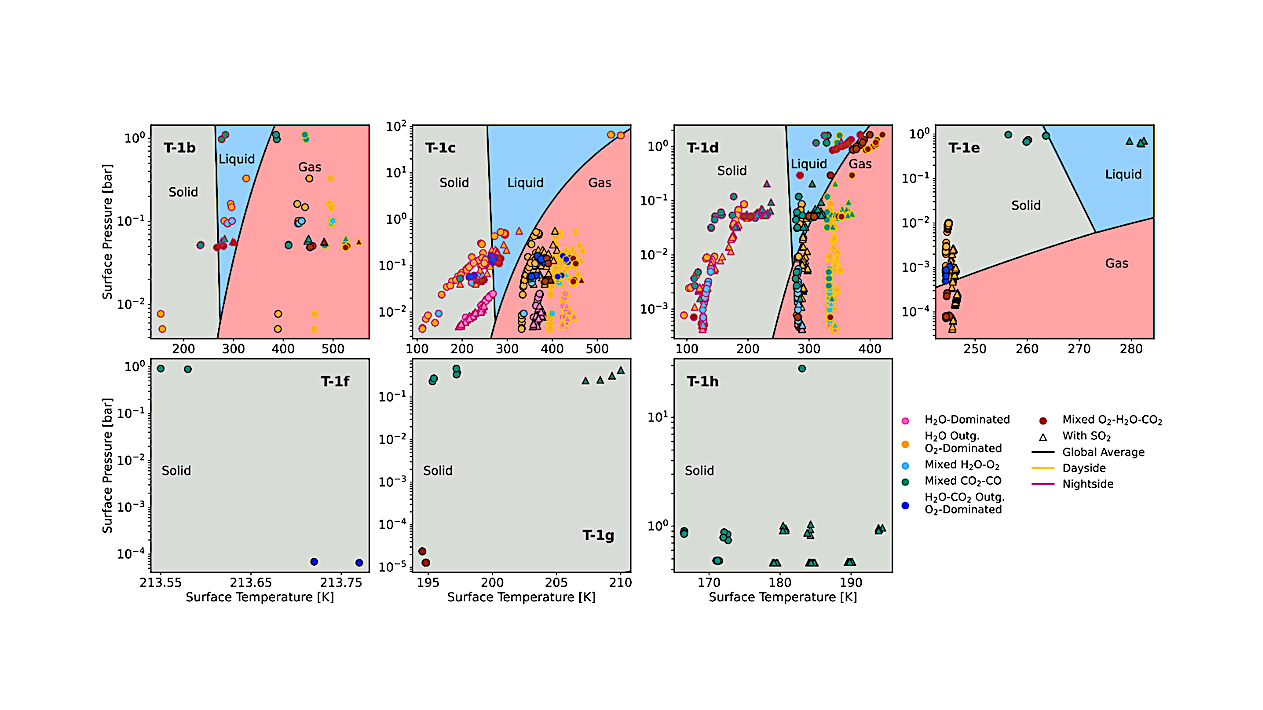
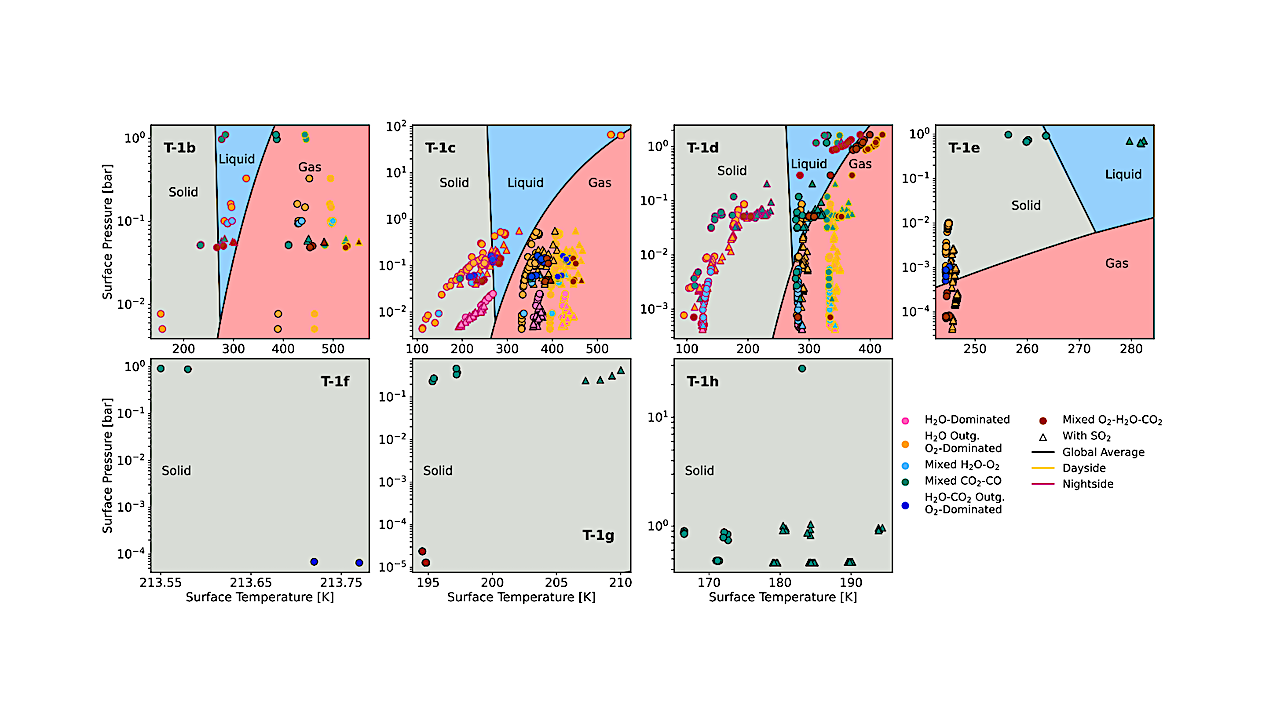
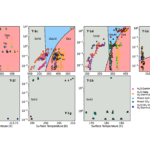
Surface pressure-temperature (P-T) points for each atmosphere in our work for each planet. Points are shown plotted over the phase diagram for water, where the grey, blue, and red shaded regions indicated solid, liquid, and gas phases. Points are colored by atmospheric composition (see figure legend). Globally averaged P-T pairs are shown with black borders, and dayside and nightside profiles for T-1b, c, and d are shown with yellow and magenta borders, respectively. Atmospheres containing SO2 are shown by triangle points. T-1d and e both have atmospheres that may be fully contained in the liquid water region of the phase diagram. — astro-ph.EP
Available JWST observations TRAPPIST-1 system have suggested that several of the planets are likely airless, or possess a very tenuous atmosphere.
However, the high atmospheric escape rates expected for these planets suggest that any tenuous atmosphere must be replenished by constant outgassing, and past studies on modeling potential atmospheres for the planets have not widely considered surface pressures <1 bar.
Here, we show that tenuous atmospheres on the TRAPPIST-1 planets are likely possible, supported by constant plausible rates of water and/or CO2 outgassing against assumed high escape rates (up to ~1030 s−1).
We use a coupled photochemical-climate model and sample from a broad phase space of outgassing, surface deposition, and top-of-atmosphere escape rates to test hundreds of atmospheres per planet. Critically, our model also allows surface pressure to vary based on the balance of sources and sinks.
We find that 6 different compositional archetypes are generated via H2O and/or CO2 outgassing across our phase space, and atmospheres commonly fall between 10−4 — 1 bar. We find that potentially habitable surface environments are possible for TRAPPIST-1d and e at pressures between 0.05 — 2 bar and 0.5 — 1 bar, respectively.
Where possible, we compare our models to JWST observational data for TRAPPIST-1b, c, d, and e; all atmospheres found in this study for these planets match available transmission data to <3σ. However, emission data are consistent with atmospheric outcomes constrained to thin O2-dominated compositions for TRAPPIST-1b (≲0.01 bars) and c (≲0.2 bars), which may or may not contain trace SO2.

Transmission and emission spectra for all stable atmospheres found for T-1c (without trace SO2). Top 3 rows (white background) and bottom 3 rows (grey background) show atmospheres sourced from H2O and H2O-CO2 outgassing, respectively. Each row corresponds to a different atmospheric archetype (described in text), from top to bottom: H2O-dominated, O2– dominated (produced via H2O outgassing), mixed H2O2, mixed CO2-CO, O2-dominated (produced via H2O-CO2 outgassing), and mixed O2-H2O-CO2. Left column shows visible to near-infrared transmission spectra (0.001 – 6.5µm), middle column shows secondary eclipse emission spectra at thermal wavelengths (8 – 17µm), and right column shows nightside thermal emission at 15µm. Transmission spectra are colored by their fit (σ-deviation) to available T-1c transmission data (Radica et al. 2025), and emission data are colored by their combined fit to all available emission data (15µm day and night points; Zieba et al. 2023; Gillon et al. 2026). Spectral features are labeled with the absorbing gas. The overall best fitting atmospheres for T-1c include lower pressure (<0.2 bar) O2-dominated atmospheres (regardless of outgassing source) and mixed O2-H2O atmospheres. — astro-ph.EP
[Editor’s NOTE] – The same information on all TRAPPIST-1 star system planets is provided in this paper.
Megan Gialluca, Victoria Meadows, Andrew Lincowski, Trent Thomas, Parker Hinton, David Brain, David Crisp
Comments: Accepted for publication in the Planetary Science Journal
Subjects: Earth and Planetary Astrophysics (astro-ph.EP)
Cite as: arXiv:2605.14101 [astro-ph.EP) (or arXiv:2605.14101v1 [astro-ph.EP] for this version)
https://doi.org/10.48550/arXiv.2605.14101
Focus to learn more
Submission history
From: Megan Gialluca
[v1] Wed, 13 May 2026 20:40:33 UTC (3,286 KB)
https://arxiv.org/abs/2605.14101
Astrobiology, exoplanet,










Related Posts
Stay Informed With the Latest & Most Important News
Previous Post
Next Post

Advertisement
-
 01Two Black Holes Observed Circling Each Other for the First Time
 -
 02From Polymerization-Enabled Folding and Assembly to Chemical Evolution: Key Processes for Emergence of Functional Polymers in the Origin of Life
 -
 03Astronomy 101: From the Sun and Moon to Wormholes and Warp Drive, Key Theories, Discoveries, and Facts about the Universe (The Adams 101 Series)
 -
 04True Anomaly hires former York Space executive as chief operating officer
 -
 05Φsat-2 begins science phase for AI Earth images
 -
 06Hurricane forecasters are losing 3 key satellites ahead of peak storm season − a meteorologist explains why it matters
 -
 07Binary star systems are complex astronomical objects − a new AI approach could pin down their properties quickly