
Now Reading: OHB Sweden to build Sterna weather constellation
-
01
OHB Sweden to build Sterna weather constellation



18/03/2026
338 views
7 likes
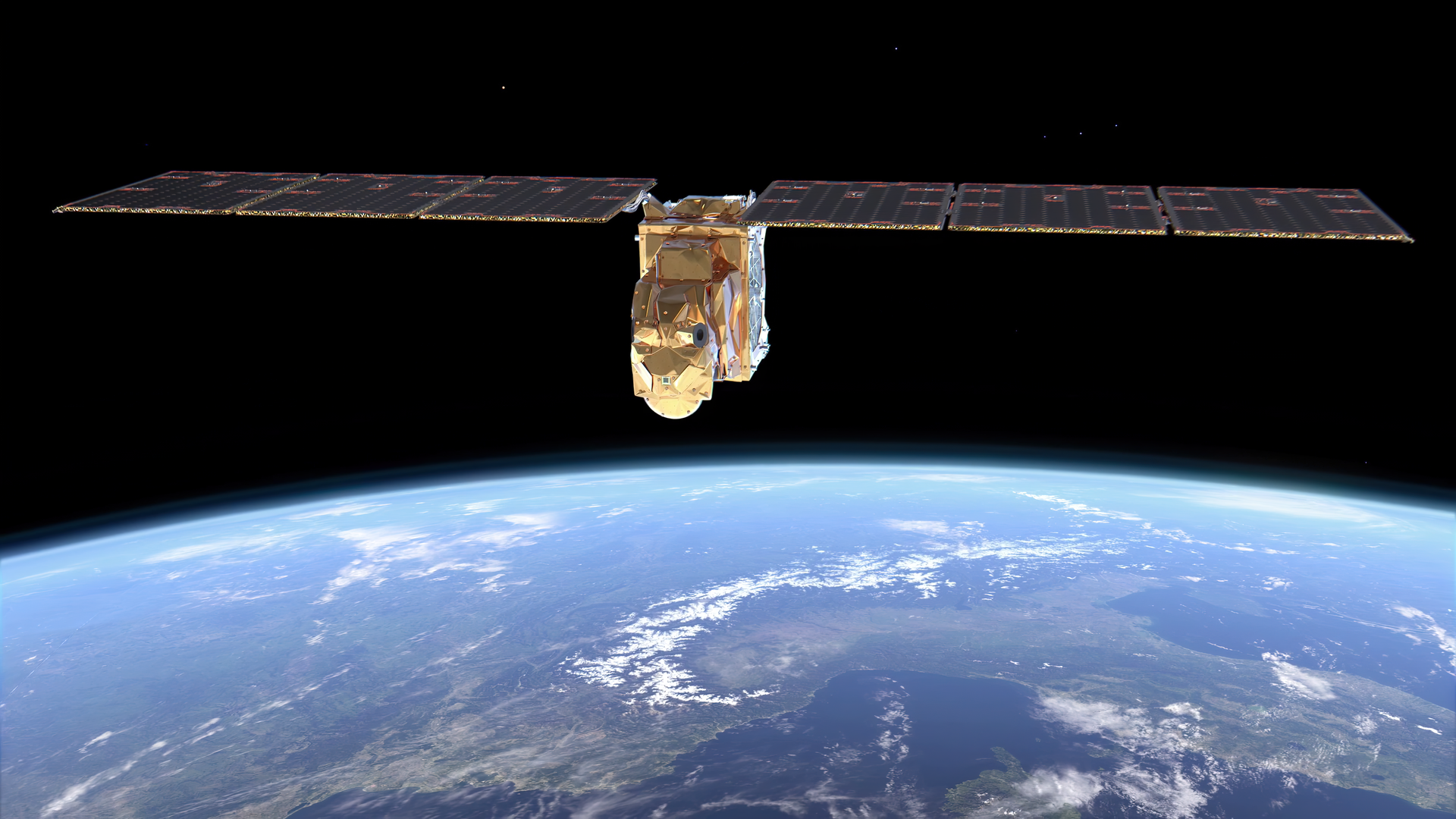
Thanks to the success of the Arctic Weather Satellite prototype and Eumetsat’s recent greenlight to develop a full constellation of similar satellites called Sterna, the European Space Agency has awarded OHB Sweden with the contract to build 20 satellites.
This marks a major step toward better monitoring rapidly evolving weather, improving forecasts of severe events in vulnerable regions such as the Mediterranean, and closing critical data gaps over the Arctic – the fastest-warming region on Earth and a key driver of Europe’s weather systems.
The contract was signed today by ESA’s Director of Earth Observation Programmes, Simonetta Cheli, and Managing Director at OHB Sweden, Fredrik Sjöberg.
Simonetta Cheli said, “We are very pleased to award this important contract to OHB Sweden, which also led the industrial consortium behind the Arctic Weather Satellite. Their ability to deliver such an outstanding mission in just 36 months and within a significantly tighter budget than traditional Earth observation programmes demonstrates that excellence and innovation can go hand in hand through a New Space approach.
“Remarkably, for a prototype, data from the Arctic Weather Satellite are being assimilated into operational weather forecasts by the European Centre for Medium-Range Weather Forecasts.
“All of this gives us strong confidence as we move forward with the new EPS-Sterna constellation in cooperation with Eumetsat. The new constellation will play a vital role in strengthening Europe’s weather forecasting capabilities and delivering timely data where it matters most.”
Fredrik Sjöberg and Oscar Hemberg, Managing Directors of OHB Sweden, said, “This contract represents an extraordinary milestone for OHB Sweden, and for the entire Swedish space community. We built the precursor satellite to this constellation, the Arctic Weather Satellite, and demonstrated the functionality of the satellite and quality of data received from it, to improve European weather forecasting.
“The EPS-Sterna contract is the cumulated evidence that OHB Sweden and its partners are ready to lead, industrialise and deliver critical space infrastructure for Europe.”
Now that the contract is signed, ESA will now manage the procurement of the Sterna satellites following the established cooperation model with Eumetsat applied to Europe’s other meteorological missions, namely the geostationary Meteosat and the polar-orbiting MetOp missions.
The Sterna constellation will comprise six satellites in orbit at any given time – and these satellites will be replenished twice during the lifetime of the mission to ensure the continued delivery of data until at least 2042. In addition, to these 18 satellites, OHB Sweden will build an extra two satellites as spares.
The aim is to launch the first six satellites of the constellation in 2029.
With just three years to this first launch, the development of the Sterna satellites will also follow the New Space approach, as proven feasible by the Arctic Weather Satellite.
Like the prototype mission each satellite will carry a cross-track scanning microwave radiometer to provide detailed profiles of atmospheric humidity and temperature.
As climate change continues to intensify weather variability in the Arctic, the need for more frequent observations is increasing, particularly measurements of atmospheric water vapour. In this region, water vapour concentrations can change rapidly and strongly influence forecast accuracy.
The required observational coverage cannot be achieved by a single satellite alone, but instead requires a dedicated constellation of polar-orbiting satellites.
Moreover, weather forecasting for the Arctic will not be the only region to benefit from Sterna. These satellites orbit the globe and so will benefit forecasting for the rest of the world too.
Information from the current Arctic Weather Satellite and the upcoming constellation complements data from similar sensors on much larger satellites provided by organisations such as Eumetsat, the US National Oceanic and Atmospheric Administration and the China Meteorological Administration.










Related Posts

Stay Informed With the Latest & Most Important News
Previous Post
Next Post
Previous Post
Next Post



Advertisement
-
 01Two Black Holes Observed Circling Each Other for the First Time
 -
 02From Polymerization-Enabled Folding and Assembly to Chemical Evolution: Key Processes for Emergence of Functional Polymers in the Origin of Life
 -
 03Astronomy 101: From the Sun and Moon to Wormholes and Warp Drive, Key Theories, Discoveries, and Facts about the Universe (The Adams 101 Series)
 -
 04True Anomaly hires former York Space executive as chief operating officer
 -
 05Φsat-2 begins science phase for AI Earth images
 -
 06Hurricane forecasters are losing 3 key satellites ahead of peak storm season − a meteorologist explains why it matters
 -
 07Binary star systems are complex astronomical objects − a new AI approach could pin down their properties quickly