
Now Reading: SpaceX Progresses with Starship Testing as Booster 19 Completes Key Milestones at Pad 2
-
01
SpaceX Progresses with Starship Testing as Booster 19 Completes Key Milestones at Pad 2

SpaceX Progresses with Starship Testing as Booster 19 Completes Key Milestones at Pad 2

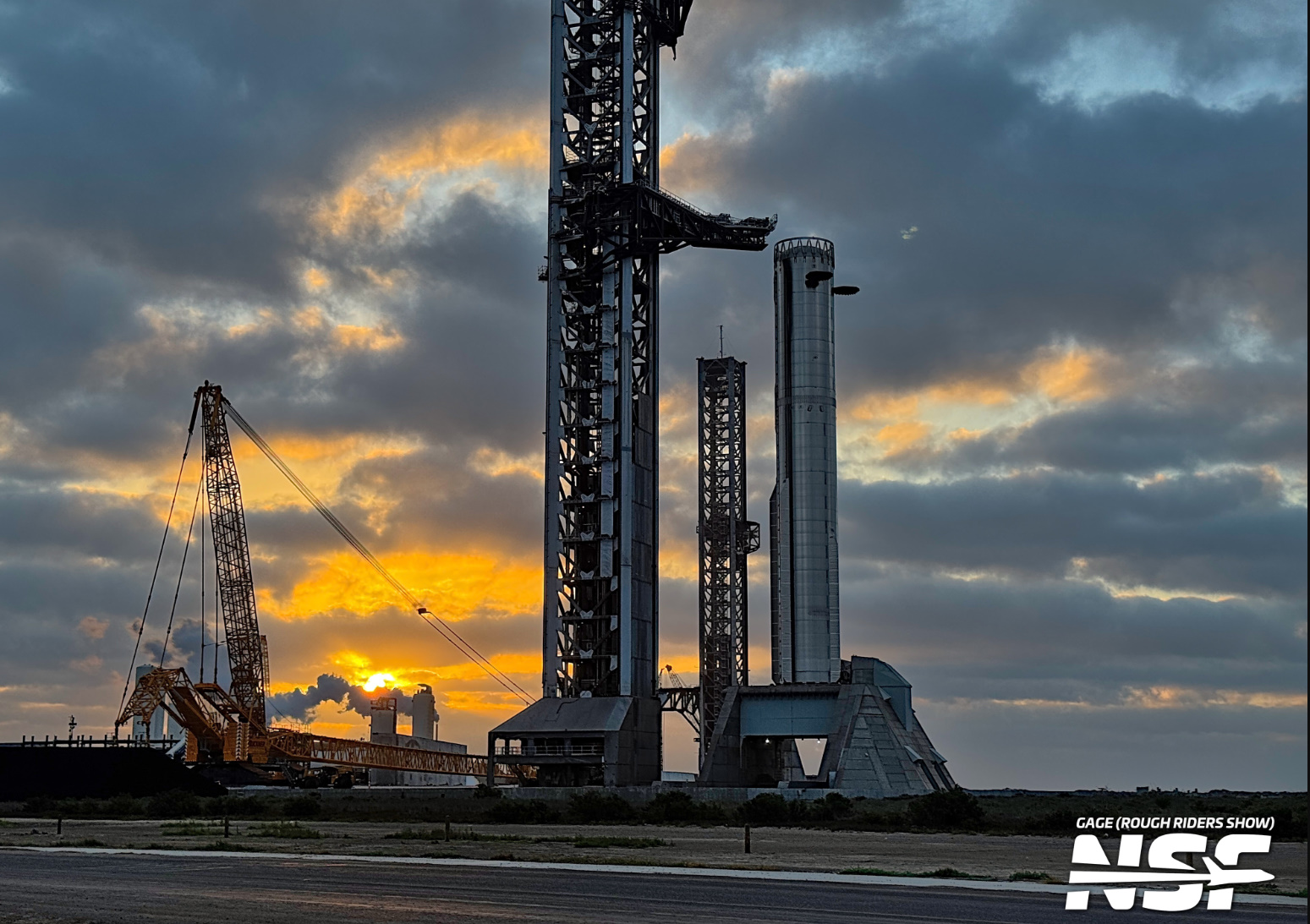

SpaceX made significant progress towards the next launch of its Starship system, as Booster 19 completed an essential test campaign at the newly established Pad 2 in Starbase, Texas. This series of tests marked a debut for both the Block 3/V3 Super Heavy Booster and the upgraded Raptor 3 engines, culminating in a brief static fire test.
Booster 19’s operations on Pad 2 served not only as a qualification test but also a milestone in the launch facility’s development, paving the way for static fire testing of its Raptor 3 engines. The testing sequence commenced shortly after Booster 19 was positioned on the orbital launch mount (OLM) at Pad 2. Crews focused on final preparations, including the removal of foreign debris from the site to ensure the safety of the vehicle and ground support infrastructure.
Once the booster was released by the deployment arms, it stood securely on the mount, demonstrating stability in the new setting. As the arms retracted into a launch configuration, the booster vented from its methane tank, an important step for maintaining structural integrity during cryogenic operations.
Pad 2 boasts significant enhancements over its predecessor, Pad 1, including dual quick disconnects for fuel systems, one for liquid methane and another for liquid oxygen. This setup allows for independent propellant pressurization and more efficient loading, significantly reducing risks associated with combining different propellants.
The upgraded tank farm played a vital role in the test campaign, efficiently cooling and delivering propellants for loading. The process involved moving fluids through subcoolers using liquid nitrogen, while vapors indicated active cooling measures. Rather than venting or flaring excess methane, it was recondensed, reflecting SpaceX’s commitment to better environmental and safety practices.
During the cryogenic tests, both LOX and methane tanks released vapor to create necessary headspace before fueling. Frost lines indicated successful filling, with noticeable levels in both tanks during the operations. Following propellant loading, the detonation suppression system (DSS) was activated to neutralize potential hazardous gases, preparing for a simulated static fire sequence without actual engine ignition.
The second day of testing, conducted in the evening, featured dramatic visuals as sunset enveloped the site. Propellant loading was effective, with the DSS activated once again. However, no ignition occurred during this round of engine activity. White clouds rising from the flame trench suggested that engineers performed a spin prime test, which involved running the turbopumps to check on propellant flow and engine status, although visibility challenges made it unclear if all ten Raptor 3 engines were engaged.
The efficiency of the new tank farm was evident as the loading of liquid oxygen was notably rapid, completing in approximately 25 to 30 minutes thanks to updated pumps and plumbing. This swiftness aligns with SpaceX’s aim for rapid reusability of spacecraft. After each day’s tests, the setup was carefully monitored to ensure safety, as venting produced characteristic clouds dispersing from the pad.
As expectations grew for a static fire on Day 3, unplanned closures for roads and beaches were lifted. Booster 19 was temporarily lifted off the mount for inspections, leading to speculation about minor issues or preparatory access for detailed engine assessments. However, transport of the vehicle back onto the OLM was completed without significant delay.
Amid continuing testing, it was confirmed that all tests preceding the anticipated static fire went smoothly. The campaign culminated on the fourth day with successful propellant loading followed by the ignition of the Raptor 3 engines, directing thrust downward through the flame trench. Although the test burn only lasted about one second—shorter than expected—technicians deemed it successful, attributing the brief duration to a minor issue with the ground systems rather than the booster itself.
With Booster 19 returned to the production facility, further engine modifications will likely take place. In the coming weeks, the focus will shift towards Ship 39, which is anticipated to head out for its own static fire test. Meanwhile, Booster 19 must still complete a full static fire of its 33 engines at Pad 2 before both spacecraft can be prepared for the upcoming Flight 12, tentatively scheduled for the latter half of April, pending successful testing conditions.










Related Posts

Stay Informed With the Latest & Most Important News
Previous Post
Next Post

Advertisement
-
 01Two Black Holes Observed Circling Each Other for the First Time
 -
 02From Polymerization-Enabled Folding and Assembly to Chemical Evolution: Key Processes for Emergence of Functional Polymers in the Origin of Life
 -
 03Astronomy 101: From the Sun and Moon to Wormholes and Warp Drive, Key Theories, Discoveries, and Facts about the Universe (The Adams 101 Series)
 -
 04True Anomaly hires former York Space executive as chief operating officer
 -
 05Φsat-2 begins science phase for AI Earth images
 -
 06Hurricane forecasters are losing 3 key satellites ahead of peak storm season − a meteorologist explains why it matters
 -
 07Binary star systems are complex astronomical objects − a new AI approach could pin down their properties quickly