
Now Reading: A Break In Planet Occurrence Near The Pebble Isolation Mass Should Be Observable By The Roman Microlensing Survey
-
01
A Break In Planet Occurrence Near The Pebble Isolation Mass Should Be Observable By The Roman Microlensing Survey

A Break In Planet Occurrence Near The Pebble Isolation Mass Should Be Observable By The Roman Microlensing Survey

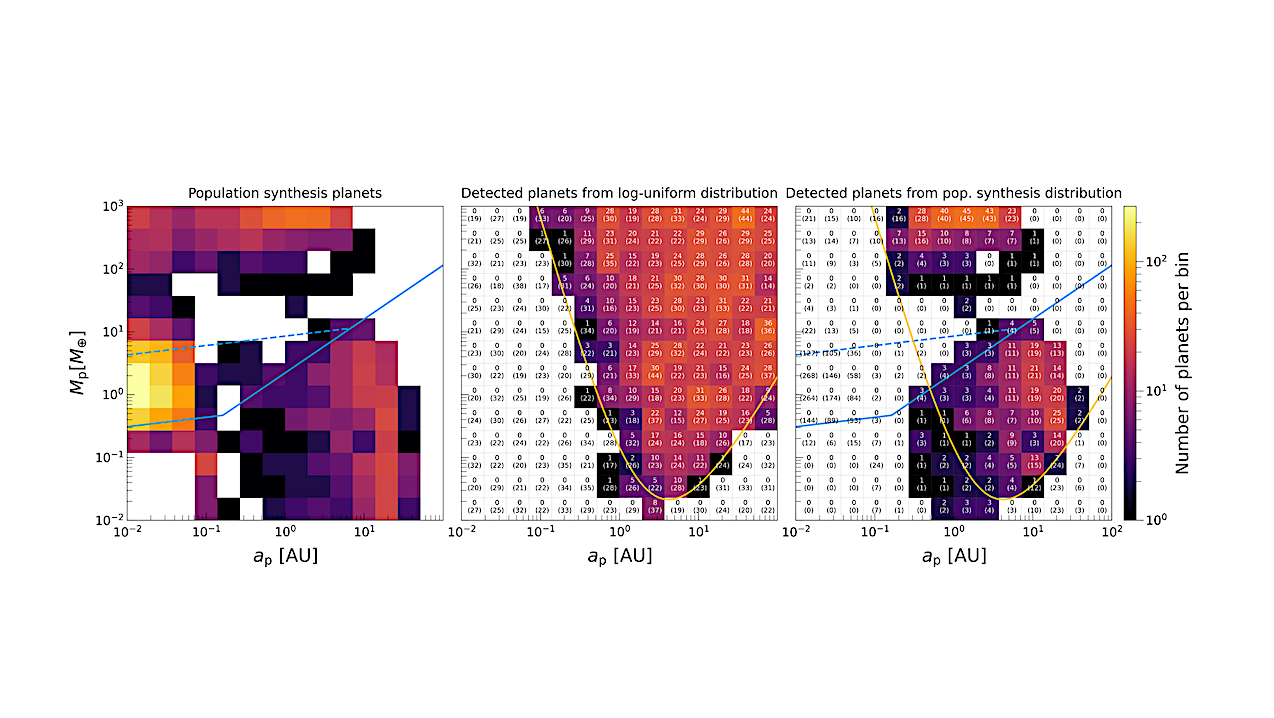

Left panel: Synthetic exoplanet population, colour coded by number of planets per bin in logarithmic semi-major axis and planet mass space, using the nominal model for a sample of Nstar=5000 different mass stars (Section 3.2). For reference, we show the pebble isolation mass as a function of orbital radius, for a 0.2 M⊙ star, at the initial (blue dashed) and final simulation time (solid blue lines). Central panel: Total number of detected lensing planets per bin, assuming an underlying log-uniform distribution of 5000 planets in semi-major axis and mass, with the lensing detection efficiency specified in Section 3.2. Annotated in each bin is the number of planets detected per bin, with the underlying number of planets in that bin in parentheses. The solid orange line shows the 3-planet detection line for the Roman Space Telescope (Penny et al. 2019). Right panel: Total number of detected lensing planets per bin, using the synthetic population shown in the left panel. The dearth of planets with masses near the pebble isolation mass at the approximate location of the water iceline is located in the high-sensitivity region of lensing surveys. — astro-ph.EP
Microlensing detections are uniquely well-suited to probing the population of planets outside the water iceline, down to planetary masses comparable to the Earth.
Here, we perform 1D pebble-accretion population synthesis simulations to explore a sample of iceline planets around stars with masses and metallicities similar to the target population of the Galactic Bulge Time-domain microlensing survey of the Nancy Grace Roman Space Telescope.
We find that the planet distribution in the microlensing sensitivity space deviates from a log-uniform distribution in mass and orbital radius. When planetary core growth comes to a halt as planets reach the pebble isolation mass, Miso, the combined effects of planetary migration and runaway gas accretion create an occurrence break.
Our simulations highlight that, between 1 and 50 AU, the fraction of stars hosting isolation-mass planets (1 to 5 Miso) is lower by a factor 20 compared to less massive planets (0.2 to 1 Miso).
If this break in planetary occurrence rates around the pebble isolation mass is detected in future lensing surveys, it would further validate the core accretion paradigm for giant planet formation.
Claudia Danti, Michiel Lambrechts, Hannah Diamond-Lowe
Comments: 9 pages, 7 figures, accepted for publication in A&A
Subjects: Earth and Planetary Astrophysics (astro-ph.EP)
Cite as: arXiv:2603.28400 [astro-ph.EP] (or arXiv:2603.28400v1 [astro-ph.EP] for this version)
https://doi.org/10.48550/arXiv.2603.28400
Focus to learn more
Submission history
From: Claudia Danti
[v1] Mon, 30 Mar 2026 13:10:55 UTC (4,887 KB)
https://arxiv.org/abs/2603.28400
Astrobiology,











Related Posts
Stay Informed With the Latest & Most Important News
Previous Post
Next Post


Advertisement
-
 01Two Black Holes Observed Circling Each Other for the First Time
 -
 02From Polymerization-Enabled Folding and Assembly to Chemical Evolution: Key Processes for Emergence of Functional Polymers in the Origin of Life
 -
 03Astronomy 101: From the Sun and Moon to Wormholes and Warp Drive, Key Theories, Discoveries, and Facts about the Universe (The Adams 101 Series)
 -
 04True Anomaly hires former York Space executive as chief operating officer
 -
 05Φsat-2 begins science phase for AI Earth images
 -
 06Hurricane forecasters are losing 3 key satellites ahead of peak storm season − a meteorologist explains why it matters
 -
 07Binary star systems are complex astronomical objects − a new AI approach could pin down their properties quickly